Uttarakhand becomes first state to implement Uniform Civil Code

News Network
January 27, 2025

uccuttarakhand.jpg

The Uniform Civil Code (UCC), a law that has faced long-standing criticism from the Opposition, will officially come into effect in Uttarakhand on January 27, making it the first state in independent India to put into effect such a law.

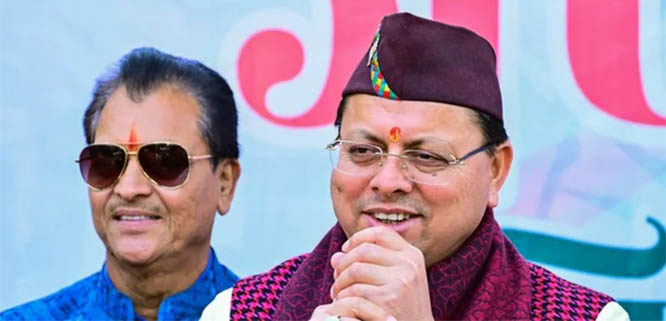
According to the state’s chief minister Pushkar Singh Dhami, the government has completed all preparations to implement the law, including getting approval of the rules for the implementation of the Act and training of officials concerned. The rationale given for the law is that it will bring about ‘uniformity in the society and ensure equal rights and responsibilities for all citizens.’

"UCC is just an offering made by our state in the great 'yagya' being performed by the Prime Minister to make the country a developed, organised, harmonious and self-reliant nation," PTI quoted Dhami as saying in a statement.

The BJP had made a promise to implement the Uniform Civil Code in Uttarakhand in the run-up to the 2022 assembly polls.These polls saw the party storming to power for a second consecutive term, something never done by any other party in the state since its creation in 2000.

According to CM Dhami, the historic mandate was because of the party's commitment to passing the UCC.

The Uniform Civil Code journey in Uttarakhand

The Uttarakhand state cabinet cleared a proposal to form an expert panel on the Uniform Civil Code in March 2022 in the first cabinet meeting after winning the assembly elections. The panel, headed by retired Supreme Court Judge Ranjana Prakash Desai, was constituted on May 27, 2022 to prepare the draft of the UCC.

The Desai committee submitted a comprehensive draft in four volumes, prepared after one and a half years of dialogue with different sections of the state's population. It was sent to the state on February 2, 2024 and just a few days later, the Uttarakhand assembly passed the UCC bill. President Droupadi Murmu gave it her assent in March 2024, nearly two years after the initial proposal.

Another expert committee was at work after that, headed by former chief secretary Shatrughna Singh. It was formed to frame the rules and regulations for the implementation of the Act. The Sinha committee submitted its report to the state government late last year.

The state cabinet gave its approval recently and authorised the chief minister to decide a date for its implementation. Dhami decided the date to be January 27, 2025, a day after the country celebrated its 76th Republic Day.

What is in the Uttarakhand UCC?

The Uniform Civil Code Act of Uttarakhand will govern and regulate the laws relating to marriage and divorce, succession, live-in relationships and related matters.

It sets equal marriageable age for men and women, grounds of divorce and procedures across all religions, and bans polygamy and 'halala'.

Doon University Vice Chancellor Surekha Dangwal, who was part of the panel that drafted the UCC and was among those who framed the rules for its implementation, described to PTI the provisions aimed at bringing about gender parity in matters of marriage, divorce and succession, treating all children as legitimate including those born of void or voidable marriages, simplifying the process of preparing a will and regulating live-in relationships as the most outstanding in the UCC. She termed gender parity across all religions as the spirit of UCC.

According to Duggal, the UCC makes registration of all marriages and live-in relationships mandatory. She also said that the government has created facilities to help people register their marriages online so that they do not have to run around government offices for it.

"Another remarkable feature of the UCC is that it treats all children as legitimate. We have in fact totally done away with the term illegitimate in the context of children," she said. The UCC also makes a special provision for defence personnel called "privileged will" which can be made both in writing or by word of mouth.

Any soldier or air force personnel engaged in an expedition or actual warfare or a mariner at sea can make a privileged will for which rules have been kept flexible.

UCC criticism

Opposition leaders have criticized the UCC, arguing that it may lead to societal division along religious lines and might be impractical and overly ambitious.
The debate surrounding the UCC extends beyond Uttarakhand, as Article 44 of the Indian Constitution advocates for a uniform civil code across the country. Prime Minister Narendra Modi has referenced the Supreme Court's direction on the need for a common code, stressing that fulfilling the vision of the Constitution's framers remains a national goal.

Uttarakhand's implementation of the UCC is likely to set a precedent, with other states potentially following suit. The success of the law's implementation will depend on its ability to balance individual rights and social harmony.

As Uttarakhand stands at the forefront of this legal revolution, the coming weeks will offer a clearer picture of how the UCC will be received, both in the state and across India. The state's experience with the UCC will undoubtedly shape the future of personal law reform in the country.

What is the implementation process?

Shailesh Bagauli, secretary (home), stated that the government will issue two notifications: one for the implementation of the UCC and another for the rules and regulations, officially launching the UCC in the state.

Dhami had promised to implement the UCC if re-elected during the 2022 state polls. After becoming CM, he appointed a five-member committee led by Justice Ranjana Prakash Desai to draft the code, which received feedback from over 2.3 lakh people, representing nearly 10% of Uttarakhand's families.

The 740-page draft was presented to the chief minister on February 2, 2024, approved by the cabinet on February 4, tabled in the assembly on February 6, and passed the following day. Governor Lt Gen Gurmit Singh (retd) approved the bill on February 28 and President Droupadi Murmu subsequently signed it on March 11.

Comments

Add new comment

  • Coastaldigest.com reserves the right to delete or block any comments.
  • Coastaldigset.com is not responsible for its readers’ comments.
  • Comments that are abusive, incendiary or irrelevant are strictly prohibited.
  • Please use a genuine email ID and provide your name to avoid reject.
News Network
November 30,2025

The United Nations Committee against Torture (CAT) has condemned the Israeli regime for enforcing a policy of “organized torture” against Palestinians.

In a report published on Friday, CAT stated that the occupying regime enforces a deliberate policy of “organized and widespread torture and ill-treatment” against Palestinian abductees, particularly since October 7, 2023, when Israel launched its genocidal war on Gaza.

The committee expressed “deep concern over repeated severe beatings, dog attacks, electrocution, water-boarding, use of prolonged stress positions [and] sexual violence” inflicted on Palestinians.

Palestinian prisoners were degraded by “being made to act like animals or being urinated on,” systematically denied medical care, and subjected to excessive restraints, “in some cases resulting in amputation,” the report added.

CAT also condemned the routine application of “unlawful combatants law” to justify the prolonged detention without trial of thousands of Palestinian men, women, and children.

More than 10,000 Palestinians, including women and children, are currently held in Israeli prisons, according to Palestinian and international human rights groups, with 3,474 Palestinians in “administrative detention,” meaning they are imprisoned without trial for indefinite periods.

The report highlighted the “high proportion of children who are currently detained without charge or on remand,” noting that while Israel sets the age of criminal responsibility at 12, even younger children have been abducted.

Children designated as security prisoners face severe restrictions on family contact, may be subjected to solitary confinement, and are denied access to education, in clear violation of international law.

The committee further suggested that Israel’s policies across the Occupied Territories constitute collective torture against the Palestinian population.

“A range of policies adopted by Israel in the course of its continued unlawful presence in the Occupied Palestinian Territory amounts to cruel, inhuman or degrading living conditions for the Palestinian population,” the report said.

On Thursday, the Palestinian resistance movement Hamas condemned the systematic killing and torture of Palestinian abductees in Israeli prisons, urging international action to halt these abuses.

Citing human rights data, Hamas stated that 94 Palestinians have been killed in Israeli prisons since the start of Tel Aviv’s genocidal war on Gaza.

“This reflects an organized criminal approach that has turned these prisons into direct killing grounds to eliminate our people,” the resistance movement said.

Hamas called on the international community, the UN, and human rights organizations to immediately pressure Israel to end crimes against prisoners and uphold their rights as guaranteed by all international conventions and norms.

Comments

Add new comment

  • Coastaldigest.com reserves the right to delete or block any comments.
  • Coastaldigset.com is not responsible for its readers’ comments.
  • Comments that are abusive, incendiary or irrelevant are strictly prohibited.
  • Please use a genuine email ID and provide your name to avoid reject.
News Network
November 26,2025

students.jpg

Bengaluru, Nov 26: Karnataka is taking its first concrete steps towards lifting a three-decade-old ban on student elections in colleges and universities. Deputy Chief Minister D.K. Shivakumar announced Wednesday that the state government will form a small committee to study the reintroduction of campus polls, a practice halted in 1989 following incidents of violence.

Speaking at a 'Constitution Day' event organised by the Karnataka Congress, Mr. Shivakumar underscored the move's aim: nurturing new political leadership from the grassroots.

"Recently, (Leader of the Opposition in Lok Sabha) Rahul Gandhi wrote a letter to me and Chief Minister (Siddaramaiah) asking us to think about restarting student elections," Shivakumar stated. "I'm announcing today that we'll form a small committee and seek a report on this."

Student elections were banned in Karnataka in 1989, largely due to concerns over violence and the infiltration of political party affiliates into campus life. The ban effectively extinguished vibrant student bodies and the pipeline of young leaders they often produced.

Mr. Shivakumar, who also serves as the Karnataka Congress president, said that former student leaders will be consulted to "study the pros and cons" of the re-introduction.

Acknowledging the history of the ban, he added, "There were many criminal activities taking place back then. We’ll see how we can conduct (student) elections by regulating such criminal activities."

The Deputy CM reminisced about his own journey, which began on campus. He recalled his political activism at Sri Jagadguru Renukacharya College leading to his first Assembly ticket in 1985 at the age of 23. "That's how student leadership was at the time. Such leadership has gone today. College elections have stopped," he lamented, adding that for many, college elections were "like a big movement" where leaders were forged.

The move, driven by the Congress high command's push to cultivate young talent, will face scrutiny from academics and university authorities who have, in the past, expressed concern that the return of polls could disrupt the peaceful academic environment and turn campuses into political battlegrounds.

Comments

Add new comment

  • Coastaldigest.com reserves the right to delete or block any comments.
  • Coastaldigset.com is not responsible for its readers’ comments.
  • Comments that are abusive, incendiary or irrelevant are strictly prohibited.
  • Please use a genuine email ID and provide your name to avoid reject.
News Network
November 21,2025

malpe.jpg

Udupi: The Malpe Police have arrested two men from Uttar Pradesh for allegedly sharing classified information related to Indian Navy vessels with individuals in Pakistan, posing a serious threat to national security.

According to a complaint filed by the CEO of Udupi Cochin Shipyard, Malpe—an institution under the Union Ministry of Ports, Shipping and Waterways—the prime accused, Rohit (29), was working as an insulator through subcontractor M/S Shushma Marine Pvt Ltd. He had earlier served at Cochin Shipyard Limited in Kochi, Kerala, where naval ships are under construction.

Udupi SP Hariram Shankar said the accused had unlawfully shared, via WhatsApp, confidential identification numbers of Navy-related ships and other classified details while working in Kerala, allegedly for illegal gains.

After joining the Malpe shipyard unit, Rohit reportedly continued collecting sensitive information through a friend in Kochi and circulated it to unauthorised individuals, violating national security protocols and potentially endangering India’s sovereignty, unity, and integrity.

Based on the complaint, Malpe Police registered a case under Section 152 of the Bharatiya Nyaya Sanhita (BNS) and Sections 3 and 5 of the Official Secrets Act, 1923.

A police team led by Karkala Subdivision Assistant Superintendent of Police Harsha Priyamvada—along with PSI Anil Kumar D, ASI Harish, and PC Ravi Jadhav—conducted the investigation and arrested the two accused, identified as Rohit (29) and Santri (37), both residents of Sultanpur district, Uttar Pradesh.

The duo was produced before the court, which remanded them in judicial custody till December 3. Further investigation is in progress.

Comments

Add new comment

  • Coastaldigest.com reserves the right to delete or block any comments.
  • Coastaldigset.com is not responsible for its readers’ comments.
  • Comments that are abusive, incendiary or irrelevant are strictly prohibited.
  • Please use a genuine email ID and provide your name to avoid reject.