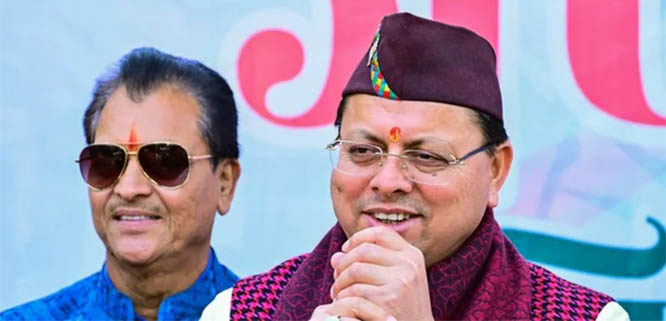
Uttarakhand becomes first state to implement Uniform Civil Code

News Network
January 27, 2025

uccuttarakhand.jpg

The Uniform Civil Code (UCC), a law that has faced long-standing criticism from the Opposition, will officially come into effect in Uttarakhand on January 27, making it the first state in independent India to put into effect such a law.

According to the state’s chief minister Pushkar Singh Dhami, the government has completed all preparations to implement the law, including getting approval of the rules for the implementation of the Act and training of officials concerned. The rationale given for the law is that it will bring about ‘uniformity in the society and ensure equal rights and responsibilities for all citizens.’

"UCC is just an offering made by our state in the great 'yagya' being performed by the Prime Minister to make the country a developed, organised, harmonious and self-reliant nation," PTI quoted Dhami as saying in a statement.

The BJP had made a promise to implement the Uniform Civil Code in Uttarakhand in the run-up to the 2022 assembly polls.These polls saw the party storming to power for a second consecutive term, something never done by any other party in the state since its creation in 2000.

According to CM Dhami, the historic mandate was because of the party's commitment to passing the UCC.

The Uniform Civil Code journey in Uttarakhand

The Uttarakhand state cabinet cleared a proposal to form an expert panel on the Uniform Civil Code in March 2022 in the first cabinet meeting after winning the assembly elections. The panel, headed by retired Supreme Court Judge Ranjana Prakash Desai, was constituted on May 27, 2022 to prepare the draft of the UCC.

The Desai committee submitted a comprehensive draft in four volumes, prepared after one and a half years of dialogue with different sections of the state's population. It was sent to the state on February 2, 2024 and just a few days later, the Uttarakhand assembly passed the UCC bill. President Droupadi Murmu gave it her assent in March 2024, nearly two years after the initial proposal.

Another expert committee was at work after that, headed by former chief secretary Shatrughna Singh. It was formed to frame the rules and regulations for the implementation of the Act. The Sinha committee submitted its report to the state government late last year.

The state cabinet gave its approval recently and authorised the chief minister to decide a date for its implementation. Dhami decided the date to be January 27, 2025, a day after the country celebrated its 76th Republic Day.

What is in the Uttarakhand UCC?

The Uniform Civil Code Act of Uttarakhand will govern and regulate the laws relating to marriage and divorce, succession, live-in relationships and related matters.

It sets equal marriageable age for men and women, grounds of divorce and procedures across all religions, and bans polygamy and 'halala'.

Doon University Vice Chancellor Surekha Dangwal, who was part of the panel that drafted the UCC and was among those who framed the rules for its implementation, described to PTI the provisions aimed at bringing about gender parity in matters of marriage, divorce and succession, treating all children as legitimate including those born of void or voidable marriages, simplifying the process of preparing a will and regulating live-in relationships as the most outstanding in the UCC. She termed gender parity across all religions as the spirit of UCC.

According to Duggal, the UCC makes registration of all marriages and live-in relationships mandatory. She also said that the government has created facilities to help people register their marriages online so that they do not have to run around government offices for it.

"Another remarkable feature of the UCC is that it treats all children as legitimate. We have in fact totally done away with the term illegitimate in the context of children," she said. The UCC also makes a special provision for defence personnel called "privileged will" which can be made both in writing or by word of mouth.

Any soldier or air force personnel engaged in an expedition or actual warfare or a mariner at sea can make a privileged will for which rules have been kept flexible.

UCC criticism

Opposition leaders have criticized the UCC, arguing that it may lead to societal division along religious lines and might be impractical and overly ambitious.
The debate surrounding the UCC extends beyond Uttarakhand, as Article 44 of the Indian Constitution advocates for a uniform civil code across the country. Prime Minister Narendra Modi has referenced the Supreme Court's direction on the need for a common code, stressing that fulfilling the vision of the Constitution's framers remains a national goal.

Uttarakhand's implementation of the UCC is likely to set a precedent, with other states potentially following suit. The success of the law's implementation will depend on its ability to balance individual rights and social harmony.

As Uttarakhand stands at the forefront of this legal revolution, the coming weeks will offer a clearer picture of how the UCC will be received, both in the state and across India. The state's experience with the UCC will undoubtedly shape the future of personal law reform in the country.

What is the implementation process?

Shailesh Bagauli, secretary (home), stated that the government will issue two notifications: one for the implementation of the UCC and another for the rules and regulations, officially launching the UCC in the state.

Dhami had promised to implement the UCC if re-elected during the 2022 state polls. After becoming CM, he appointed a five-member committee led by Justice Ranjana Prakash Desai to draft the code, which received feedback from over 2.3 lakh people, representing nearly 10% of Uttarakhand's families.

The 740-page draft was presented to the chief minister on February 2, 2024, approved by the cabinet on February 4, tabled in the assembly on February 6, and passed the following day. Governor Lt Gen Gurmit Singh (retd) approved the bill on February 28 and President Droupadi Murmu subsequently signed it on March 11.

Comments

Add new comment

  • Coastaldigest.com reserves the right to delete or block any comments.
  • Coastaldigset.com is not responsible for its readers’ comments.
  • Comments that are abusive, incendiary or irrelevant are strictly prohibited.
  • Please use a genuine email ID and provide your name to avoid reject.
News Network
November 30,2025

The United Nations Committee against Torture (CAT) has condemned the Israeli regime for enforcing a policy of “organized torture” against Palestinians.

In a report published on Friday, CAT stated that the occupying regime enforces a deliberate policy of “organized and widespread torture and ill-treatment” against Palestinian abductees, particularly since October 7, 2023, when Israel launched its genocidal war on Gaza.

The committee expressed “deep concern over repeated severe beatings, dog attacks, electrocution, water-boarding, use of prolonged stress positions [and] sexual violence” inflicted on Palestinians.

Palestinian prisoners were degraded by “being made to act like animals or being urinated on,” systematically denied medical care, and subjected to excessive restraints, “in some cases resulting in amputation,” the report added.

CAT also condemned the routine application of “unlawful combatants law” to justify the prolonged detention without trial of thousands of Palestinian men, women, and children.

More than 10,000 Palestinians, including women and children, are currently held in Israeli prisons, according to Palestinian and international human rights groups, with 3,474 Palestinians in “administrative detention,” meaning they are imprisoned without trial for indefinite periods.

The report highlighted the “high proportion of children who are currently detained without charge or on remand,” noting that while Israel sets the age of criminal responsibility at 12, even younger children have been abducted.

Children designated as security prisoners face severe restrictions on family contact, may be subjected to solitary confinement, and are denied access to education, in clear violation of international law.

The committee further suggested that Israel’s policies across the Occupied Territories constitute collective torture against the Palestinian population.

“A range of policies adopted by Israel in the course of its continued unlawful presence in the Occupied Palestinian Territory amounts to cruel, inhuman or degrading living conditions for the Palestinian population,” the report said.

On Thursday, the Palestinian resistance movement Hamas condemned the systematic killing and torture of Palestinian abductees in Israeli prisons, urging international action to halt these abuses.

Citing human rights data, Hamas stated that 94 Palestinians have been killed in Israeli prisons since the start of Tel Aviv’s genocidal war on Gaza.

“This reflects an organized criminal approach that has turned these prisons into direct killing grounds to eliminate our people,” the resistance movement said.

Hamas called on the international community, the UN, and human rights organizations to immediately pressure Israel to end crimes against prisoners and uphold their rights as guaranteed by all international conventions and norms.

Comments

Add new comment

  • Coastaldigest.com reserves the right to delete or block any comments.
  • Coastaldigset.com is not responsible for its readers’ comments.
  • Comments that are abusive, incendiary or irrelevant are strictly prohibited.
  • Please use a genuine email ID and provide your name to avoid reject.
News Network
November 29,2025

DKSsiddu.jpg

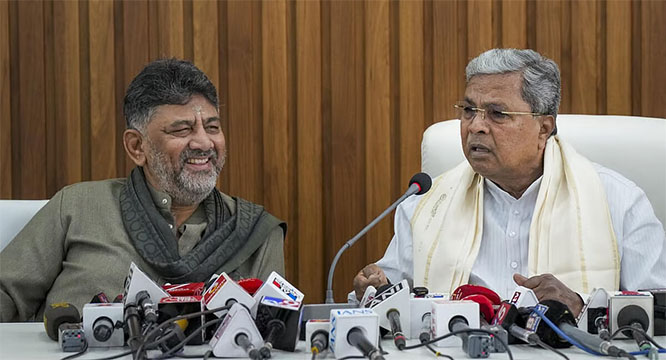
New Delhi: Karnataka chief minister Siddaramaiah and deputy CM DK Shivakumar on Saturday put up a dramatic display of unity at a closely watched joint press briefing, firmly dismissing weeks of speculation about a power-sharing tussle within the Congress. With the high command nudging both leaders to sit together and settle the dust, the meeting became a political spectacle, ending with the duo declaring that there was “no confusion, no differences.”

Calling the reports of a rift “manufactured confusion,” Siddaramaiah said the talks had gone smoothly, even joking about their breakfast. “Breakfast was very good. All three of us enjoyed it,” he said. “We want to end this confusion once and for all. For local elections and for 2028, our mission is clear — Congress must return to power. There is no difference between me and DKS, not now, not before.”

He blamed the media for fuelling rumours and reiterated absolute adherence to the party leadership. “From tomorrow, let there be no confusion. What the high command says, we will follow.”

Siddaramaiah also assured that the Assembly session starting December 8 would run smoothly and vowed that Congress would take on the BJP and JD(S) “together.”

Shivakumar echoed the chief minister word for word, stressing loyalty and discipline. “People have given us a massive mandate. It is our duty to deliver,” he said. “This government was formed under Siddaramaiah’s leadership. We both have complete trust in the high command. If they tell me to wait, I will wait.”

He added that the two leaders had discussed strategy for the 2028 Assembly elections. “Whatever the CM says, I agree. We are loyal soldiers of the party. The party may be facing challenges nationally, but we will keep it strong in Karnataka.”

Shivakumar also said Siddaramaiah would soon visit his home for lunch or dinner — another symbolic gesture meant to underline their unity.

Both leaders later posted on social media describing the breakfast meeting as “productive” and focused on “Karnataka’s priorities.”

The BJP, however, rejected the show of camaraderie as “pure bunkum,” accusing Congress of trying to paper over an internal power struggle. But Siddaramaiah and Shivakumar insisted their united front would continue — and that there was “no confusion” within the state leadership.

Comments

Add new comment

  • Coastaldigest.com reserves the right to delete or block any comments.
  • Coastaldigset.com is not responsible for its readers’ comments.
  • Comments that are abusive, incendiary or irrelevant are strictly prohibited.
  • Please use a genuine email ID and provide your name to avoid reject.
News Network
December 3,2025

indigo.jpg

IndiGo, India’s largest airline, is battling one of its worst operational disruptions in recent years, with hundreds of delays and cancellations throwing domestic travel into chaos.

Government data on Tuesday showed its on-time performance plunging to 35%, an unusual dip for a carrier long associated with punctuality.

By Wednesday afternoon, airports in Delhi, Mumbai, Bengaluru and Hyderabad had collectively reported close to 200 cancellations, stranding travellers across the country.

Crew Shortage After New Duty Norms

A major trigger behind the meltdown is a severe crew shortage, especially among pilots, following the rollout of revised Flight Duty Time Limitation (FDTL) norms last month.

The rules mandate longer rest hours and more humane rosters — a shift IndiGo has struggled to incorporate across its vast network.

Sources said several flights were grounded due to lack of cabin crew, while some delays stretched upwards of eight hours.

With IndiGo controlling over 60% of India’s domestic aviation market, the ripple effect has impacted airports nationwide.

IndiGo Issues Apology, Lists “Compounding Factors”

In a statement, IndiGo acknowledged the large-scale disruption:

“We sincerely apologise to customers. A series of unforeseen operational challenges — technology glitches, winter schedule changes, adverse weather, system congestion and updated FDTL norms — created a compounding impact that could not have been anticipated.”

To stabilise operations, the airline has begun calibrated schedule adjustments for the next 48 hours, aiming to restore punctuality. Affected passengers are being offered refunds or alternate travel arrangements, IndiGo said.

What the FDTL Rules Require

The FDTL norms, designed to reduce pilot fatigue, cap duty and flying hours as follows:
•    Maximum 8 hours of flying per day
•    35 hours per week
•    125 hours per month
•    1,000 hours per year

Crew must also receive rest equalling twice the flight duration, with a minimum 10-hour rest period in any 24-hour window.

The DGCA introduced these limits to enhance flight safety.

Hyderabad: 33 Flights Cancelled, Long Queues Reported

Hyderabad’s Rajiv Gandhi International Airport saw heavy early-morning crowds as 33 IndiGo flights (arrivals and departures) were cancelled.

The airport clarified on X that operations were normal, advising passengers to contact IndiGo directly for latest flight status.

Cancellations included flights to and from Visakhapatnam, Goa, Ahmedabad, Delhi, Bengaluru, Chennai, Madurai, Hubli, Bhopal and Bhubaneswar.

Bengaluru: 42 Flights Disrupted

Bengaluru’s Kempegowda International Airport recorded 42 cancellations — 22 arrivals and 20 departures — affecting routes to Delhi, Mumbai, Chennai, Hyderabad, Goa, Kolkata and Lucknow.

Passengers Vent on Social Media

Irate travellers took to X to share their experiences. One passenger stranded in Hyderabad wrote: “I have been here since 3 a.m. and missed an important meeting.”

Another said: “My flight was pushed from 1:55 PM to 2:55 PM and now 4:35 PM. I was informed only three minutes before entering the airport.”

Delhi Airport Hit by Tech Glitch

At Delhi Airport, the disruption deepened due to a slowdown in the Amadeus system — used for reservations, check-ins and departure control.

The technical issue led to longer queues and sluggish processing, adding to delays already worsened by staff shortages.

Comments

Add new comment

  • Coastaldigest.com reserves the right to delete or block any comments.
  • Coastaldigset.com is not responsible for its readers’ comments.
  • Comments that are abusive, incendiary or irrelevant are strictly prohibited.
  • Please use a genuine email ID and provide your name to avoid reject.