When and which Covid-19 vaccines likely to be available in India and other Asian countries

News Network
November 26, 2020

covaccine.JPG

Pfizer Inc with partner BioNTech SE, Moderna Inc and AstraZeneca Plc have released trial data this month showing their experimental vaccines are effective in preventing the disease.

If regulators approve any of the vaccines in coming weeks, the companies have said distribution could begin almost immediately with governments around the world.

But many Asian countries do not expect to receive big amounts initially, and below are estimated distribution timelines, supply deals announced so far and clinical trials underway in the region.

Australia

It has agreed to buy 135 million doses: 34 million from AstraZeneca, 40 million from Novavax Inc, 10 million from Pfizer and 51 million from CSL Ltd.

It expects delivery of 3.8 million doses of AstraZeneca's vaccine in January and February next year.

China

China has not announced supply deals with Western drugmakers, which instead have partnered with private companies.

AstraZeneca's vaccine may be approved in China by mid-2021 and its Chinese partner Shenzhen Kangtai Biological Products plans to have annual production capacity of at least 100 million doses of the vaccine by end-2020.

For the Pfizer/BioNTech vaccine, a unit of Shanghai Fosun Pharmaceutical Group plans a Phase 2 trial.

Tibet Rhodiola Pharmaceutical Holding is bringing in Russian vaccine candidate Sputnik V and plans early and mid-stage trials of the shot in China.

China has also approved three vaccine candidates developed by Sinovac and state-owned Sinopharm for emergency use programme, and Sinopharm is hopeful of its two candidates receiving conditional approval for general public use within this year.

Japan

Japan has deals to purchase 120 million doses from Pfizer/BioNTech in the first half of next year, 120 million from AstraZeneca, of which first 30 million will be shipped by March 2021, and 250 million from Novavax.

It is also in talks with Johnson & Johnson and has a deal with Shionogi & Co.

Experts said vaccine makers would need to conduct at least Phase 1-2 trials in Japan before seeking approval.

South Korea

It aims to secure vaccines for 10 million people from COVAX and 20 million people from separate deals with drugmakers by the end of this year.

It has the "Optional Purchase" arrangement with COVAX that allows it to select vaccines from specific vaccine makers.

The timing of the procurement and the amount depend on the production schedule of those vaccines, according to health officials.

Inoculation is likely to start in the second quarter of next year to allow more time to observe potential side effects.

India

The head of the Serum Institute of India, which makes the AstraZeneca vaccine, said on November 23 the positive late-state trial result of the candidate will allow it to seek emergency use authorisation by year-end, before gaining approval for a full rollout by February or March next year.

India also expects a government-backed vaccine to be launched as early as February, while it is conducting a late-stage trial of Sputnik V.

Taiwan

Taiwan aims to secure around 15 million doses initially, both via the COVAX scheme and by directly purchasing from vaccine makers, and may buy additional 15 million doses.

The government has said it hopes to begin vaccinations in the first quarter of next year.

The Philippines

It is in talks with AstraZeneca for the supply of at least 20 million doses, which may arrive in the country in the second quarter of next year. It hopes to lock in 60 million doses in total and also is in talks with Pfizer and Sinovac.

Vaccine makers can apply for approval with the country's regulators even if no clinical trial is done in the Philippines.

Indonesia

It is one of the countries listed as 92 low and middle-income economies, which means it is entitled to have access to vaccines through COVAX for 20% of its population, or approximately 106-107 million doses if each person gets two injections.

Indonesia is testing Sinovac vaccine and preparing to start mass vaccination for medical staff and other frontline workers as early as late January.

Vietnam

A government official says vaccines from COVAX would cover only 20% of its population and the country is likely to have a chance to secure separate deals soon as overall demand is very high.

Bangladesh

Bangladesh signed a deal with India's Serum to buy 30 million doses of the AstraZeneca vaccine.

It also expects to receive 68 million doses from GAVI at a subsidized rate, a senior health ministry official said.

Comments

Add new comment

  • Coastaldigest.com reserves the right to delete or block any comments.
  • Coastaldigset.com is not responsible for its readers’ comments.
  • Comments that are abusive, incendiary or irrelevant are strictly prohibited.
  • Please use a genuine email ID and provide your name to avoid reject.
News Network
December 5,2025

indigoCEO.jpg

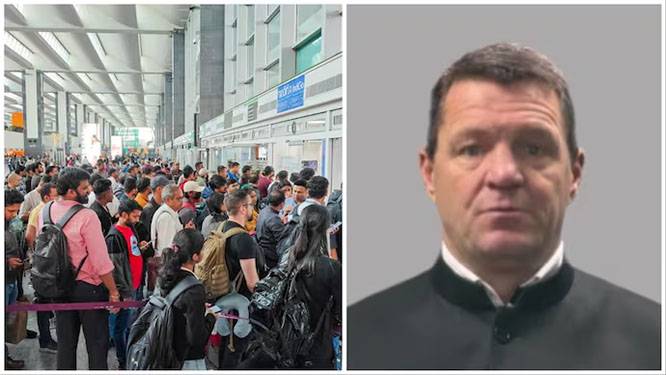
New Delhi, Dec 5: IndiGo CEO Pieter Elbers issued a public apology this evening after more than a thousand flights were cancelled today, making it the "most severely impacted day" in terms of cancellations. The biggest airline of the country cancelled "more than half" of its daily number of flights on Friday, said Elbers. He also said that even though the crisis will persist on Saturday, the airline anticipates fewer than 1,000 flight cancellations.

"Full normalisation is expected between December 10 and 15, though IndiGo cautions that recovery will take time due to the scale of operations," the IndiGo CEO said. 

IndiGo operates around 2,300 domestic and international flights daily.

Pieter Elbers, while apologising for the major inconvenience due to delays and cancellations, said the situation is a result of various causes.

The crisis at IndiGo stems from new regulations that boost pilots' weekly rest requirements by 12 hours to 48 and allow only two night-time landings per week, down from six. IndiGo has attributed the mass cancellations to "misjudgment and planning gaps".

Elbers also listed three lines of action that the airline will adopt to address the issue.

"Firstly, customer communication and addressing your needs, for this, messages have been sent on social media. And just now, a more detailed communication with information, refunds, cancellations and other customer support measures was sent," he said.

The airline has also stepped up its call centre capacity.

"Secondly, due to yesterday's situation, we had customers stranded mostly at the nation's largest airports. Our focus was for all of them to be able to travel today itself, which will be achieved. For this, we also ask customers whose flights are cancelled not to come to the airports as notifications are sent," the CEO said.

"Thirdly, cancellations were made for today to align our crew and planes to be where they need to start tomorrow morning afresh. Earlier measures of the last few days, regrettable, have proven not to be enough, but we have decided today to reboot all our systems and schedules, resulting in the highest numbers of cancellations so far, but imperative for progressive improvements starting from tomorrow," he added.

As airports witnessed chaotic scenes, the Directorate General of Civil Aviation (DGCA) stepped in to grant IndiGo a temporary exemption from stricter night duty rules for pilots. It also allowed substitution of leaves with a weekly rest period. 

Civil Aviation Minister Ram Mohan Naidu has said a high-level inquiry will be ordered and accountability will be fixed.

Comments

Add new comment

  • Coastaldigest.com reserves the right to delete or block any comments.
  • Coastaldigset.com is not responsible for its readers’ comments.
  • Comments that are abusive, incendiary or irrelevant are strictly prohibited.
  • Please use a genuine email ID and provide your name to avoid reject.
News Network
December 6,2025

indigoticket.jpg

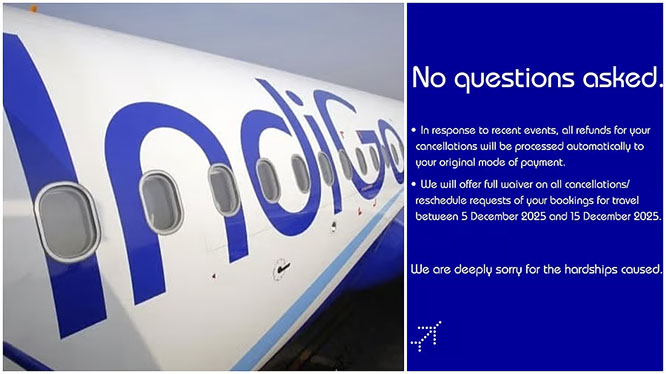
With IndiGo flight disruptions impacting thousands of passengers, the airline on Saturday said that it will offer full waiver on all cancellations/reschedule requests for travel bookings between December 5, 2025 and December 15, 2025.

Earlier in the day, the civil aviation ministry had directed the airline to complete the ticket refund process for the cancelled flights by Sunday evening, as well as ensure baggage separated from the travellers are delivered in the next two days.

In a post on X, titled 'No questions asked', IndiGo wrote, "In response to recent events, all refunds for your cancellations will be processed automatically to your original mode of payment."

"We are deeply sorry for the hardships caused," it further added.

Several passengers, however, complained of not getting full refund as promised by the airline.

Netizens have shared screenchots of getting charged for airline cancellation fee and convenience fee.

"Please tell me why u have did this airline cancellation charges when u say full amount will be refunded (sic)," a user wrote sharing a screenshot of the refund page.

"Well, but you have still debited the convenience charges," wrote another.

Passengers have also raised concerns about the "cancel" option being disabled on the IndiGo app. "First enable the 'Cancel' button on your App & offer full refund on tickets cancelled by customers between the said dates," wrote a user.

A day after the country's largest airline, IndiGo, cancelled more than 1,000 flights and caused disruptions for the fifth day on Saturday, the ministry said that any delay or non-compliance in refund processing will invite immediate regulatory action.

The refund process for all cancelled or disrupted flights must be completed by 8 pm on Sunday, the ministry said in a statement.

"Airlines have also been instructed not to levy any rescheduling charges for passengers whose travel plans were affected by cancellations," it said.

On Saturday, more than 400 flights were cancelled at various airports.

IndiGo has also been instructed to set up dedicated passenger support and refund facilitation cells.

Comments

Add new comment

  • Coastaldigest.com reserves the right to delete or block any comments.
  • Coastaldigset.com is not responsible for its readers’ comments.
  • Comments that are abusive, incendiary or irrelevant are strictly prohibited.
  • Please use a genuine email ID and provide your name to avoid reject.
News Network
November 24,2025

israelsyra.jpg

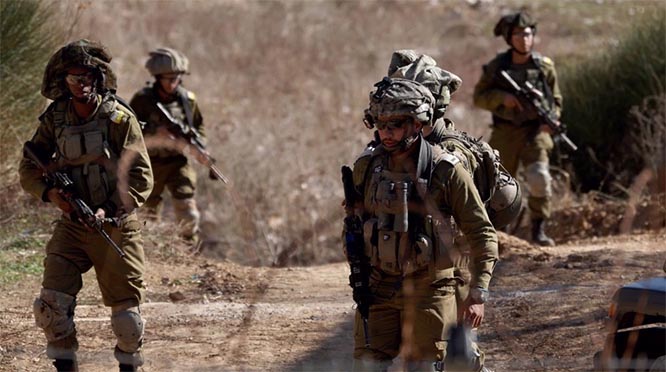
Israeli forces have pushed over the Syrian frontier, erecting a checkpoint and stopping vehicles in the southwestern city of Quneitra, in yet another breach of the Arab country’s sovereignty.

The violation took place on Sunday, when the troops made their way across the border, setting up the outpost near the Ain al-Bayda junction in northern Quneitra, Syrian outlets reported.

According to the al-Ikhbariya paper, an Israeli detachment positioned itself at the junction, halting cars and conducting searches.

The Syrian Arab News Agency (SANA) reported that three Israeli military vehicles then moved further into the northern countryside, deploying between the town of Jubata al-Khashab and the villages of Ofaniya and Ain al-Bayda. The agency added that a separate Israeli unit mounted a new incursion in the central region, approaching the villages of Umm Batina and al-Ajraf.

Residents said such activities have surged in recent months, pointing to Israeli advances onto farmland, leveling of extensive forested areas, arrests, and spread of mobile checkpoints.

The Israeli regime began markedly increasing its military aggression against Syria last year.

The escalation coincided with increasingly ferocious onslaughts throughout the country by the so-called Hay'at Tahrir al-Sham (HTS) Takfiri terrorist group, which the government of President Bashar al-Assad had confined to northwestern Syria. The HTS, however, managed to overthrow the government as the Israeli attacks would pummel the country’s civilian and defensive infrastructure.

Various reports have shown that, during the escalation, the regime conducted more than 1,000 airstrikes on the Syrian territory and over 400 ground raids into the south.

Following the collapse of the Assad government, Tel Aviv also widened its grip over the occupied Golan Heights by taking control of a demilitarized buffer zone, in defiance of a 1974 Disengagement Agreement. Earlier this month, senior Israeli officials, including Prime Minister Benjamin Netanyahu, visited the buffer zone, prompting expressions of alarm on the part of the United Nations.

The United States, the regime’s biggest ally, has, meanwhile, been fraternizing the HTS head Abu Mohammed al-Jolani amid the widely reported prospect of rapprochement with Tel Aviv.

Comments

Add new comment

  • Coastaldigest.com reserves the right to delete or block any comments.
  • Coastaldigset.com is not responsible for its readers’ comments.
  • Comments that are abusive, incendiary or irrelevant are strictly prohibited.
  • Please use a genuine email ID and provide your name to avoid reject.