'Why PMO ignored Niti recommendations against handing over 6 airports to Adani?'

News Network
February 8, 2023

adani.jpg

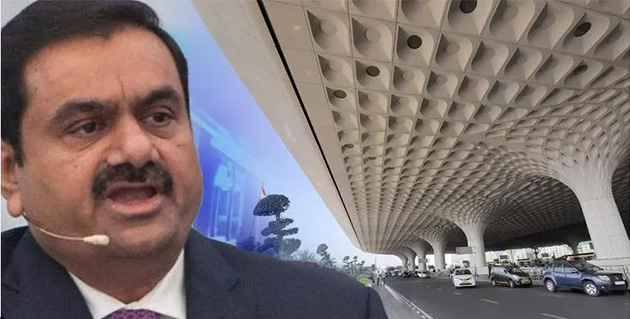
New Delhi, Feb 8: The Congress on Wednesday questioned as to why the Prime Minister’s Office “ignored” Niti Aayog recommendations against handing over six airports to an “inexperienced” Adani Group, a day after Rahul Gandhi linked the meteoric rise in the wealth of the business conglomerate to the BJP coming to power.

In the Congress’ HAHK (Hum Adani Ke Hain Kaun) series, the party’s general secretary Jairam Ramesh posed a set of three questions to the BJP, asking how the group became the largest airport operator in the country in a short span on time.

He also alleged that while the Congress-led UPA government promoted competition in the sector, the BJP dispensation favoured one business group.

In 2006, the United Progressive Alliance government awarded concessions to the GMR and GVK groups to operate Delhi and Mumbai airports respectively for a period of 30 years, he said. On November 7, 2006, the Supreme Court upheld these privatisation along with the condition that each bidder needed to partner with an experienced airport operator, he said.

Even though GMR had emerged as the top bidder in both cases, it was decided not to award both the airports to the firm in the interests of competition, the Congress leader claimed.

However, the BJP government in 2019 gave the right to operate six airports — Ahmedabad, Lucknow, Mangalore, Jaipur, Guwahati and Thiruvananthapuram — to the Adani Group, which had zero prior experience of operating airports, for a period of 50 years, Ramesh said.

He claimed the airports were handed over to the group despite a NITI Aayog memo of December 10, 2018 arguing that “a bidder lacking sufficient technical capacity” could “jeopardise the project and compromise the quality of services the government is committed to provide”.

On the same day as the NITI Aayog filed its objection, a note from the Department of Economic Affairs (DEA) in the Ministry of Finance strongly recommended that not more than two airports be awarded to a single bidder so as to reduce risk and to facilitate competition, he claimed.

“Why did the PMO and the NITI Aayog chairman, who headed the Empowered Group of Secretaries, ignore this recommendation and facilitate a clean sweep of six airports by the inexperienced Adani Group,” the Congress leader asked.

He also pointed out that the model Request for Quotes (RFQ) document though gave points for project experience outside the airports sector, the experience in the airports sector was important. “Yet this too was ignored by the ruling dispensation in its rush to help its cronies. Who instructed the Empowered Group of Secretaries to set aside this prior condition, thus clearing the way for the Adani Group to build a virtual monopoly in the sector,” he asked.

The Adani Group’s takeover of Mumbai airport should be a case study in crony capitalism, he also said, claiming that the GVK group had vigorously contested the Adani Group’s attempts to buy a stake in Mumbai airport in 2019, going to the courts and raising funds to buy out its joint venture partners Bidvest and ACSA.

“Yet in August 2020, only one month following raids by the Central Bureau of Investigation (CBI) and Enforcement Directorate (ED), GVK felt compelled to sell its most valuable asset to the Adani Group.

“What happened to the CBI and ED investigations against GVK? How did they miraculously disappear after the sale of Mumbai airport to the Adani Group? Are those cases being used to apply pressure on GVK to defend the very group that forced it to divest India’s second busiest airport,” he asked.

Business conglomerate GVK Group on Wednesday categorically said there was no “extraneous pressure” from anyone to sell its stake in Mumbai airport as alleged by Congress leader Rahul Gandhi.

The company’s comments came a day after Gandhi alleged in Lok Sabha that “Mumbai airport was taken away from GVK using agencies such as the CBI and the ED, and was given to Adani by the Government of India”.

“GVK reiterates that the decision to sell its stakes in Mumbai Airport to Adani, was taken by the management and there was absolutely no question of any extraneous pressure being exerted on us,” a GVK Group spokesperson told PTI.

The Adani Group, which is currently in the eye of a storm over the recent report by short-seller Hindenburg Research related to its company’s business dealings, took over the management of the Mumbai airport from GVK Group in July 2021. 

Comments

Add new comment

  • Coastaldigest.com reserves the right to delete or block any comments.
  • Coastaldigset.com is not responsible for its readers’ comments.
  • Comments that are abusive, incendiary or irrelevant are strictly prohibited.
  • Please use a genuine email ID and provide your name to avoid reject.
News Network
February 4,2026

Mangaluru: Urban local bodies and gram panchayats should make the use of Kannada on signboards mandatory while issuing trade licences to commercial establishments, Dakshina Kannada Deputy Commissioner Darshan HV said. He also called for regular inspections to ensure compliance.

Presiding over the District Kannada Awareness Committee meeting at the deputy commissioner’s office, Darshan said the city corporation would be directed to ensure that shops operating in malls prominently display their names in Kannada. “All commercial establishments, including shops, companies, offices and hotels, must mandatorily display their names in Kannada on signboards,” he said.

The deputy commissioner added that the National Highways Authority of India (NHAI) would be instructed to include Kannada on signboards along national highways. Banks, he said, would be directed through committee meetings to provide application forms in Kannada.

“Even if English-medium schools and colleges impart education in English, their signboards must display the institution’s name in Kannada. Steps will also be taken to ensure that private buses display place names in Kannada,” Darshan said.

During the meeting, committee members raised concerns over the closure of Kannada-medium schools in rural areas due to a shortage of teachers and stressed the need for immediate corrective measures. They also pointed out that several industries employ workers from other states while overlooking local candidates.

Members further demanded that nationalised banks provide deposit and withdrawal slips in Kannada. It was brought to the deputy commissioner’s notice that the presence of staff without knowledge of Kannada in rural branches of nationalised banks is causing hardship to local customers.

Meanwhile, MP Srinath, president of the District Kannada Sahitya Parishat, urged the district administration to allot land for the construction of a district Kannada Bhavana in Mangaluru.

Comments

Add new comment

  • Coastaldigest.com reserves the right to delete or block any comments.
  • Coastaldigset.com is not responsible for its readers’ comments.
  • Comments that are abusive, incendiary or irrelevant are strictly prohibited.
  • Please use a genuine email ID and provide your name to avoid reject.
News Network
January 31,2026

Roy.jpg

Bengaluru: The shooting incident involving CJ Roy, founder of the Confident Group, has once again put the spotlight on a businessman whose life has swung between flamboyant global success and persistent controversy at home.

Though Roy’s business interests extended across continents, his roots lay firmly in Karnataka. An alumnus of Christ School in Bengaluru, he later moved to Tumakuru to pursue an engineering degree. Those familiar with his early years describe him as intensely ambitious, beginning his career as a salesman at a small electronics firm dealing in computers.

Roy’s entry into large-scale real estate came through the Crystal Group, where he worked closely with Latha Namboothiri and rose from manager to director. However, the launch of the Confident Group in 2005 was clouded by industry speculation. Insiders speak of a fallout involving alleged “benami” properties and claims of deception that ultimately led to his independent venture—an episode Roy spent years trying to distance himself from, according to associates.

A tale of two cities

Roy’s professional trajectory diverged sharply across geographies.

In Dubai, he built a reputation as a bold and efficient developer, completing massive luxury residential projects in record time—some reportedly within 11 months. His rapid project delivery and lavish lifestyle in the Emirates earned him admiration and visibility in the real estate sector.

In Bengaluru, however, his image remained far more fractured. Sources say Roy stayed away from the city for several years amid disputes over unpaid dues to vendors and suppliers. Several projects were allegedly stalled, with accusations of unfulfilled commitments to cement and steel suppliers continuing to follow him.

Roy’s return to Bengaluru’s business and social circles began around 2018, marked by a conscious attempt at rebranding. His appointment as Honorary Consul of the Slovak Republic added diplomatic legitimacy, which he complemented with visible CSR initiatives, including ambulance donations and high-profile charity events.

Heavy police presence in Langford Town

Following the incident, police personnel from the Central division were deployed outside the Confident Group building in Langford Town, which also houses the Slovak Honorary Consulate in Bengaluru.

The otherwise busy premises near Hosur Road wore a deserted look on Friday, reflecting the shock and uncertainty that followed the tragedy.

Comments

Add new comment

  • Coastaldigest.com reserves the right to delete or block any comments.
  • Coastaldigset.com is not responsible for its readers’ comments.
  • Comments that are abusive, incendiary or irrelevant are strictly prohibited.
  • Please use a genuine email ID and provide your name to avoid reject.
News Network
February 1,2026

Bengaluru, Feb 1: For travelers landing at Kempegowda International Airport (KIA), the sleek, wood-paneled curves of Terminal 2 promise a world-class welcome. But the famed “Garden City” charm quickly withers at the curb. As India’s aviation sector swells to record numbers—handling over 43 million passengers in Bengaluru alone this past year—the “last mile” has turned into a marathon of frustration.

The Bengaluru Logjam: Rules vs Reality

While the city awaits the 2027 completion of the Namma Metro Blue Line, the interim has been chaotic. Recent “decongestion” rules at Terminal 1 have pushed app-based cab pickups to distant parking zones, forcing weary passengers into a 20-minute walk with luggage.

“I landed after ten months away and felt like a stranger in my own city,” says Ruchitha Jain, a Koramangala resident. “My driver couldn’t find me, staff couldn’t guide me, and the so-called ‘Premium’ lane is just a fancy tax on convenience.”

•    The Cost of Distance: A 40-km cab ride can now easily cross ₹1,500, driven by demand pricing and airport surcharges.

•    The Bus Gap: While Vayu Vajra remains a lifeline, its ₹300–₹400 fare is often cited as the most expensive airport bus service in the country.

A National Pattern of Disconnect

The struggle is not unique to Karnataka. From Chennai’s coast to Hyderabad’s plateau, India’s airports tell a familiar story: brilliant runways, broken exits.

City:    Primary Issue   |    Recent Development

Bengaluru:    Cab pickup restrictions & distance  |    App-based taxis shifted to far parking zones; long walks and fare spikes reported

Chennai:    Multi-Level Parking (MLCP) hike  |    Passengers report 40-minute walks to reach cab pickup points

Hyderabad:    “Taxi mafia” & touting  |    Over 440 touting cases reported; security presence intensified

Mumbai:    Fare scams  |     Tourists charged ₹18,000 for just 400 metres, triggering police action

In Hyderabad, travelers continue to battle entrenched local groups that intimidate Uber and Ola drivers, pushing passengers toward overpriced private taxis. Chennai flyers, meanwhile, complain that reaching the designated pickup zones now takes longer than short-haul flights from cities like Coimbatore.

The ‘Budget Day’ Hope

As Finance Minister Nirmala Sitharaman presents the Union Budget 2026 today, the aviation sector is watching closely. With the government’s renewed emphasis on multimodal integration, there is cautious hope for funding toward seamless airport-metro-bus hubs.

The vision is clear: a future where planes, trains, and metros speak the same language. Until then, passengers at KIA—and airports across India—will continue to discover that the hardest part of flying isn’t the thousands of kilometres in the air, but the last few on the ground.

Comments

Add new comment

  • Coastaldigest.com reserves the right to delete or block any comments.
  • Coastaldigset.com is not responsible for its readers’ comments.
  • Comments that are abusive, incendiary or irrelevant are strictly prohibited.
  • Please use a genuine email ID and provide your name to avoid reject.