Wistron violence could sour Apple's 'Make in India' plans

News Network
December 16, 2020

apple.JPG

Violence at a Wistron Corp factory in southern India is likely to stall the company's and its client Apple Inc's drive to expand local manufacturing, while forcing the government to redouble efforts to encourage foreign investors.

Thousands of contract workers angry over the alleged non-payment of wages, destroyed equipment and vehicles at a Wistron plant in southern India on Saturday, causing an estimated $60 million in damages.

The Taiwanese company, one of Apple's top suppliers, had been hiring in significant numbers at the plant that became operational earlier this year.

It assembled the second-generation iPhone SE there and was expected to start producing newer models, but the violence has led the company to shut the site and file a police complaint against more than 5,000 contract workers for destruction of property.

Wistron has not disclosed details, but one source familiar with the situation, speaking on condition of anonymity, said the area where smartphones are assembled and lines where delicate components, such as printed circuit boards, are mounted, have been damaged.

The company did not respond to a request for comment from Reuters. It said in a regulatory filing in Taiwan that it was doing its best to get the plant running again.

Apple also did not respond to a request for comment.

Two sources close to the situation, who asked not to be named because they were not authorised to speak to the press, said restarting could be difficult.

"It disrupts business for Wistron massively," one of the sources said.

"The company was looking to hire between 15,000 to 20,000 workers over the next one year, had plans to assemble another iPhone device but the company could take several weeks, or even months to get back on its feet again."

Wistron committed earlier this year to invest roughly 13 billion rupees ($176.74 million) for smartphone manufacturing over the next five years to qualify for the federal government's production-linked incentive plan.

Three sources familiar with the matter said Wistron could lose most of this year's incentives if operations stay suspended, although they did not give figures.

An Apple investigation into whether Wistron flouted supplier guidelines and a labour department enquiry into the alleged non-payment of wages could add to its problems in India.

'MAKE IN INDIA' CAMPAIGN

Wistron's issues are also a setback to Apple, which has in turn committed to expanding manufacturing in India and lobbied for incentives.

Apple has used India as a base to widen assembly beyond China as it adapts to a trade war between Beijing and Washington.

In India, it uses Foxconn's unit in southern Tamil Nadu state as well as Wistron's factory to make smartphones for the domestic market and for export.

Industry executives and tech analysts said Apple may seek to deepen ties with other contract manufacturers in India.

Pegatron Corp, another of Apple's Taiwan-based global suppliers, is expected to begin India operations soon.

Apart from any inconvenience to the companies, the fall-out from Saturday's violence in the southern Indian hub for automobile and electronics production, is a blow to Prime Minister Narendra Modi's Make In India campaign to lure international manufacturers.

Officials are already working to limit the damage.

The technology ministry said in a statement the Wistron plant was an aberration.

Officials from New Delhi and the government of Karnataka state, where the plant is located, said they have assured Wistron of their support.

Analysts predict India can prevail.

"The episode could dent India's potential as a source base for larger corporations, but the overall attractiveness of this market will stand the test," said Abheek Barua, the chief economist at top Indian private lender HDFC Bank.

"I also believe it will induce companies like Apple to take a closer look at their vendors and their policies, instead of driving them to an exodus."


Comments

Add new comment

  • Coastaldigest.com reserves the right to delete or block any comments.
  • Coastaldigset.com is not responsible for its readers’ comments.
  • Comments that are abusive, incendiary or irrelevant are strictly prohibited.
  • Please use a genuine email ID and provide your name to avoid reject.
News Network
December 6,2025

pilot.jpg

New Delhi: IndiGo, India’s largest airline, faced major operational turbulence this week after failing to prepare for new pilot-fatigue regulations issued by the Directorate General of Civil Aviation (DGCA). The stricter rules—designed to improve flight safety—took effect in phases through 2024, with the latest implementation on November 1. IndiGo has acknowledged that inadequate roster planning led to widespread cancellations and delays.

Below are the key DGCA rules that affected IndiGo’s operations:

1. Longer Mandatory Weekly Rest

Weekly rest for pilots has been increased from 36 hours to 48 hours.

The government says the extended break is essential to curb cumulative fatigue. This rule remains in force despite the current crisis.

2. Cap on Night Landings

Pilots can now perform only two night landings per week—a steep reduction from the earlier limit of six.

Night hours, defined as midnight to early morning, are considered the least alert period for pilots.

Given the disruptions, this rule has been temporarily relaxed for IndiGo until February 10.

3. Reduced Maximum Night Flight Duty

Flight duty that stretches into the night is now capped at 10 hours.

This measure has also been kept on hold for IndiGo until February 10 to stabilize operations.

4. Weekly Rest Cannot Be Replaced With Personal Leave

Airlines can no longer count a pilot’s personal leave as part of the mandatory 48-hour rest.

Pilots say this closes a loophole that previously reduced actual rest time.

Currently, all airlines are exempt from this rule to normalise travel.

5. Mandatory Fatigue Monitoring

Airlines must submit quarterly fatigue reports along with corrective actions to DGCA.

This system aims to create a transparent fatigue-tracking framework across the industry.

The DGCA has stressed that these rules were crafted to strengthen flight safety and align India with global fatigue-management standards. The temporary relaxations are expected to remain until February 2025, giving IndiGo time to stabilise its schedules and restore normal air travel.

Comments

Add new comment

  • Coastaldigest.com reserves the right to delete or block any comments.
  • Coastaldigset.com is not responsible for its readers’ comments.
  • Comments that are abusive, incendiary or irrelevant are strictly prohibited.
  • Please use a genuine email ID and provide your name to avoid reject.
News Network
December 6,2025

pilot.jpg

New Delhi: IndiGo, India’s largest airline, faced major operational turbulence this week after failing to prepare for new pilot-fatigue regulations issued by the Directorate General of Civil Aviation (DGCA). The stricter rules—designed to improve flight safety—took effect in phases through 2024, with the latest implementation on November 1. IndiGo has acknowledged that inadequate roster planning led to widespread cancellations and delays.

Below are the key DGCA rules that affected IndiGo’s operations:

1. Longer Mandatory Weekly Rest

Weekly rest for pilots has been increased from 36 hours to 48 hours.

The government says the extended break is essential to curb cumulative fatigue. This rule remains in force despite the current crisis.

2. Cap on Night Landings

Pilots can now perform only two night landings per week—a steep reduction from the earlier limit of six.

Night hours, defined as midnight to early morning, are considered the least alert period for pilots.

Given the disruptions, this rule has been temporarily relaxed for IndiGo until February 10.

3. Reduced Maximum Night Flight Duty

Flight duty that stretches into the night is now capped at 10 hours.

This measure has also been kept on hold for IndiGo until February 10 to stabilize operations.

4. Weekly Rest Cannot Be Replaced With Personal Leave

Airlines can no longer count a pilot’s personal leave as part of the mandatory 48-hour rest.

Pilots say this closes a loophole that previously reduced actual rest time.

Currently, all airlines are exempt from this rule to normalise travel.

5. Mandatory Fatigue Monitoring

Airlines must submit quarterly fatigue reports along with corrective actions to DGCA.

This system aims to create a transparent fatigue-tracking framework across the industry.

The DGCA has stressed that these rules were crafted to strengthen flight safety and align India with global fatigue-management standards. The temporary relaxations are expected to remain until February 2025, giving IndiGo time to stabilise its schedules and restore normal air travel.

Comments

Add new comment

  • Coastaldigest.com reserves the right to delete or block any comments.
  • Coastaldigset.com is not responsible for its readers’ comments.
  • Comments that are abusive, incendiary or irrelevant are strictly prohibited.
  • Please use a genuine email ID and provide your name to avoid reject.
News Network
December 2,2025

DKSsiddu.jpg

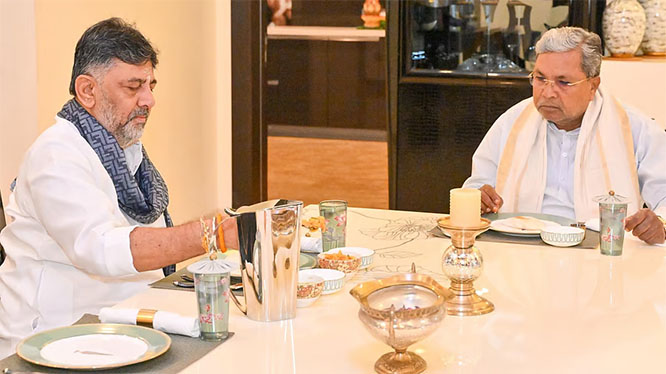
Bengaluru: 'Nati koli saaru' (country chicken curry) considered one of Chief Minister Siddaramaiah’s favourites along with steaming hot idlis was on the breakfast menu at Deputy CM D K Shivakumar’s residence on Tuesday, according to official sources.

The spread also included 'nati koli' fry, vada and pongal, among other items, they said.

In an apparent show of unity, Siddaramaiah visited Shivakumar’s residence for breakfast, just days after the two leaders shared a meal amid a simmering power tussle in the state Congress.

Siddaramaiah drove to the Deputy CM’s residence in Sadashivanagar, where he was received by Shivakumar and his brother D K Suresh, who is a former Congress MP.

Suresh and Kunigal MLA H D Ranganath, a relative of Shivakumar, joined them for breakfast, which featured a mix of vegetarian and non-vegetarian dishes.

Speaking to reporters later, Siddaramaiah said Shivakumar had invited him during his visit to the CM’s residence for breakfast on Saturday.

Asked about the difference between the two meals, the chief minister said, "At his (Shivakumar’s) house it was non-veg, while at my house it was veg. He is a vegetarian, I am a non-vegetarian. I had not prepared non-veg. I told DK to get chicken from the village as you won’t get the original in Bengaluru."

Shivakumar said he had initially invited Siddaramaiah to his residence, but the CM had suggested visiting his place first and reciprocating later. "It was a vegetarian breakfast at the CM’s house on Saturday," he noted.

"Today, I invited him (the CM) to my house. He enjoyed the breakfast, which had his Mysuru taste," Shivakumar added. At this point, Siddaramaiah remarked that Shivakumar’s wife is also from Mysuru.

Saturday’s breakfast at Siddaramaiah’s official residence, held as part of efforts by the Congress high command to ease tensions in the leadership dispute between the two, reportedly included idlis and sambar, according to official sources.

Comments

Add new comment

  • Coastaldigest.com reserves the right to delete or block any comments.
  • Coastaldigset.com is not responsible for its readers’ comments.
  • Comments that are abusive, incendiary or irrelevant are strictly prohibited.
  • Please use a genuine email ID and provide your name to avoid reject.