



‘Is your name Mohammed?’: 65-yr-old mentally ill Bhanwarlal Jain thrashed by Hindutva chauvinist, later found dead

News Network
May 21, 2022

attack.jpg

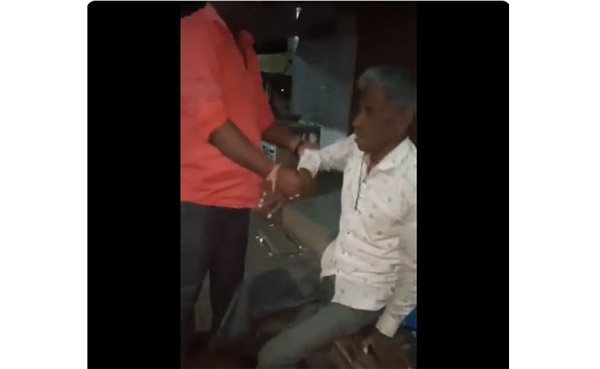
Bhopal: A murder case has been registered in Madhya Pradesh after a missing 65-year-old with mental illness was found dead and a video showed a man asking him if his "name is Mohammed" and repeatedly assaulting him as he struggled to answer.

The case has been registered in Neemuch district. The attacker in the video has been identified as Hindutva chauvinist Dinesh Kushwaha and named the main accused. Kushwaha is the husband of a former BJP corporator.

Police said that the elderly man, Bhanwarlal Jain, was from Sarsi in Ratlam district and went missing on May 15 after a visit to a religious event in Rajasthan. Following a missing complaint, police put out an alert with his photographs. His body was found on a roadside in Neemuch district yesterday. It was handed over to his family and they performed last rites.

The family then came to know of the video. The video shows Mr Jain sitting on a bench as Kushwaha towers over him. "What's your name? Mohammed?" he asks the elderly man and slaps him across the face. "Tell your name properly, show your Aadhaar card," he adds.

The elderly man, visibly petrified, offers money. This infuriates the attacker and he slaps the senior citizen non-stop on his head and ears. The 65-year-old appears to be struggling to understand the situation he is in. He lifts his shirt and a hidden pocket can be seen. He again tries to offer the attacker money as the latter keeps slapping him hard.

After the horrifying video emerged, family members of Jain reached the police station and demanded Kushwaha's immediate arrest.

KL Dangi, in-charge of the police station where the FIR was filed, said the video was probably shot on Thursday.

State Home Minister Narottam Mishra said a case has been registered under sections of murder and death by negligence.

The Opposition has slammed the ruling BJP after the video surfaced. Congress MLA Jitu Patwari accused the BJP of "lighting a furnace of hate".

Senior party leader Digvijaya Singh said a case has been filed but it remains to be seen if action will follow.

State BJP secretary Rajneesh Agrawal said, "The incident is unfortunate. An accused is an accused and it has nothing to do with party politics. None of the people involved in such an act will be spared by the state government." 

Comments

Add new comment

  • Coastaldigest.com reserves the right to delete or block any comments.
  • Coastaldigset.com is not responsible for its readers’ comments.
  • Comments that are abusive, incendiary or irrelevant are strictly prohibited.
  • Please use a genuine email ID and provide your name to avoid reject.
News Network
December 13,2025

New Delhi: School-going children are picking up drug and smoking habits and engaging in consumption of alcohol, with the average age of introduction to such harmful substances found to be around 13 years, suggesting a need for earlier interventions as early as primary school, a multi-city survey by AIIMS-Delhi said.

The findings also showed substance use increased in higher grades, with grade XI/XII students two times more likely to report use of substances when compared with grade VIII students. This emphasised the importance of continued prevention and intervention through middle and high school.

The study led by Dr Anju Dhawan of AIIMS's National Drug Dependence Treatment Centre, published in the National Medical Journal of India this month, looks at adolescent substance use across diverse regions.

The survey included 5,920 students from classes 8, 9, 11 and 12 in urban government, private and rural schools across 10 cities -- Bengaluru, Chandigarh, Delhi, Dibrugarh, Hyderabad, Imphal, Jammu, Lucknow, Mumbai, and Ranchi. The data were collected between May 2018 and June 2019.

The average age of initiation for any substance was 12.9 (2.8) years. It was lowest for inhalants (11.3 years) followed by heroin (12.3 years) and opioid pharmaceuticals (without prescription; 12.5 years).

Overall, 15.1 per cent of participants reported lifetime use, 10.3 per cent reported past year use, and 7.2 per cent reported use in the past month of any substance, the study found.

The most common substances used in the past year, after tobacco (4 per cent) and alcohol (3.8 per cent), were opioids (2.8 per cent), followed by cannabis (2 per cent) and inhalants (1.9 per cent). Use of non-prescribed pharmaceutical opioids was most common among opioid users (90.2 per cent).

On being asked, 'Do you think this substance is easily available for a person of your age' separately for each substance category, nearly half the students (46.3 per cent) endorsed that tobacco products and more than one-third of the students (36.5 per cent) agreed that a person of their age can easily procure alcohol products.

Similarly, for Bhang (21.9 per cent), ganja/charas (16.1 per cent), inhalants (15.2 per cent), sedatives (13.7 per cent), opium and heroin (10 per cent each), the students endorsed that these can be easily procured.

About 95 per cent of the children, irrespective of their grade, agreed with the statement that 'drug use is harmful'.

The rates of substance use (any) among boys were significantly higher than those of girls for substance use (ever), use in the past year and use in the past 30 days. Compared to grade VIII students, grade IX students were more likely, and grade XI/XII students were twice as likely to have used any substance (ever).

The likelihood of past-year use of any substance was also higher for grade IX students and for grade XI/XII students as compared to grade VIII students.

About 40 per cent of students mentioned that they had a family member who used tobacco or alcohol each. The use of cannabis (any product) and opioid (any product) by a family member was reported by 8.2 per cent and 3.9 per cent of students, respectively, while the use of other substances, such as inhalants/sedatives by family was 2-3 per cent, the study found.

A relatively smaller percentage of students reported use of tobacco or alcohol among peers as compared to among family members, while a higher percentage reported inhalants, sedatives, cannabis or opioid use among peers.

Children using substances (past year) compared to non-users reported significantly higher any substance use by their family members and peers.

There were 25.7 per cent students who replied 'yes' to the question 'conflicts/fights often occur in your family'. Most students also replied affirmatively to 'family members are aware of how their time is being spent' and 'damily members are aware of with whom they spend their time'.

Comments

Add new comment

  • Coastaldigest.com reserves the right to delete or block any comments.
  • Coastaldigset.com is not responsible for its readers’ comments.
  • Comments that are abusive, incendiary or irrelevant are strictly prohibited.
  • Please use a genuine email ID and provide your name to avoid reject.