KCR calls Chandrababu Naidu 'mental', questions his development claims

Agencies
November 26, 2018

Hyderabad, Nov 26: The verbal attacks during the ongoing election campaign in Telangana hit a new low on November 25 Sunday when Chief Minister K Chandrasekhar Rao called his Andhra Pradesh counterpart N Chandrababu Naidu "a mental".

The Telangana Rashtra Samithi (TRS) chief was speaking at a public meeting at Pargi in Vikarabad district ahead of the December 7 state Assembly polls.

"I say Chandrababu is a mental. Why? Because he had once said goats should be banned in order to save the forests (by preventing grazing). When was the goat born (the species came into existence) and when was he born? Who are you to ban the goat, a creation of nature?" Rao asked.

"He (Naidu) claims that he was instrumental in putting Hyderabad on the world map. What should we do with this man," he said, hitting out at the Telugu Desam Party (TDP) supremo.

"If he is that capable, why did he fail in building Amaravati (the upcoming capital of Andhra Pradesh)? Except graphic representations, no real building has come up there.

"This kind of cheats are coming to you, seeking votes. If we are not careful, we will be cheated," Rao said in a scathing attack on the People's Front alliance of the Congress, TDP, Telangana Jana Samithi and CPI.

He claimed that the power situation in Telangana had improved drastically since 2014, but it would worsen again if his party lost in the upcoming polls.

The TRS was going to form the government by winning 103 to 106 of the 119 seats in the state, Rao claimed, citing a survey.

At a public meeting at Devarkadra, Rao alleged that Naidu had filed 35 court cases and "written 40 letters", opposing the irrigating projects in Telangana, and now, he was seeking votes in the state.

Hitting out at the Congress, the TRS chief said, "Don't you see the development here? Are you giving a Rs 1,000 pension to people in the states where your party is in power (as in Telangana)?"

Speaking at Narayanpet, the chief minister said democracy in the country had not reached "enough maturity levels" and that people should not vote carelessly.

"Many parties will come and say many things. Please listen to them and think once again before casting the vote, which is going to change our fate," he said.

Rao also addressed public meetings at Tandur, Shadnagar and Ibrahimpatnam on November 25.

Comments

Add new comment

  • Coastaldigest.com reserves the right to delete or block any comments.
  • Coastaldigset.com is not responsible for its readers’ comments.
  • Comments that are abusive, incendiary or irrelevant are strictly prohibited.
  • Please use a genuine email ID and provide your name to avoid reject.
News Network
December 1,2025

hindutvaboy.jpg

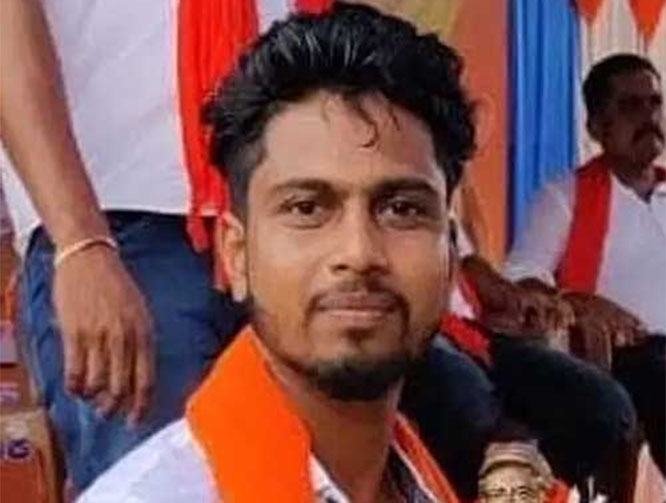
Udupi, Dec 1: A horrific case of alleged rape has unfolded in Udupi, where a worker from a Hindutva organisation, previously arrested and released on bail for harassing a young woman, is now accused of waylaying and sexually assaulting her.

The arrested individual has been identified as Pradeep Poojary (26), a member of the Hindu Jagarana Vedike's Nairkode unit in Perdur.

Poojary had allegedly been relentlessly harassing the young woman, pressuring her to marry him. When she bravely stood up to him and refused his demands, she filed a formal complaint at the Hiriyadka police station. He was subsequently arrested in that initial harassment case but was later granted bail.

According to police reports, driven by the same malicious grudge, Poojary allegedly intercepted the woman again on November 29. While she was walking through a deserted area, the accused is claimed to have threatened her by grabbing her neck. When she again refused to marry him, he allegedly proceeded to rape her.

The survivor immediately informed her family about the traumatic assault. Following this, her parents lodged a complaint at the Udupi women’s police station.

Police arrested Poojary again and produced him before the court. He has since been remanded to judicial custody.

Comments

Add new comment

  • Coastaldigest.com reserves the right to delete or block any comments.
  • Coastaldigset.com is not responsible for its readers’ comments.
  • Comments that are abusive, incendiary or irrelevant are strictly prohibited.
  • Please use a genuine email ID and provide your name to avoid reject.
News Network
December 2,2025

A major upgrade in safety and monitoring is planned for Haj 2026, with every Indian pilgrim set to receive a Haj Suvidha smart wristband linked to the official Haj Suvidha mobile app. The initiative aims to support pilgrims—especially senior citizens—who may struggle with smartphones during the 45-day journey.

What the Smart Wristband Will Do

Officials said the device will come with:
•    Location tracking
•    Pedometer
•    SOS emergency button
•    Qibla compass
•    Prayer timings
•    Basic health monitoring

SP Tiwari, secretary of the UP State Haj Committee, said the goal is to make the pilgrimage safer and more comfortable.

“Most Hajis are elderly and not comfortable with mobile apps,” he said. “The smartwatch will help locate pilgrims who forget their way or cannot communicate their location.”

The wristbands will be monitored by the Consulate General of India in Saudi Arabia, similar to mobile tracking via the Haj Suvidha App.

Free Distribution and Training

•    Smart wristbands will be given free of cost.
•    Training for pilgrims will be conducted between January and February 2026.
•    Sample units will reach state Haj committees soon.
•    Final devices will be distributed as pilgrims begin their journey.

New Rules for Accommodation

Two major decisions have also been finalised for Haj 2026:
1.    Separate rooms for men and women – including married couples. They may stay on the same floor but must occupy different rooms, following stricter Saudi guidelines.
2.    Cooking banned – gas cylinders will not be allowed; all meals will be provided through official catering services arranged by the Haj Committee of India.

These decisions were finalised during a meeting of the Haj Committee of India and state representatives in Mumbai.

Haj Suvidha App Launched Earlier

The government launched the Haj Suvidha App in 2024, offering:

•    Training modules
•    Accommodation and flight details
•    Baggage information
•    SOS and translation tools
•    Grievance redressal

Haj 2026 Quota and Key States

•    India’s total Haj quota for 2026: 1,75,025 pilgrims
•    70% (1,25,000) allotted to the Haj Committee of India
•    30% (around 50,000) reserved for Haj Group Organisers

Uttar Pradesh has the largest allocation (around 30,000 seats), though approximately 18,000 pilgrims are expected to go this year. States with high pilgrim numbers include Kerala, Maharashtra and Gujarat.

Dates of Haj 2026

The pilgrimage is scheduled to take place from 24 May to 29 May, 2026 (tentative).
Haj is one of the five pillars of Islam and is mandatory for Muslims who meet the required conditions.

Comments

Add new comment

  • Coastaldigest.com reserves the right to delete or block any comments.
  • Coastaldigset.com is not responsible for its readers’ comments.
  • Comments that are abusive, incendiary or irrelevant are strictly prohibited.
  • Please use a genuine email ID and provide your name to avoid reject.
News Network
December 13,2025

New Delhi: School-going children are picking up drug and smoking habits and engaging in consumption of alcohol, with the average age of introduction to such harmful substances found to be around 13 years, suggesting a need for earlier interventions as early as primary school, a multi-city survey by AIIMS-Delhi said.

The findings also showed substance use increased in higher grades, with grade XI/XII students two times more likely to report use of substances when compared with grade VIII students. This emphasised the importance of continued prevention and intervention through middle and high school.

The study led by Dr Anju Dhawan of AIIMS's National Drug Dependence Treatment Centre, published in the National Medical Journal of India this month, looks at adolescent substance use across diverse regions.

The survey included 5,920 students from classes 8, 9, 11 and 12 in urban government, private and rural schools across 10 cities -- Bengaluru, Chandigarh, Delhi, Dibrugarh, Hyderabad, Imphal, Jammu, Lucknow, Mumbai, and Ranchi. The data were collected between May 2018 and June 2019.

The average age of initiation for any substance was 12.9 (2.8) years. It was lowest for inhalants (11.3 years) followed by heroin (12.3 years) and opioid pharmaceuticals (without prescription; 12.5 years).

Overall, 15.1 per cent of participants reported lifetime use, 10.3 per cent reported past year use, and 7.2 per cent reported use in the past month of any substance, the study found.

The most common substances used in the past year, after tobacco (4 per cent) and alcohol (3.8 per cent), were opioids (2.8 per cent), followed by cannabis (2 per cent) and inhalants (1.9 per cent). Use of non-prescribed pharmaceutical opioids was most common among opioid users (90.2 per cent).

On being asked, 'Do you think this substance is easily available for a person of your age' separately for each substance category, nearly half the students (46.3 per cent) endorsed that tobacco products and more than one-third of the students (36.5 per cent) agreed that a person of their age can easily procure alcohol products.

Similarly, for Bhang (21.9 per cent), ganja/charas (16.1 per cent), inhalants (15.2 per cent), sedatives (13.7 per cent), opium and heroin (10 per cent each), the students endorsed that these can be easily procured.

About 95 per cent of the children, irrespective of their grade, agreed with the statement that 'drug use is harmful'.

The rates of substance use (any) among boys were significantly higher than those of girls for substance use (ever), use in the past year and use in the past 30 days. Compared to grade VIII students, grade IX students were more likely, and grade XI/XII students were twice as likely to have used any substance (ever).

The likelihood of past-year use of any substance was also higher for grade IX students and for grade XI/XII students as compared to grade VIII students.

About 40 per cent of students mentioned that they had a family member who used tobacco or alcohol each. The use of cannabis (any product) and opioid (any product) by a family member was reported by 8.2 per cent and 3.9 per cent of students, respectively, while the use of other substances, such as inhalants/sedatives by family was 2-3 per cent, the study found.

A relatively smaller percentage of students reported use of tobacco or alcohol among peers as compared to among family members, while a higher percentage reported inhalants, sedatives, cannabis or opioid use among peers.

Children using substances (past year) compared to non-users reported significantly higher any substance use by their family members and peers.

There were 25.7 per cent students who replied 'yes' to the question 'conflicts/fights often occur in your family'. Most students also replied affirmatively to 'family members are aware of how their time is being spent' and 'damily members are aware of with whom they spend their time'.

Comments

Add new comment

  • Coastaldigest.com reserves the right to delete or block any comments.
  • Coastaldigset.com is not responsible for its readers’ comments.
  • Comments that are abusive, incendiary or irrelevant are strictly prohibited.
  • Please use a genuine email ID and provide your name to avoid reject.