



KSA's Prince Sultan Center for Defense Studies reveals its advanced projects during AFED 2018

Arab News
March 4, 2018

Riyadh, Mar 4: Two highly sophisticated drones were among a selection of military defense research projects showcased at the Armed Forces Exhibition for Diversity of Requirements and Capabilities (AFED 2018).

Two Skyguard drones, “Haris Al-Ajwaa” and “Al-Nawras,” were revealed by the Prince Sultan Center for Defense Studies and Researchers to reflect the Kingdom’s advancement in the military industries sector and in complementary industries.

The Skyguard drone was designed to be used in the strategic operations of ground, air, and naval forces due to its high accuracy in detecting, tracking, and destroying targets and its great ability to support and correct artillery shooting.

The drone can also handle e-war support tasks, automatically take off and land, and fly for 10 continuous hours at a range of 200 kilometers and an altitude of 18,000 feet.

Moreover, the drone was equipped with high-resolution cameras and can also be equipped with an electronic warfare system and a system for communications or for jamming or blocking the enemy’s radars and communications.

The Skyguard weighs 250 kilograms and can carry two laser-guided bombs, each of which weighs 12 kg with explosive bombs that weigh up to 7 kg. It is similar to precision-guided munition that can be guided by laser using a land or an airborne guidance system installed to the drone itself or another drone.

Al-Nawras is a strategic, lightweight unmanned aerial vehicle system that can be carried and launched from different locations. It performs several tasks, including surveillance, monitoring, and tracking targets, as well as supporting and correcting shootings.

It is four meters long, weighs 38 kg, flies for five hours at an altitude of 4,000 meters, and, owing to its small size, can be launched from ships using a launcher.

Also on show were radars updated by Saudi experts at the center. These are passive covert radar, naval radar, the electronic surveillance radar “Manar,” noise radar, the Rasid (monitor) radar, the mortar guidance system, and the mine detection radar, which is still being developed.

Comments

Add new comment

  • Coastaldigest.com reserves the right to delete or block any comments.
  • Coastaldigset.com is not responsible for its readers’ comments.
  • Comments that are abusive, incendiary or irrelevant are strictly prohibited.
  • Please use a genuine email ID and provide your name to avoid reject.
News Network
November 22,2025

gaza.jpg

The Israeli regime’s forces have killed two Palestinian children in the Gaza Strip every day since the ceasefire began in early October, UNICEF has warned.

The UN children’s agency said on Friday that Israeli forces continue to attack Palestinians in Gaza even though the agreement was meant to stop the killing.

“Since 11 October, while the ceasefire has been in effect, at least 67 children have been killed in conflict-related incidents in the Gaza Strip. Dozens more have been injured. That is an average of almost two children killed every day since the ceasefire took effect,” UNICEF spokesperson Ricardo Pires said in Geneva, reminding that each number in the statistics represents a child whose life had ended violently.

“These are not statistics,” he said. “Each child had a story, a family, and a future that was stolen from them.”

Data from Palestinian factions, human rights groups, and government bodies recorded since the US-brokered ceasefire deal went into effect on October 10 show that Israeli forces have carried out numerous attacks, each constituting a separate ceasefire violation.

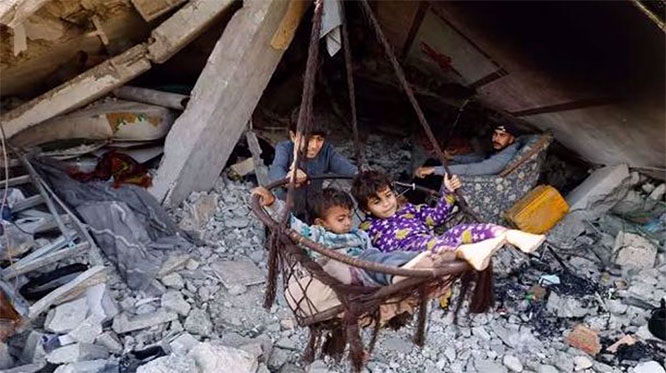
UNICEF teams say they repeatedly continue to witness heart-wrenching scenes of fearful Palestinian children sleeping outdoors with amputated limbs, while others live as orphans in flooded, makeshift shelters.

“I saw this myself in August. There is no safe place for them. The world cannot normalize their suffering,” Pires said, lamenting that the UN could “do a lot more if the aid that is really needed was entering faster.”

The UNICEF spokesperson warned that with the advent of winter, the risks for hundreds of thousands of displaced children will increase.

He warned, “The stakes are incredibly high” for children as winter acts as a threat multiplier, where children have no heating, no insulation, and few blankets. He said respiratory infections rise.

“Too many children have already paid the highest price,” Pires said. “Too many are still paying it, even under a ceasefire. The world promised them it would stop and that we would protect them.”

“Now we must act like it,” the UNICEF spokesperson added.

Since the Israeli regime launched its genocidal war against Palestinians in Gaza in October 2023, it has killed nearly 70,000 people in the territory, most of them women and children, and injured over 170,000 more, while reducing most of the structures in the enclave to rubble.

Comments

Add new comment

  • Coastaldigest.com reserves the right to delete or block any comments.
  • Coastaldigset.com is not responsible for its readers’ comments.
  • Comments that are abusive, incendiary or irrelevant are strictly prohibited.
  • Please use a genuine email ID and provide your name to avoid reject.