



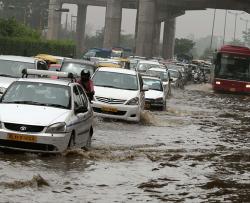
Landslides, floods claim over 50 in north India

June 17, 2013
car
New Delhi, Jun 17: Monsoon woes gripped several parts of north India today as heavy rains wreaked havoc in the hill states of Uttarakhand and Himachal Pradesh, leaving over 50 people dead and hundreds stranded, while several parts in Haryana were flooded after water level of Yamuna rose alarmingly.

Flashfloods in the Ganga and its tributaries triggered by incessant rains for over 48 hours left a trail of death and devastation across Uttarakhand killing 30 people, injuring 19 and damaging 164 buildings.

Seven persons went missing and five vehicles including a chopper were swept away in the heavy showers which are still continuing at a number of places across the state, Disaster Management authorities in Dehradun said.

At least 15 people were killed in different incidents in Uttar Pradesh as flash floods lashed Saharanpur district following incessant rainfalls in neighbouring Uttarakhand.

IG (Law and order) R K Vishkarma said nearly 45 people were stranded due to the flash floods and were airlifted from Sarsava airbase to safer places by Air Force helicopters.

In Himachal Pradesh, a high alert was sounded and army assistance was sought for rescue operations in the tribal border district of Kinnaur as incessant rains and snow wreaked havoc in the region, killing 10 people and damaging property worth crores of rupees.

Five members of a family, including three children, were buried alive when boulders fell on their house while five others were killed in landslides in three other places.

Kinnaur district was cut off from the state from Tapri onwards as most of the approach roads and Hindustan-Tibet National highway was blocked at several places due landslides and about 1,700 people were stranded.

Over 700 people, including Chief Minister Virbhadra Singh who was campaigning in the area for Mandi Lok Sabha by-poll slated for June 23, were stranded in the Sangla valley and assistance of army has been sought for rescue operations and airlifting them, state Chief Secretary S Roy said.

"The Election Commission has given permission for evacuation of the chief minister by a state chopper but it could not land due to bad weather and returned," he said.

About 25 foreigners and a Doordarshan team were also stranded in Kinnaur district.

The disaster management cell of the army has been informed and it has already started preparations for launching the rescue operations in coordination with IAF and Army.

In Uttarakhand, Rudraprayag bore the brunt of the disaster with a maximum of 20 people killed there. Two persons each were killed in Chamoli, Uttarkashi and Tehri districts whereas three were killed in Dehradun and one in Almora.

A large number of structures including shrines, hotels, rest houses, commercial and residential buildings located close to Alaknanda caved in like a pack of cards in Rudraparayag district.

Chief Minister Vijay Bahuguna who took information from district magistrates on the extent of damage caused by the flashfloods through video conferencing expressed grief at the loss of lives in the calamity describing it as "huge".

Rescue operations are going on a war footing with the help of ITBP, BSF and the Army but the bad weather is a hindrance, he admitted.

Char dam yatra and Mansarovar yatra through Uttarakhand have been suspended which will be resumed after the weather clears up, he said.

Arriving almost a fortnight in advance than its usual date, the southwest monsoon brought heavy rains in several parts of Haryana, particularly Yamunanagar district, where normal life was paralysed. Fifty-two people were rescued by the Army and NDRF as several parts were flooded after Yamuna river's level rose alarmingly, prompting the authorities to sound an alert.

One hundred and fifty residents of the village Shergarh Tapu and 42 of Chandrao in district Karnal, who were also stranded due to floods, were also successfully got evacuated, officials said.

Heavy showers in the national capital for the second consecutive day caused water-logging and traffic chaos in various parts.

According to the MeT department, Delhi received 17.1 mm rains from 8.30 am to 5.30 pm. Earlier, during the last 24 hours ending at 8.30 am, rain gauges measured 58.5 mm. The city had received 36.6 mm of rains till 5.30 pm yesterday which were the first monsoon showers of the season.

The day temperature in the national temperature dropped sharply today settling at 30.3 deg C which was nine notches below normal while the minimum temperature remained five notches below normal at 23.5 deg c.


Comments

Add new comment

  • Coastaldigest.com reserves the right to delete or block any comments.
  • Coastaldigset.com is not responsible for its readers’ comments.
  • Comments that are abusive, incendiary or irrelevant are strictly prohibited.
  • Please use a genuine email ID and provide your name to avoid reject.
News Network
December 6,2025

pilot.jpg

New Delhi: IndiGo, India’s largest airline, faced major operational turbulence this week after failing to prepare for new pilot-fatigue regulations issued by the Directorate General of Civil Aviation (DGCA). The stricter rules—designed to improve flight safety—took effect in phases through 2024, with the latest implementation on November 1. IndiGo has acknowledged that inadequate roster planning led to widespread cancellations and delays.

Below are the key DGCA rules that affected IndiGo’s operations:

1. Longer Mandatory Weekly Rest

Weekly rest for pilots has been increased from 36 hours to 48 hours.

The government says the extended break is essential to curb cumulative fatigue. This rule remains in force despite the current crisis.

2. Cap on Night Landings

Pilots can now perform only two night landings per week—a steep reduction from the earlier limit of six.

Night hours, defined as midnight to early morning, are considered the least alert period for pilots.

Given the disruptions, this rule has been temporarily relaxed for IndiGo until February 10.

3. Reduced Maximum Night Flight Duty

Flight duty that stretches into the night is now capped at 10 hours.

This measure has also been kept on hold for IndiGo until February 10 to stabilize operations.

4. Weekly Rest Cannot Be Replaced With Personal Leave

Airlines can no longer count a pilot’s personal leave as part of the mandatory 48-hour rest.

Pilots say this closes a loophole that previously reduced actual rest time.

Currently, all airlines are exempt from this rule to normalise travel.

5. Mandatory Fatigue Monitoring

Airlines must submit quarterly fatigue reports along with corrective actions to DGCA.

This system aims to create a transparent fatigue-tracking framework across the industry.

The DGCA has stressed that these rules were crafted to strengthen flight safety and align India with global fatigue-management standards. The temporary relaxations are expected to remain until February 2025, giving IndiGo time to stabilise its schedules and restore normal air travel.

Comments

Add new comment

  • Coastaldigest.com reserves the right to delete or block any comments.
  • Coastaldigset.com is not responsible for its readers’ comments.
  • Comments that are abusive, incendiary or irrelevant are strictly prohibited.
  • Please use a genuine email ID and provide your name to avoid reject.
News Network
December 4,2025

indigoflight.jpg

Domestic carrier IndiGo has cancelled over 180 flights from three major airports — Mumbai, Delhi and Bengaluru — on Thursday, December 4, as the airline struggles to secure the required crew to operate its flights in the wake of new flight-duty and rest-period norms for pilots.

While the number of cancellations at Mumbai airport stands at 86 (41 arrivals and 45 departures) for the day, at Bengaluru, 73 flights have been cancelled, including 41 arrivals, according to a PTI report that quoted sources.

"IndiGo cancelled over 180 flights on Thursday at three airports-Mumbai, Delhi and Bengaluru," the source told the news agency.

Besides, it had cancelled as many as 33 flights at Delhi airport for Thursday, the source said, adding, "The number of cancellations is expected to be higher by the end of the day."

The Gurugram-based airline's On-Time Performance (OTP) nosedived to 19.7 per cent at six key airports — Delhi, Mumbai, Chennai, Kolkata, Bengaluru and Hyderabad — on December 3, as it struggled to get the required crew to operate its services, down from almost half of December 2, when it was 35 per cent.

"IndiGo has been facing acute crew shortage since the implementation of the second phase of the FDTL (Flight Duty Time Limitations) norms, leading to cancellations and huge delays in its operations across the airports," a source had told PTI on Wednesday.

Chaos continued at several major airports for the third day on Thursday because of the cancellations.

A spokesperson for the Kempegowda International Airport (KIA) in Bengaluru said that 73 IndiGo flights had been cancelled on Thursday.

At least 150 flights were cancelled and dozens of others delayed on Wednesday, airport sources said, leaving thousands of travellers stranded, according to news agency Reuters.

The Directorate General of Civil Aviation (DGCA) has said it is investigating IndiGo flight disruptions and has asked the airline to submit the reasons for the current situation, as well as its plans to reduce flight cancellations and delays.

It may be mentioned here that the pilots' body, Federation of Indian Pilots (FIP), has alleged that IndiGo, despite getting a two-year preparatory window before the full implementation of new flight duty and rest period norms for cockpit crew, "inexplicably" adopted a "hiring freeze".

The FIP said it has urged the safety regulator, the DGCA, not to approve airlines' seasonal flight schedules unless they have adequate staff to operate their services "safely and reliably" in accordance with the New Flight Duty Time Limitations (FDTL) norms.

In a letter to the DGCA late on Wednesday, the FIP urged the DGCA to consider re-evaluating and reallocating slots to other airlines, which have the capacity to operate them without disruption during the peak holiday and fog season if IndiGo continues to "fail in delivering on its commitments to passengers due to its own avoidable staffing shortages."

Comments

Add new comment

  • Coastaldigest.com reserves the right to delete or block any comments.
  • Coastaldigset.com is not responsible for its readers’ comments.
  • Comments that are abusive, incendiary or irrelevant are strictly prohibited.
  • Please use a genuine email ID and provide your name to avoid reject.
News Network
December 2,2025

A major upgrade in safety and monitoring is planned for Haj 2026, with every Indian pilgrim set to receive a Haj Suvidha smart wristband linked to the official Haj Suvidha mobile app. The initiative aims to support pilgrims—especially senior citizens—who may struggle with smartphones during the 45-day journey.

What the Smart Wristband Will Do

Officials said the device will come with:
•    Location tracking
•    Pedometer
•    SOS emergency button
•    Qibla compass
•    Prayer timings
•    Basic health monitoring

SP Tiwari, secretary of the UP State Haj Committee, said the goal is to make the pilgrimage safer and more comfortable.

“Most Hajis are elderly and not comfortable with mobile apps,” he said. “The smartwatch will help locate pilgrims who forget their way or cannot communicate their location.”

The wristbands will be monitored by the Consulate General of India in Saudi Arabia, similar to mobile tracking via the Haj Suvidha App.

Free Distribution and Training

•    Smart wristbands will be given free of cost.
•    Training for pilgrims will be conducted between January and February 2026.
•    Sample units will reach state Haj committees soon.
•    Final devices will be distributed as pilgrims begin their journey.

New Rules for Accommodation

Two major decisions have also been finalised for Haj 2026:
1.    Separate rooms for men and women – including married couples. They may stay on the same floor but must occupy different rooms, following stricter Saudi guidelines.
2.    Cooking banned – gas cylinders will not be allowed; all meals will be provided through official catering services arranged by the Haj Committee of India.

These decisions were finalised during a meeting of the Haj Committee of India and state representatives in Mumbai.

Haj Suvidha App Launched Earlier

The government launched the Haj Suvidha App in 2024, offering:

•    Training modules
•    Accommodation and flight details
•    Baggage information
•    SOS and translation tools
•    Grievance redressal

Haj 2026 Quota and Key States

•    India’s total Haj quota for 2026: 1,75,025 pilgrims
•    70% (1,25,000) allotted to the Haj Committee of India
•    30% (around 50,000) reserved for Haj Group Organisers

Uttar Pradesh has the largest allocation (around 30,000 seats), though approximately 18,000 pilgrims are expected to go this year. States with high pilgrim numbers include Kerala, Maharashtra and Gujarat.

Dates of Haj 2026

The pilgrimage is scheduled to take place from 24 May to 29 May, 2026 (tentative).
Haj is one of the five pillars of Islam and is mandatory for Muslims who meet the required conditions.

Comments

Add new comment

  • Coastaldigest.com reserves the right to delete or block any comments.
  • Coastaldigset.com is not responsible for its readers’ comments.
  • Comments that are abusive, incendiary or irrelevant are strictly prohibited.
  • Please use a genuine email ID and provide your name to avoid reject.