Lives of marginalized matter: When will their suffocation end?

Ram Puniyani
June 29, 2020

In Minneapolis, US an African American, George Floyd lost his life as the white policeman, Derek Chauvin, caught hold of him and put his knee on his neck. This is a technique developed by Israel police. For nine long minutes the knee of the while policeman was on the neck of George, who kept shouting, I can’t breathe.
Following this gruesome murder America erupted with protests, ‘Black lives matter’. The protestors were not just African Americans but also a large section of whites. Within US one police Chief apologized for the act of this. In a touching gesture of apology the police force came on its knees. This had reverberations in different parts of the World.

The act was the outcome of the remnants of the racial hatred against blacks by the whites. It is the hatred and the perceptions which are the roots of such acts of violence. What was also touching that the state of democracy in US is so deep that even the police apologized, the nation, whites and blacks, stood up as a sensitive collective against this violence.

US is not the only country where the brutal acts of violence torment the marginalized sections of society. In India there is a list of dalits, minorities and adivasis who are regularly subjected to such acts. But the reaction is very different. We have witnessed the case of Tabrez Ansari, who was tied to the pole by the mob and beaten ruthlessly. When he was taken to police station, police took enough time to take him to hospital and Tabrez died.

Mohsin Sheikh, a Pune techie was murdered by Hindu Rashtra Sena mob, the day Modi came to power in 2014. Afrazul was killed by Shambhulal Regar, videotaped the act released on social media. Regar believed that Muslims are indulging in love Jihad, so deserve such a fate. Mohammad Akhlaq is one among many names who were mob lynched on the issue of beef cow. The list can fill pages after pages.

Recently a young dalit boy was shot dead for the crime of entering a temple. In Una four dalits were stripped above waste and beaten mercilessly. Commenting on this act the Union Minister Ramvilas Paswan commented that it is a minor incident. Again the list of atrocities against dalits is long enough. The question is what Paswan is saying is the typical response to such gruesome murders and tortures. In US loss of one black life, created the democratic and humane response. In India there is a general silence in response to these atrocities. Some times after a good lapse of time, the Prime Minister will utter, ‘Mother Bharati has lost a son’. Most of the time victim is blamed. Some social groups raise their voice in some fora but by and large the deafening silence from the country is the norm.

India is regarded as the largest democracy. Democracy is the rule of law, and the ground on which the injustices are opposed. In America though the present President is insensitive person, but its institutions and processes of democratic articulations are strong. The institutions have deepened their roots and though prejudices may be guiding the actions of some of the officers like the killer of George, there are also police officers who can tell their President to shut up if he has nothing meaningful to say on the issue. The prejudices against Blacks may be prevalent and deep in character, still there are large average sections of society, who on the principles of ‘Black lives matter’. There are large sections of vocal population who can protest the violation of basic norms of democracy and humanism.

In India by contrast there are multiple reasons as to why the lives of Tabrez Ansari, Mohammad Akhlaq, Una dalit victims and their likes don’t matter. Though we claim that we are a democracy, insensitivity to injustices is on the rise. The strong propaganda against the people from margins has become so vicious during last few decades that any violence against them has become sort of a new normal. The large populace, though disturbed by such brutalities, is also fed the strong dose of biases against the victims. The communal forces have a great command over effective section of media and large section of social media, which generates Hate against these disadvantaged groups, thereby the response is muted, if at all.

As such also the process of deepening of our democracy has been weak. Democracy is a dynamic process; it’s not a fixed entity. Decades ago workers and dalits could protest for their rights. Now even if peasants make strong protests, dominant media presents it as blocking of traffic! How the roots of democracy are eroded and are visible in the form where the criticism of the ruling dispensation is labelled as anti National..

Our institutions have been eroded over a period of time, and these institutions coming to the rescue of the marginalized sections have been now become unthinkable. The outreach of communal, divisive ideology, the ideology which looks down on minorities, dalits and Adivasis has risen by leaps and bounds.

The democracy in India is gradually being turned in to a hollow shell, the rule of law being converted in to rule of an ideology, which does not have faith in Indian Constitution, which looks down upon pluralism and diversity of this country, which is more concerned for the privileges of the upper caste, rich and affluent. The crux of the matter is the weak nature of democracy, which was on way to become strong, but from decades of 1980s, as emotive issues took over, the strength of democracy started dwindling, and that’s when the murders of the types of George Floyd, become passé. One does complement the deeper roots of American democracy and its ability to protect the democratic institutions, which is not the case in India, where protests of the type, which were witnessed after George Floyd’s murder may be unthinkable, at least in the present times. 

Comments

Add new comment

  • Coastaldigest.com reserves the right to delete or block any comments.
  • Coastaldigset.com is not responsible for its readers’ comments.
  • Comments that are abusive, incendiary or irrelevant are strictly prohibited.
  • Please use a genuine email ID and provide your name to avoid reject.
News Network
November 21,2025

Bantwal: A domestic dispute appears to have led to a violent confrontation in BC Road area, where the owner of a textile shop was allegedly attacked with a knife by his wife on Wednesday evening.

Krishna Kumar Somayaji, the owner of Somayaji Textiles, sustained serious injuries in the incident and was immediately taken to a hospital for treatment. He is currently receiving care in the intensive care unit and is reported to have survived the assault, according to police.

The Bantwal Town police have registered a case against Somayaji's wife, Jyothi KT, who has since been taken into custody.

Police stated that the complainant, Namita, an employee at the shop, reported the sequence of events. She stated that around 7 p.m. on Wednesday, the suspect entered the shop, wearing a burqa and disguised as a customer, before attacking Somayaji with a knife. The employee then transported the injured owner to a local hospital via an autorickshaw.

Superintendent of Police Arun K confirmed that an ongoing domestic dispute between Somayaji and his wife reportedly preceded the attack. Police noted that Jyothi KT had previously visited the shop and issued threats.

Based on the complaint, Bantwal Town police have registered a case under relevant sections of the Bharatiya Nyaya Sanhita (BNS) and the Indian Arms Act-1959. An investigation into the incident is currently underway.

Comments

Add new comment

  • Coastaldigest.com reserves the right to delete or block any comments.
  • Coastaldigset.com is not responsible for its readers’ comments.
  • Comments that are abusive, incendiary or irrelevant are strictly prohibited.
  • Please use a genuine email ID and provide your name to avoid reject.
News Network
December 4,2025

Mangaluru: Chaos erupted at Mangaluru International Airport (MIA) after IndiGo flight 6E 5150, bound for Mumbai, was repeatedly delayed and ultimately cancelled, leaving around 100 passengers stranded overnight. The incident highlights the ongoing country-wide operational disruptions affecting the airline, largely due to the implementation of new Flight Duty Time Limitations (FDTL) norms for crew.

The flight was initially scheduled for 9:25 PM on Tuesday but was first postponed to 11:40 PM, then midnight, before being cancelled around 3:00 AM. Passengers expressed frustration over last-minute communication and the lack of clarity, with elderly and ailing travellers particularly affected. “Though the airline arranged food, there was no proper communication, leaving us confused,” said one family member.

An IndiGo executive at MIA cited the FDTL rules, designed to prevent pilot fatigue by limiting crew working hours, as the cause of the cancellation. While alternative arrangements, including hotel stays, were offered, about 100 passengers chose to remain at the airport, creating tension. A replacement flight was arranged but also faced delays due to the same constraints, finally departing for Mumbai around 1:45 PM on Wednesday. Passengers either flew, requested refunds, or postponed their travel.

The Mangaluru delay is part of a broader crisis for IndiGo. The airline has been forced to make “calibrated schedule adjustments”—a euphemism for widespread cancellations and delays—after stricter FDTL norms came into effect on November 1.

While an IndiGo spokesperson acknowledged unavoidable flight disruptions due to technology issues, operational requirements, and the updated crew rostering rules, the DGCA has intervened, summoning senior airline officials to explain the chaos and outline corrective measures.

The ripple effect has been felt across the country, with major hubs like Bengaluru and Mumbai reporting numerous cancellations. The Mangaluru incident underscores the systemic operational strain currently confronting India’s largest carrier, leaving passengers nationwide grappling with uncertainty and delays.

Comments

Add new comment

  • Coastaldigest.com reserves the right to delete or block any comments.
  • Coastaldigset.com is not responsible for its readers’ comments.
  • Comments that are abusive, incendiary or irrelevant are strictly prohibited.
  • Please use a genuine email ID and provide your name to avoid reject.
News Network
November 29,2025

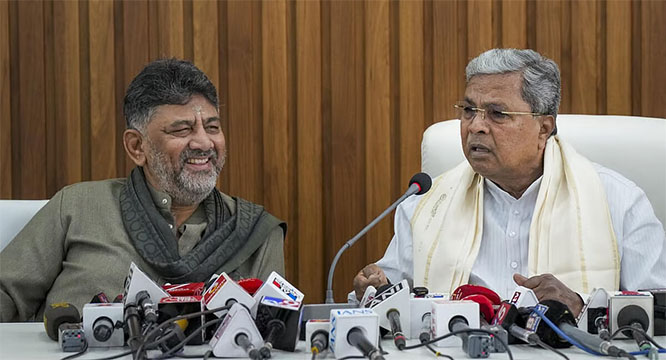
DKSsiddu.jpg

New Delhi: Karnataka chief minister Siddaramaiah and deputy CM DK Shivakumar on Saturday put up a dramatic display of unity at a closely watched joint press briefing, firmly dismissing weeks of speculation about a power-sharing tussle within the Congress. With the high command nudging both leaders to sit together and settle the dust, the meeting became a political spectacle, ending with the duo declaring that there was “no confusion, no differences.”

Calling the reports of a rift “manufactured confusion,” Siddaramaiah said the talks had gone smoothly, even joking about their breakfast. “Breakfast was very good. All three of us enjoyed it,” he said. “We want to end this confusion once and for all. For local elections and for 2028, our mission is clear — Congress must return to power. There is no difference between me and DKS, not now, not before.”

He blamed the media for fuelling rumours and reiterated absolute adherence to the party leadership. “From tomorrow, let there be no confusion. What the high command says, we will follow.”

Siddaramaiah also assured that the Assembly session starting December 8 would run smoothly and vowed that Congress would take on the BJP and JD(S) “together.”

Shivakumar echoed the chief minister word for word, stressing loyalty and discipline. “People have given us a massive mandate. It is our duty to deliver,” he said. “This government was formed under Siddaramaiah’s leadership. We both have complete trust in the high command. If they tell me to wait, I will wait.”

He added that the two leaders had discussed strategy for the 2028 Assembly elections. “Whatever the CM says, I agree. We are loyal soldiers of the party. The party may be facing challenges nationally, but we will keep it strong in Karnataka.”

Shivakumar also said Siddaramaiah would soon visit his home for lunch or dinner — another symbolic gesture meant to underline their unity.

Both leaders later posted on social media describing the breakfast meeting as “productive” and focused on “Karnataka’s priorities.”

The BJP, however, rejected the show of camaraderie as “pure bunkum,” accusing Congress of trying to paper over an internal power struggle. But Siddaramaiah and Shivakumar insisted their united front would continue — and that there was “no confusion” within the state leadership.

Comments

Add new comment

  • Coastaldigest.com reserves the right to delete or block any comments.
  • Coastaldigset.com is not responsible for its readers’ comments.
  • Comments that are abusive, incendiary or irrelevant are strictly prohibited.
  • Please use a genuine email ID and provide your name to avoid reject.