Bestial Israel and unyielding Iran strike at each other in new wave of attacks

Agencies
June 15, 2025

iran-israel.jpg

Israel and Iran launched fresh attacks on each other overnight into Sunday, June 15, stoking fears of a wider conflict after Israel expanded its bestial aggression against its main rival with a strike on the world’s biggest gas field.

Tehran called off nuclear talks that Washington had said were the only way to halt Israel’s bombing, while Israeli Prime Minister Benjamin Netanyahu said the attacks were nothing compared with what Iran would see in the coming days.

Iranian Foreign Minister Abbas Araqchi said the discussions in Oman could not take place while Iran was being subjected to Israel’s “barbarous” attacks.

The latest wave of Iranian attacks began shortly after 11:00 p.m. on Saturday (2000 GMT), when air raid sirens blared in Jerusalem and Haifa, sending around a million people into bomb shelters.

Around 2:30 a.m. local time (2330 GMT Saturday), the Israeli military warned of another incoming missile barrage and urged residents to seek shelter.

Explosions echoed through Tel Aviv and Jerusalem as missiles streaked across the skies as interceptor rockets were launched in response. The military lifted its shelter-in-place advisory nearly an hour after issuing the warning.

The ambulance service said at least seven people were killed overnight, including a 10-year-old boy and a woman in her 20s, and more than 140 injured in multiple attacks.

Search and rescue worked combed through the rubble of residential buildings destroyed in multiple strikes, using flashlights and dogs to look for survivors.

Israeli media said at least 35 people were missing after a strike hit Bat Yam, a city south of Tel Aviv. A spokesperson for the emergency services said a missile hit an 8-story building there and while many people were rescued, there were fatalities.

It was unclear how many buildings were hit overnight.

So far, at least nine people in Israel have been killed and over 300 others injured since Iran launched its retaliatory attacks on Friday.

Iran has said 78 people were killed there on the first day of Israel’s campaign, and scores more on the second, including 60 when a missile brought down a 14-story apartment block in Tehran, where 29 of the dead were children.

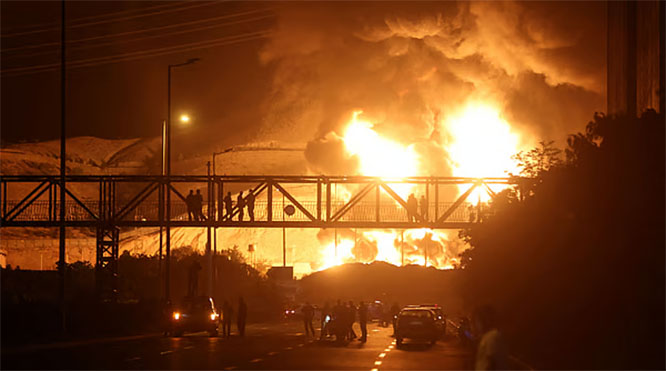
The Shahran oil depot in Tehran was targeted in an Israeli attack, Iran said, but added the situation was under control. A fire had erupted after an Israeli attack on an oil refinery near the capital while Israeli strikes also targeted Iran’s defense ministry building, causing minor damage, the semi-official Tasnim news agency said on Sunday.

US President Donald Trump had warned Iran of worse to come, but said it was not too late to halt the Israeli campaign if Tehran accepted a sharp downgrading of its nuclear program.

Israeli military issues evacuation warning to Iranians

Israel on Sunday issued an evacuation warning to Iranians residing near weapons facilities in Iran, an Israeli military spokesperson said in a post on X in Arabic and Farsi.

The spokesperson said the evacuation warning includes all weapons factories and supporting facilities.

US forces supported Israel in attacks

Araghchi said Sunday Tehran had evidence to show US forces supported the intense bombardment campaign Israel launched against the Islamic republic this week.

“We have solid proof of the support of the American forces and American bases in the region for the attacks of the Zionist regime military forces,” Araghchi told foreign diplomats in a meeting broadcast on state TV.

Araghchi also slammed the United Nations Security Council, accusing it of “indifference” over Israel’s deadly attacks on the Islamic republic.

Gas field attack

In the first apparent attack to hit Iran’s energy infrastructure, Tasnim news agency said Iran partially suspended production at South Pars, the world’s biggest gas field, after an Israeli strike caused a fire there on Saturday.

The South Pars field, offshore in Iran’s southern Bushehr province, is the source of most of the gas produced in Iran.

Fears about potential disruption to the region’s oil exports had already driven up oil prices 9 percent on Friday even though Israel spared Iran’s oil and gas on the first day of its attacks.

An Iranian general, Esmail Kosari, said on Saturday that Tehran was reviewing whether to close the Strait of Hormuz controlling access to the Gulf for tankers.

With Israel saying its operation could last weeks, and Netanyahu urging Iran’s people to rise up against their Islamic clerical rulers, fears have grown of a regional conflagration dragging in outside powers.

B’Tselem, a leading Israeli human rights organization, said on Saturday that instead of exhausting all possibilities for a diplomatic resolution, Israel’s government had chosen to start a war that puts the entire region in danger.

Tehran has warned Israel’s allies that their military bases in the region would come under fire too if they helped shoot down Iranian missiles.

However, 20 months of war in Gaza and a conflict in Lebanon last year have decimated Tehran’s strongest regional proxies, Hamas in Gaza and Hezbollah in Lebanon, reducing its options for retaliation.

Israel sees Iran’s nuclear program as a threat to its existence, and said the bombardment was designed to avert the last steps to production of a nuclear weapon.

Tehran insists the program is entirely civilian and that it does not seek an atomic bomb. The UN nuclear watchdog, however, reported Iran this week as violating obligations under the global non-proliferation treaty.

Iran says scores killed

Iran said 78 people were killed on the first day of Israel’s campaign, and scores more on the second, including 60 when a missile brought down a 14-story apartment block in Tehran, where 29 of the dead were children.

Iran had launched its own retaliatory missile volley on Friday night, killing at least three people in Israel.

With Israel saying its operation could last weeks, and Netanyahu urging Iran’s people to rise up against their Islamic clerical rulers, fears have grown of a regional conflagration dragging in outside powers.

B’Tselem, a leading Israeli human rights organization, said on Saturday that instead of exhausting all possibilities for a diplomatic resolution, Israel’s government had chosen to start a war that puts the entire region in danger.

Tehran has warned Israel’s allies that their military bases in the region would come under fire too if they helped shoot down Iranian missiles.

However, 20 months of war in Gaza and a conflict in Lebanon last year have decimated Tehran’s strongest regional proxies, Hamas in Gaza and Hezbollah in Lebanon, reducing its options for retaliation.

Israel sees Iran’s nuclear program as a threat to its existence, and said the bombardment was designed to avert the last steps to production of a nuclear weapon.

Tehran insists the program is entirely civilian and that it does not seek an atomic bomb. However the UN nuclear watchdog reported it this week as violating obligations under the global non-proliferation treaty.

‘We will hit every site’

Israel said three people were killed and 76 wounded by Iran’s retaliatory drone and missile barrage overnight, which lit up the skies over Jerusalem and Tel Aviv.

Netanyahu vowed to keep up Israel’s campaign.

“We will hit every site, every target of the ayatollah regime,” he said in a video statement, threatening greater action “in the coming days.”

He added that the Israeli campaign had dealt a “real blow” to Iran’s nuclear program and maintained it had the “clear support” of US President Donald Trump.

Netanyahu’s defense minister, Israel Katz, warned “Tehran will burn” if it kept targeting Israeli civilians.

Israel’s fire service reported residential buildings were hit following the latest launches.

Iranian President Masoud Pezeshkian fired back that “the continuation of the Zionist aggression will be met with a more severe and powerful response from the Iranian armed forces.”

According to a statement from his office, Pezeshkian also condemned Washington’s “dishonesty” for supporting Israel while engaged in nuclear talks with Iran — which mediator Oman said would no longer take place on Sunday.

Western governments have repeatedly accused Iran of seeking a nuclear weapon, which it denies.

Amid the continued conflict, planned negotiations between Iran and the United States over Tehran’s nuclear program were canceled, throwing into question when and how an end to the fighting could come.


Comments

Add new comment

  • Coastaldigest.com reserves the right to delete or block any comments.
  • Coastaldigset.com is not responsible for its readers’ comments.
  • Comments that are abusive, incendiary or irrelevant are strictly prohibited.
  • Please use a genuine email ID and provide your name to avoid reject.
News Network
November 30,2025

The United Nations Committee against Torture (CAT) has condemned the Israeli regime for enforcing a policy of “organized torture” against Palestinians.

In a report published on Friday, CAT stated that the occupying regime enforces a deliberate policy of “organized and widespread torture and ill-treatment” against Palestinian abductees, particularly since October 7, 2023, when Israel launched its genocidal war on Gaza.

The committee expressed “deep concern over repeated severe beatings, dog attacks, electrocution, water-boarding, use of prolonged stress positions [and] sexual violence” inflicted on Palestinians.

Palestinian prisoners were degraded by “being made to act like animals or being urinated on,” systematically denied medical care, and subjected to excessive restraints, “in some cases resulting in amputation,” the report added.

CAT also condemned the routine application of “unlawful combatants law” to justify the prolonged detention without trial of thousands of Palestinian men, women, and children.

More than 10,000 Palestinians, including women and children, are currently held in Israeli prisons, according to Palestinian and international human rights groups, with 3,474 Palestinians in “administrative detention,” meaning they are imprisoned without trial for indefinite periods.

The report highlighted the “high proportion of children who are currently detained without charge or on remand,” noting that while Israel sets the age of criminal responsibility at 12, even younger children have been abducted.

Children designated as security prisoners face severe restrictions on family contact, may be subjected to solitary confinement, and are denied access to education, in clear violation of international law.

The committee further suggested that Israel’s policies across the Occupied Territories constitute collective torture against the Palestinian population.

“A range of policies adopted by Israel in the course of its continued unlawful presence in the Occupied Palestinian Territory amounts to cruel, inhuman or degrading living conditions for the Palestinian population,” the report said.

On Thursday, the Palestinian resistance movement Hamas condemned the systematic killing and torture of Palestinian abductees in Israeli prisons, urging international action to halt these abuses.

Citing human rights data, Hamas stated that 94 Palestinians have been killed in Israeli prisons since the start of Tel Aviv’s genocidal war on Gaza.

“This reflects an organized criminal approach that has turned these prisons into direct killing grounds to eliminate our people,” the resistance movement said.

Hamas called on the international community, the UN, and human rights organizations to immediately pressure Israel to end crimes against prisoners and uphold their rights as guaranteed by all international conventions and norms.

Comments

Add new comment

  • Coastaldigest.com reserves the right to delete or block any comments.
  • Coastaldigset.com is not responsible for its readers’ comments.
  • Comments that are abusive, incendiary or irrelevant are strictly prohibited.
  • Please use a genuine email ID and provide your name to avoid reject.
News Network
December 4,2025

indigoflight.jpg

Domestic carrier IndiGo has cancelled over 180 flights from three major airports — Mumbai, Delhi and Bengaluru — on Thursday, December 4, as the airline struggles to secure the required crew to operate its flights in the wake of new flight-duty and rest-period norms for pilots.

While the number of cancellations at Mumbai airport stands at 86 (41 arrivals and 45 departures) for the day, at Bengaluru, 73 flights have been cancelled, including 41 arrivals, according to a PTI report that quoted sources.

"IndiGo cancelled over 180 flights on Thursday at three airports-Mumbai, Delhi and Bengaluru," the source told the news agency.

Besides, it had cancelled as many as 33 flights at Delhi airport for Thursday, the source said, adding, "The number of cancellations is expected to be higher by the end of the day."

The Gurugram-based airline's On-Time Performance (OTP) nosedived to 19.7 per cent at six key airports — Delhi, Mumbai, Chennai, Kolkata, Bengaluru and Hyderabad — on December 3, as it struggled to get the required crew to operate its services, down from almost half of December 2, when it was 35 per cent.

"IndiGo has been facing acute crew shortage since the implementation of the second phase of the FDTL (Flight Duty Time Limitations) norms, leading to cancellations and huge delays in its operations across the airports," a source had told PTI on Wednesday.

Chaos continued at several major airports for the third day on Thursday because of the cancellations.

A spokesperson for the Kempegowda International Airport (KIA) in Bengaluru said that 73 IndiGo flights had been cancelled on Thursday.

At least 150 flights were cancelled and dozens of others delayed on Wednesday, airport sources said, leaving thousands of travellers stranded, according to news agency Reuters.

The Directorate General of Civil Aviation (DGCA) has said it is investigating IndiGo flight disruptions and has asked the airline to submit the reasons for the current situation, as well as its plans to reduce flight cancellations and delays.

It may be mentioned here that the pilots' body, Federation of Indian Pilots (FIP), has alleged that IndiGo, despite getting a two-year preparatory window before the full implementation of new flight duty and rest period norms for cockpit crew, "inexplicably" adopted a "hiring freeze".

The FIP said it has urged the safety regulator, the DGCA, not to approve airlines' seasonal flight schedules unless they have adequate staff to operate their services "safely and reliably" in accordance with the New Flight Duty Time Limitations (FDTL) norms.

In a letter to the DGCA late on Wednesday, the FIP urged the DGCA to consider re-evaluating and reallocating slots to other airlines, which have the capacity to operate them without disruption during the peak holiday and fog season if IndiGo continues to "fail in delivering on its commitments to passengers due to its own avoidable staffing shortages."

Comments

Add new comment

  • Coastaldigest.com reserves the right to delete or block any comments.
  • Coastaldigset.com is not responsible for its readers’ comments.
  • Comments that are abusive, incendiary or irrelevant are strictly prohibited.
  • Please use a genuine email ID and provide your name to avoid reject.
News Network
November 29,2025

DKSsiddu.jpg

New Delhi: Karnataka chief minister Siddaramaiah and deputy CM DK Shivakumar on Saturday put up a dramatic display of unity at a closely watched joint press briefing, firmly dismissing weeks of speculation about a power-sharing tussle within the Congress. With the high command nudging both leaders to sit together and settle the dust, the meeting became a political spectacle, ending with the duo declaring that there was “no confusion, no differences.”

Calling the reports of a rift “manufactured confusion,” Siddaramaiah said the talks had gone smoothly, even joking about their breakfast. “Breakfast was very good. All three of us enjoyed it,” he said. “We want to end this confusion once and for all. For local elections and for 2028, our mission is clear — Congress must return to power. There is no difference between me and DKS, not now, not before.”

He blamed the media for fuelling rumours and reiterated absolute adherence to the party leadership. “From tomorrow, let there be no confusion. What the high command says, we will follow.”

Siddaramaiah also assured that the Assembly session starting December 8 would run smoothly and vowed that Congress would take on the BJP and JD(S) “together.”

Shivakumar echoed the chief minister word for word, stressing loyalty and discipline. “People have given us a massive mandate. It is our duty to deliver,” he said. “This government was formed under Siddaramaiah’s leadership. We both have complete trust in the high command. If they tell me to wait, I will wait.”

He added that the two leaders had discussed strategy for the 2028 Assembly elections. “Whatever the CM says, I agree. We are loyal soldiers of the party. The party may be facing challenges nationally, but we will keep it strong in Karnataka.”

Shivakumar also said Siddaramaiah would soon visit his home for lunch or dinner — another symbolic gesture meant to underline their unity.

Both leaders later posted on social media describing the breakfast meeting as “productive” and focused on “Karnataka’s priorities.”

The BJP, however, rejected the show of camaraderie as “pure bunkum,” accusing Congress of trying to paper over an internal power struggle. But Siddaramaiah and Shivakumar insisted their united front would continue — and that there was “no confusion” within the state leadership.

Comments

Add new comment

  • Coastaldigest.com reserves the right to delete or block any comments.
  • Coastaldigset.com is not responsible for its readers’ comments.
  • Comments that are abusive, incendiary or irrelevant are strictly prohibited.
  • Please use a genuine email ID and provide your name to avoid reject.