



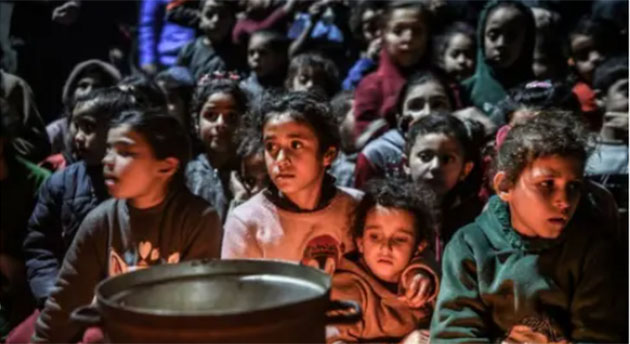
Gaza children, who survived off animal feed, going without food for days as inhuman Israel blocks aid convoys

News Network
February 10, 2024

gaza.jpg

People living in the isolated north of Gaza have revealed that children are going without food for days, as aid convoys are increasingly denied permits to enter thanks to Israeli army’s inhuman blockade. Some residents have resorted to grinding animal feed into flour to survive, but even stocks of those grains are now dwindling, they say.

People have also described digging down into the soil to access water pipes, for drinking and washing.

The UN has warned that acute malnutrition among young children in the north has risen sharply, and is now above the critical threshold of 15%.

The UN's humanitarian coordination agency, Ocha, says more than half the aid missions to the north of Gaza were denied access last month, and that there is increasing interference from Israeli forces in how and where aid is delivered.

It says 300,000 people estimated to be living in northern areas are largely cut off from assistance, and face a growing risk of famine.

A spokesman for the Israeli military agency tasked with coordinating aid access in Gaza said in a briefing last month that there was "no starvation in Gaza. Period." The agency, Cogat, has repeatedly said it does not limit the amount of humanitarian aid sent to Gaza.

The BBC spoke to three people living in Gaza City and Beit Lahia, and viewed footage and interviews filmed by local journalists in Jabalia.

Mahmoud Shalabi, a local medical aid worker in Beit Lahia, said people had been grinding grains used for animal feed into flour, but that even that was now running out.

"People are not finding it in the market," he said. "It's unavailable nowadays in the north of Gaza, and Gaza City."

He also said stocks of tinned food were disappearing.

"What we had was actually from the six or seven days of truce [in November], and whatever aid was allowed into the north of Gaza has actually been consumed by now. What people are eating right now is basically rice, and only rice."

The World Food Programme (WFP) told the BBC this week that four out of the last five aid convoys into the north had been stopped by Israeli forces, meaning a gap of two weeks between deliveries to Gaza City.

'Serious risk of famine'

"We know there is a very serious risk of famine in Gaza if we don't provide very significant volumes of food assistance on a regular basis," said the WFP regional chief, Matt Hollingworth.

The UN Office for the Coordination of Humanitarian Affairs (Ocha) said there had been a sharp increase in the number of aid missions denied access to northern Gaza: with 56% of deliveries denied access in January, up from 14% in October to December.

It also said the Israeli military "at times required justifications" for quantities of fuel destined for health facilities, and "imposed reductions on the volume of assistance, such as the quantity of food".

A famine risk assessment, carried out by several UN agencies, estimated that almost a third of residents in northern areas could now be facing a "catastrophic" lack of food, though restrictions on accessing the area make real-time measurements very difficult.

Families in northern areas are also struggling to find reliable water supplies.

"Many of us are now drinking unpotable water. There are no pipes; we have to dig for water," explained Mahmoud Salah in Beit Lahia.

Video filmed in the Jabalia neighbourhood north of Gaza City shows residents sitting among the rubble of bombed out streets, digging down into the earth to tap large underground water pipes.

"We get water here once every 15 days," Yusuf al-Ayoti said. "The water is dirty. Our children are inflamed and their teeth are eroded from the dirty water. There is sand in it, and it's very salty."

After four months of war, the makeshift solutions for bridging the hunger gaps are wearing thin. And there are few ways to restock Gaza's larder.

The territory was reliant on food aid before the war; now much of its agricultural industry has been ruined or abandoned.

Comments

Add new comment

  • Coastaldigest.com reserves the right to delete or block any comments.
  • Coastaldigset.com is not responsible for its readers’ comments.
  • Comments that are abusive, incendiary or irrelevant are strictly prohibited.
  • Please use a genuine email ID and provide your name to avoid reject.
News Network
November 26,2025

Mangaluru, Nov 26: Assembly Speaker and local MLA U.T. Khader has initiated a high-level push to resolve one of Mangaluru’s longest-standing traffic headaches: the narrow, high-density stretch of National Highway-66 between Nanthoor and Talapady.

He announced on Tuesday that a formal proposal has been submitted to the Union Ministry of Road Transport and Highways (MoRTH) seeking approval to prepare a Detailed Project Report (DPR) for the widening of this crucial corridor.

The plan specifically aims to expand the existing 45-meter road width to a full 60 meters, coupled with the construction of dedicated service roads. Khader highlighted that land for a 60-meter highway was originally acquired during the initial four-laning project, but only 45 meters were developed, leading to a perpetual bottleneck.

"With vehicle density rising sharply, the expansion has become unavoidable," Khader stated, stressing that the upgrade is essential for ensuring smoother traffic flow and improving safety at the city's main entry and exit points.

The stretch between Nanthoor and Talapady is a vital link on the busy Kochi-Panvel coastal highway and connects to major city junctions. The move to utilize the previously acquired land for the full 60-meter width is seen as a necessary measure to catch up with the region's rapid vehicular growth and prevent further traffic gridlocks.

Comments

Add new comment

  • Coastaldigest.com reserves the right to delete or block any comments.
  • Coastaldigset.com is not responsible for its readers’ comments.
  • Comments that are abusive, incendiary or irrelevant are strictly prohibited.
  • Please use a genuine email ID and provide your name to avoid reject.
News Network
November 22,2025

gaza.jpg

The Israeli regime’s forces have killed two Palestinian children in the Gaza Strip every day since the ceasefire began in early October, UNICEF has warned.

The UN children’s agency said on Friday that Israeli forces continue to attack Palestinians in Gaza even though the agreement was meant to stop the killing.

“Since 11 October, while the ceasefire has been in effect, at least 67 children have been killed in conflict-related incidents in the Gaza Strip. Dozens more have been injured. That is an average of almost two children killed every day since the ceasefire took effect,” UNICEF spokesperson Ricardo Pires said in Geneva, reminding that each number in the statistics represents a child whose life had ended violently.

“These are not statistics,” he said. “Each child had a story, a family, and a future that was stolen from them.”

Data from Palestinian factions, human rights groups, and government bodies recorded since the US-brokered ceasefire deal went into effect on October 10 show that Israeli forces have carried out numerous attacks, each constituting a separate ceasefire violation.

UNICEF teams say they repeatedly continue to witness heart-wrenching scenes of fearful Palestinian children sleeping outdoors with amputated limbs, while others live as orphans in flooded, makeshift shelters.

“I saw this myself in August. There is no safe place for them. The world cannot normalize their suffering,” Pires said, lamenting that the UN could “do a lot more if the aid that is really needed was entering faster.”

The UNICEF spokesperson warned that with the advent of winter, the risks for hundreds of thousands of displaced children will increase.

He warned, “The stakes are incredibly high” for children as winter acts as a threat multiplier, where children have no heating, no insulation, and few blankets. He said respiratory infections rise.

“Too many children have already paid the highest price,” Pires said. “Too many are still paying it, even under a ceasefire. The world promised them it would stop and that we would protect them.”

“Now we must act like it,” the UNICEF spokesperson added.

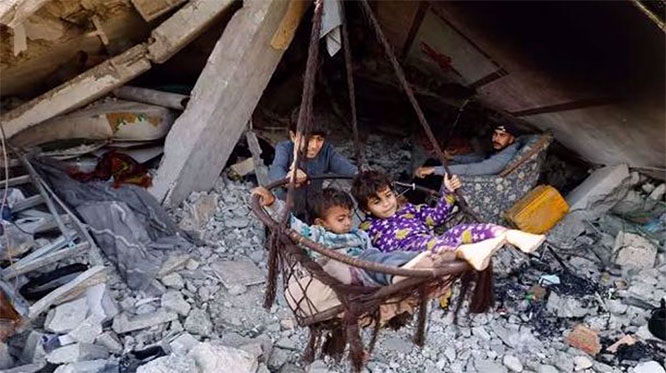
Since the Israeli regime launched its genocidal war against Palestinians in Gaza in October 2023, it has killed nearly 70,000 people in the territory, most of them women and children, and injured over 170,000 more, while reducing most of the structures in the enclave to rubble.

Comments

Add new comment

  • Coastaldigest.com reserves the right to delete or block any comments.
  • Coastaldigset.com is not responsible for its readers’ comments.
  • Comments that are abusive, incendiary or irrelevant are strictly prohibited.
  • Please use a genuine email ID and provide your name to avoid reject.
News Network
December 2,2025

A major upgrade in safety and monitoring is planned for Haj 2026, with every Indian pilgrim set to receive a Haj Suvidha smart wristband linked to the official Haj Suvidha mobile app. The initiative aims to support pilgrims—especially senior citizens—who may struggle with smartphones during the 45-day journey.

What the Smart Wristband Will Do

Officials said the device will come with:
•    Location tracking
•    Pedometer
•    SOS emergency button
•    Qibla compass
•    Prayer timings
•    Basic health monitoring

SP Tiwari, secretary of the UP State Haj Committee, said the goal is to make the pilgrimage safer and more comfortable.

“Most Hajis are elderly and not comfortable with mobile apps,” he said. “The smartwatch will help locate pilgrims who forget their way or cannot communicate their location.”

The wristbands will be monitored by the Consulate General of India in Saudi Arabia, similar to mobile tracking via the Haj Suvidha App.

Free Distribution and Training

•    Smart wristbands will be given free of cost.
•    Training for pilgrims will be conducted between January and February 2026.
•    Sample units will reach state Haj committees soon.
•    Final devices will be distributed as pilgrims begin their journey.

New Rules for Accommodation

Two major decisions have also been finalised for Haj 2026:
1.    Separate rooms for men and women – including married couples. They may stay on the same floor but must occupy different rooms, following stricter Saudi guidelines.
2.    Cooking banned – gas cylinders will not be allowed; all meals will be provided through official catering services arranged by the Haj Committee of India.

These decisions were finalised during a meeting of the Haj Committee of India and state representatives in Mumbai.

Haj Suvidha App Launched Earlier

The government launched the Haj Suvidha App in 2024, offering:

•    Training modules
•    Accommodation and flight details
•    Baggage information
•    SOS and translation tools
•    Grievance redressal

Haj 2026 Quota and Key States

•    India’s total Haj quota for 2026: 1,75,025 pilgrims
•    70% (1,25,000) allotted to the Haj Committee of India
•    30% (around 50,000) reserved for Haj Group Organisers

Uttar Pradesh has the largest allocation (around 30,000 seats), though approximately 18,000 pilgrims are expected to go this year. States with high pilgrim numbers include Kerala, Maharashtra and Gujarat.

Dates of Haj 2026

The pilgrimage is scheduled to take place from 24 May to 29 May, 2026 (tentative).
Haj is one of the five pillars of Islam and is mandatory for Muslims who meet the required conditions.

Comments

Add new comment

  • Coastaldigest.com reserves the right to delete or block any comments.
  • Coastaldigset.com is not responsible for its readers’ comments.
  • Comments that are abusive, incendiary or irrelevant are strictly prohibited.
  • Please use a genuine email ID and provide your name to avoid reject.