Gaza doctors refuse to abandon patients as ruthless Israel bombs overcrowded hospitals

News Network
October 27, 2023

childdeaths.jpg

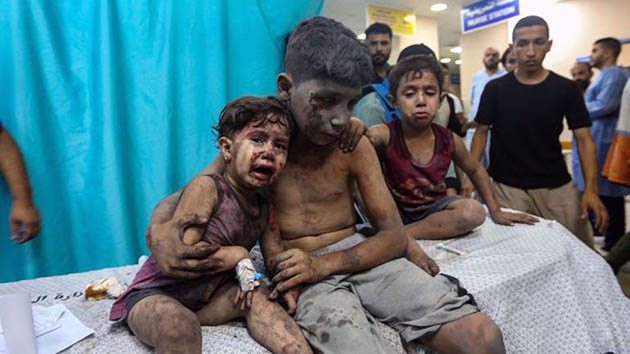
Doctors in northern Gaza are sounding the alarm about a humanitarian "catastrophe" as Israel continues its ferocious bombardment of the besieged Palestinian coastal territory for a third week, media reports say.

As Israel prepares for its planned ground invasion of Gaza, it has warned residents in the north to flee south to avoid being targeted. That includes hospitals.

But health officials at Gaza's biggest hospitals have insisted the evacuation of the wounded and displaced would be impossible.

In Gaza's biggest hospital, al-Shifa, doctors are faced with a massive influx of casualties, added to the thousands of displaced civilians taking shelter there.

Bassel Amr, a volunteer ICU physician, said that the number of the wounded brought in all at once is bigger than the hospital’s capacity.

"We have 17 operation rooms that are prepared at the same time during massacres and ready to be used. But that is not enough. Most of the wounded need operations," he was quoted by the Middle East Eye as saying.  

"But we only have the capacity to deal with 17 people at a time, while the rest wait for their turn, and some die in front of your eyes and you cannot help them because the operation rooms are full," he added.

"The wounded keep dying in front of your eyes but there’s nothing we can do."

The most traumatizing situation faced by doctors is the fact that they have to prioritize some cases over others.

"We are left in a situation where we have to make the difficult decision to risk the life of one patient in order to save the life of another,"  Amr noted

Amr also pointed out that the hospital has no space for post-operative care, and many patients have to sleep in the intensive care units, which he says hinders the work of doctors. This forces doctors to treat patients on the floor.

"The hospital won't be able to deal with any other crisis in the coming days as its equipment and necessary tools are already running out," he warned.

Gaza hospitals are dangerously overcrowded

As almost 1.4 million people in Gaza are now internally displaced, thousands have taken shelter in hospitals.

Al-Shifa Hospital alone is now home to 62,000 displaced people and viruses are spreading rapidly. This compounds the lack of sterilization in the hospital for patients, which makes them vulnerable to infections.

Amr added that the type of wounds received by his hospital, mainly scarring and disfigurations, indicates another health crisis after the end of hostilities.

"Many of the wounded will live but will have to be on medication for a long time to manage the pain, which may lead to addiction. Others will live with disabilities."

In addition, international organizations have warned about the spread of water-borne diseases and scabies because of a lack of clean water in the besieged territory.

Al-Aqsa Martyrs Hospital operating in a state of panic

Meanwhile, at Al-Aqsa Martyrs Hospital in central Gaza, the obstetrics department has been converted from delivery rooms and clinics into operating rooms for treating the wounded.

One doctor working in the obstetrics and neonatology department said that the hospital staff is operating "in a state of panic, fear and shock" as Israel has warned them to flee and already bombed a building adjacent to the hospital.

"One night, I was working in my department caring for sick newborns when the Israeli occupation shelled a house next to the hospital. My colleagues and I tried to secure the children," the doctor said.

Many Gaza hospitals remain out of service

On Wednesday, the United Nations Office for the Coordination of Humanitarian Affairs (OCHA) said that at least 12 out of the 35 hospitals in Gaza are now out of service because of damage from Israeli bombardment.

OCHA added that 46 out of 72 healthcare clinics have also shut down, leaving thousands of people without any form of medical aid.

The remaining clinics and hospitals are running on generators and have few resources to treat patients who have been critically wounded or are in intensive care.

Fuel to run out completely

Since Israel cut off all electricity, fuel and water to Gaza on 9 October, hospitals have been overwhelmed, with a lack of life-saving resources and a high volume of critically wounded patients.

Patients who have been wounded in air strikes, pregnant women, children and people with kidney failure are some of the worst affected. The hospitals that are still working are running on generators, which health officials say won't last long.

They say this will lead to the instant death of thousands of people, including newborn babies in incubators, wounded people in intensive care units, and kidney dialysis

This comes as doctors and health officials have been warning for days that fuel is set to run out completely by Thursday.

No shrouds for burial

Hussam al-Madhoun, another doctor, highlighted a similar situation at al-Awda hospital in northern Gaza. He said the hospital "has no space to walk" as thousands of civilians have also taken refuge there from the Israeli bombing.

Similar to al-Shifa, al-Awda doesn't have enough room for casualties and is suffering a severe shortage of supplies.

“In the beginning, there was a scarcity of medical supplies, now there is a scarcity of available beds at the intensive care unit, and of oxygen, medical and sterilization materials," al-Madhoun said.

He added that Gaza is now suffering from a shortage of shrouds. "There is nothing worse than not finding enough shrouds to cover the martyrs, so you wrap them with garbage bags and old pieces of cloth."

UNRWA facing a critical 24 hours to secure fuel 

The UN agency for Palestinian refugees faces a critical 24 hours to secure fuel or be forced to close shelters providing crucial aid to hundreds of thousands of people displaced in Gaza.

UNRWA is providing shelter and assistance to 600,000 people at its 150 facilities in the Gaza Strip, where Israeli air strikes have displaced about one million people.

“The coming 24 hours are very critical and we have to make some really tough decisions,” UNRWA spokeswoman Juliette Touma said on Wednesday.

“If we don’t have fuel we will not be able to drive our cars and deliver the assistance nor are we able to drive our trucks to the borders to pick up what very little is coming on the convoys,” she said.

The agency needs fuel to run water facilities and deliver flour to bakeries amid shortages of food and water. It may also be forced to close health clinics, which are running on electric generators.

Earlier on Wednesday, the agency said its shelters are "four times over their capacities – many people are sleeping in the streets as current facilities are overwhelmed".

UNRWA has 13,000 staff in Gaza, with 125 health staff working in rotating shifts at health centers. So far, 29 have been killed by Israeli airstrikes.

On Sunday, Philippe Lazzarini, the agency's commissioner general, said that "without fuel, we will fail the people of Gaza whose needs are growing by the hour, under our watch. This cannot and should not happen”.

"No fuel will further strangle the children, women and people of Gaza," he said.

UN says ‘nowhere is safe in Gaza’

Lynn Hastings, the UN’s Humanitarian Coordinator in Palestine, has said  Israel’s system of notifying Gaza residents before airstrikes make “no difference”.

“For people who can’t evacuate – because they have nowhere to go or are unable to move – advance warnings make no difference.”

“When the evacuation routes are bombed, when people north as well as south are caught up in hostilities, when the essentials for survival are lacking, and when there are no assurances for return, people are left with nothing but impossible choices. Nowhere is safe in Gaza,” she added.

Israel has frequently demanded the eviction of Palestinians from the north of Gaza to the south but also continues to bomb the southern half of the territory and has even attacked convoys of displaced people trying to comply with its orders. 

Comments

Add new comment

  • Coastaldigest.com reserves the right to delete or block any comments.
  • Coastaldigset.com is not responsible for its readers’ comments.
  • Comments that are abusive, incendiary or irrelevant are strictly prohibited.
  • Please use a genuine email ID and provide your name to avoid reject.
News Network
November 24,2025

lebanon.jpg

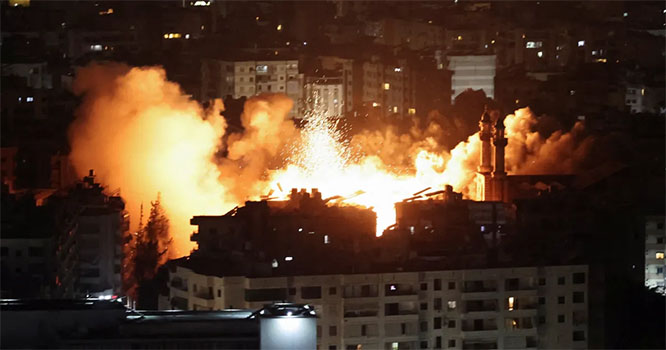
Israel has launched a new act of aggression on a residential neighborhood in Lebanon's capital, Beirut, killing and injuring about two dozen civilians.

The Israeli regime's military said in a statement that its forces carried out a so-called precise strike in a residential apartment in Dahiyeh in the southern suburbs of Beirut on Sunday.

The aggression targeted residential areas, killing at least five people and injuring more than 28 people, Lebanon's Health Ministry said. 

Hezbollah announced the martyrdom of senior Hezbollah commander Haytham Ali Tabatabai and four resistance fighters.

Lebanese President Michel Aoun condemned the airstrike, calling it a clear demonstration of Tel Aviv’s disregard for repeated international calls to halt violations on Lebanese soil.

“Israel refuses to implement international resolutions and all efforts aimed at ending the escalation and restoring stability,” Aoun said, urging the international community to take action to prevent further aggression.

The Palestinian Islamic Jihad movement also condemned the attack, holding the international community accountable. 

“The international community bears responsibility and continues to provide cover for these attacks as long as it does not restrain the occupiers,” said Ali Abu Shahin, a member of the group’s political bureau.

Israeli prime minister Benjamin Netanyahu’s office announced that the Israeli army carried out a strike “in the heart of Beirut."

Netanyahu reportedly approved the operation following recommendations from top Israeli security officials.

Two senior US officials commented on the Israeli strike.

The first official said that Israel did not notify Americans in advance about the attack. "We were informed immediately after the strike was carried out."

The second senior official said that the "US knew for several days that Israel was planning to escalate its strikes in Lebanon, but did not know in advance the timing, location, or target of the strike."

Speaking from the site of the Israeli strike, Lebanese MP Ali Ammar condemned the attack as part of a broader campaign of aggression that has targeted "all of Lebanon since the Washington-sponsored ceasefire."

He stated that "any attack on Lebanon is a violation of red lines; this aggression is part and parcel of the entity that targets Lebanon's dignity, sovereignty, and security of citizens."

Ammar went on to say the resistance is responding with "utmost wisdom, patience, and will confront the enemy at the appropriate time."

"Unfortunately, the enemy is emboldened to commit its aggression by voices within Lebanon that have turned themselves into tools that support its aggression," he added.

The Israeli attack on the southern suburbs of the Lebanese capital is the latest blatant violation of the ceasefire Israel signed with Hezbollah in November 2024, which was intended to end hostilities that had escalated into full-scale war.

An Israeli strike on the Ain al-Hilweh camp near Sidon in southern Lebanon late Tuesday killed at least 14 people. It wounded several others, including young students, according to the Lebanese health ministry.

The military claimed the attack targeted “a Hamas training compound” used to plan and carry out attacks against the regime -- a claim that has frequently been made without evidence.

Hamas rejected the allegations as “a blatant lie aimed at justifying the massacre,” stating it had “no military installations in the Palestinian camps in Lebanon” and that the targeted site was merely “an open sports field.”

According to Lebanese authorities, Israeli attacks have killed approximately 4,000 people and displaced more than 1.2 million residents across the country since October 2023.

Comments

Add new comment

  • Coastaldigest.com reserves the right to delete or block any comments.
  • Coastaldigset.com is not responsible for its readers’ comments.
  • Comments that are abusive, incendiary or irrelevant are strictly prohibited.
  • Please use a genuine email ID and provide your name to avoid reject.
News Network
December 4,2025

Mangaluru: Chaos erupted at Mangaluru International Airport (MIA) after IndiGo flight 6E 5150, bound for Mumbai, was repeatedly delayed and ultimately cancelled, leaving around 100 passengers stranded overnight. The incident highlights the ongoing country-wide operational disruptions affecting the airline, largely due to the implementation of new Flight Duty Time Limitations (FDTL) norms for crew.

The flight was initially scheduled for 9:25 PM on Tuesday but was first postponed to 11:40 PM, then midnight, before being cancelled around 3:00 AM. Passengers expressed frustration over last-minute communication and the lack of clarity, with elderly and ailing travellers particularly affected. “Though the airline arranged food, there was no proper communication, leaving us confused,” said one family member.

An IndiGo executive at MIA cited the FDTL rules, designed to prevent pilot fatigue by limiting crew working hours, as the cause of the cancellation. While alternative arrangements, including hotel stays, were offered, about 100 passengers chose to remain at the airport, creating tension. A replacement flight was arranged but also faced delays due to the same constraints, finally departing for Mumbai around 1:45 PM on Wednesday. Passengers either flew, requested refunds, or postponed their travel.

The Mangaluru delay is part of a broader crisis for IndiGo. The airline has been forced to make “calibrated schedule adjustments”—a euphemism for widespread cancellations and delays—after stricter FDTL norms came into effect on November 1.

While an IndiGo spokesperson acknowledged unavoidable flight disruptions due to technology issues, operational requirements, and the updated crew rostering rules, the DGCA has intervened, summoning senior airline officials to explain the chaos and outline corrective measures.

The ripple effect has been felt across the country, with major hubs like Bengaluru and Mumbai reporting numerous cancellations. The Mangaluru incident underscores the systemic operational strain currently confronting India’s largest carrier, leaving passengers nationwide grappling with uncertainty and delays.

Comments

Add new comment

  • Coastaldigest.com reserves the right to delete or block any comments.
  • Coastaldigset.com is not responsible for its readers’ comments.
  • Comments that are abusive, incendiary or irrelevant are strictly prohibited.
  • Please use a genuine email ID and provide your name to avoid reject.
News Network
December 3,2025

indigo.jpg

IndiGo, India’s largest airline, is battling one of its worst operational disruptions in recent years, with hundreds of delays and cancellations throwing domestic travel into chaos.

Government data on Tuesday showed its on-time performance plunging to 35%, an unusual dip for a carrier long associated with punctuality.

By Wednesday afternoon, airports in Delhi, Mumbai, Bengaluru and Hyderabad had collectively reported close to 200 cancellations, stranding travellers across the country.

Crew Shortage After New Duty Norms

A major trigger behind the meltdown is a severe crew shortage, especially among pilots, following the rollout of revised Flight Duty Time Limitation (FDTL) norms last month.

The rules mandate longer rest hours and more humane rosters — a shift IndiGo has struggled to incorporate across its vast network.

Sources said several flights were grounded due to lack of cabin crew, while some delays stretched upwards of eight hours.

With IndiGo controlling over 60% of India’s domestic aviation market, the ripple effect has impacted airports nationwide.

IndiGo Issues Apology, Lists “Compounding Factors”

In a statement, IndiGo acknowledged the large-scale disruption:

“We sincerely apologise to customers. A series of unforeseen operational challenges — technology glitches, winter schedule changes, adverse weather, system congestion and updated FDTL norms — created a compounding impact that could not have been anticipated.”

To stabilise operations, the airline has begun calibrated schedule adjustments for the next 48 hours, aiming to restore punctuality. Affected passengers are being offered refunds or alternate travel arrangements, IndiGo said.

What the FDTL Rules Require

The FDTL norms, designed to reduce pilot fatigue, cap duty and flying hours as follows:
•    Maximum 8 hours of flying per day
•    35 hours per week
•    125 hours per month
•    1,000 hours per year

Crew must also receive rest equalling twice the flight duration, with a minimum 10-hour rest period in any 24-hour window.

The DGCA introduced these limits to enhance flight safety.

Hyderabad: 33 Flights Cancelled, Long Queues Reported

Hyderabad’s Rajiv Gandhi International Airport saw heavy early-morning crowds as 33 IndiGo flights (arrivals and departures) were cancelled.

The airport clarified on X that operations were normal, advising passengers to contact IndiGo directly for latest flight status.

Cancellations included flights to and from Visakhapatnam, Goa, Ahmedabad, Delhi, Bengaluru, Chennai, Madurai, Hubli, Bhopal and Bhubaneswar.

Bengaluru: 42 Flights Disrupted

Bengaluru’s Kempegowda International Airport recorded 42 cancellations — 22 arrivals and 20 departures — affecting routes to Delhi, Mumbai, Chennai, Hyderabad, Goa, Kolkata and Lucknow.

Passengers Vent on Social Media

Irate travellers took to X to share their experiences. One passenger stranded in Hyderabad wrote: “I have been here since 3 a.m. and missed an important meeting.”

Another said: “My flight was pushed from 1:55 PM to 2:55 PM and now 4:35 PM. I was informed only three minutes before entering the airport.”

Delhi Airport Hit by Tech Glitch

At Delhi Airport, the disruption deepened due to a slowdown in the Amadeus system — used for reservations, check-ins and departure control.

The technical issue led to longer queues and sluggish processing, adding to delays already worsened by staff shortages.

Comments

Add new comment

  • Coastaldigest.com reserves the right to delete or block any comments.
  • Coastaldigset.com is not responsible for its readers’ comments.
  • Comments that are abusive, incendiary or irrelevant are strictly prohibited.
  • Please use a genuine email ID and provide your name to avoid reject.