Iran’s retaliation causes chaos in Israel as missile strikes hit multiple locations

Agencies
June 14, 2025

truepromise.jpg

In a fresh wave, a series of Iranian missile strikes have hit multiple locations across the occupied Palestinian territories, causing extensive damage and casualties, according to reports.

The third phase of Iran’s retaliatory military operation – True Promise III – began at around 1:30 am on Saturday, June 14, Iran time after two successful phases in which many strategic Israeli sites were targeted.

According to various Israeli media reports, in the latest wave, missiles impacted areas in Tel Aviv, occupied Jerusalem al-Quds, Lake Tiberias, Haifa, Beersheba and other places.

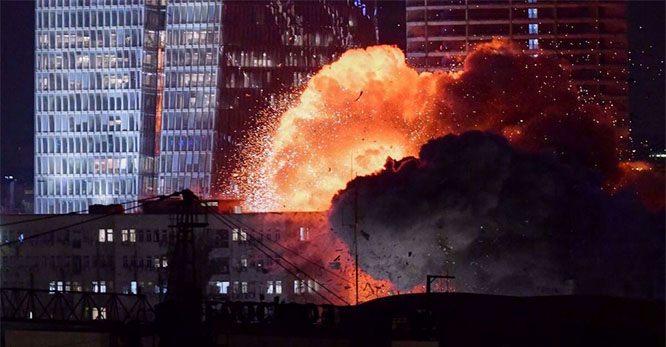
The most severe damage was reported in Tel Aviv, where at least one missile struck a 50-story building, triggering a powerful explosion that sent columns of smoke rising over the city skyline.

Israeli media reports described scenes of chaos in Tel Aviv, with emergency services responding to what officials called a "strategic" hit on a critical facility south of the city.

Due to the sensitive nature of the target, Israel's so-called Home Front Command has reportedly imposed a media blackout on certain details to avoid further embarrassment.

According to the Director of the Center for Strategic Studies and International Relations, Amir Al-Mousawi, one of the Iranian missiles hit a nuclear research center in Tel Aviv.

Some reports suggest that the Israeli military affairs ministry was also successfully targeted.

The regime has imposed censorship, ordering settlers not to publish pictures or videos of the sites targeted by Iranian missiles, according to Israeli media.

Israeli regime authorities are continuing damage assessments and rescue operations as sirens and emergency alerts remain active across the occupied territories.

Brigadier General Ahmad Vahidi, speaking to state television, said the Operation True Promise III "will continue as long as necessary," while vowing to avenge the blood of martyrs.

The Israeli military aggression early on Friday, which targeted multiple cities across Iran, including the capital Tehran, focused on high-profile assassinations.

These dastardly attacks resulted in the martyrdom of Major General Mohammad Bagheri, Chief of Staff of Iran’s Armed Forces; Major General Hossein Salami, former commander-in-chief of the Islamic Revolutionary Guard Corps (IRGC), Brigadier General Amir Ali Hajizadeh, head of the IRGC’s Aerospace Force; and Major General Gholam-Ali Rashid, commander of the Khatam al-Anbiya Central Headquarters.

The attacks also claimed the lives of veteran nuclear scientists Mohammad-Mehdi Tehranchi, Fereydoun Abbasi, and Dr. Abdol-Hamid Minoucher, along with more than 70 civilians, including children and women.

Earlier, Vahidi said at least 150 targets had been struck during the retaliatory operation against the Israeli regime, including several critically strategic military bases.

A senior advisor to the chief commander of the Islamic Revolution Guards Corps (IRGC) said the Operation True Promise III was successfully implemented by the IRGC aerospace division.

“These targets were successfully struck in multiple phases,” Brigadier General Vahidi, who served as Interior Minister in the Ebrahim Raeisi administration, stated.

The operation was launched minutes after the Leader of the Islamic Revolution, Ayatollah Seyyed Ali Khamenei, said the Iranian armed forces will act strongly and render the despicable regime helpless.

The Leader emphasized that the evil and wicked Zionist regime has made a "big mistake," the consequences of which will make it helpless.

"The great Iranian people can be assured that the Armed Forces will act powerfully in support of them and will deliver heavy blows to this regime,” Ayatollah Khamenei emphasized.


Comments

Add new comment

  • Coastaldigest.com reserves the right to delete or block any comments.
  • Coastaldigset.com is not responsible for its readers’ comments.
  • Comments that are abusive, incendiary or irrelevant are strictly prohibited.
  • Please use a genuine email ID and provide your name to avoid reject.
News Network
December 6,2025

pilot.jpg

New Delhi: IndiGo, India’s largest airline, faced major operational turbulence this week after failing to prepare for new pilot-fatigue regulations issued by the Directorate General of Civil Aviation (DGCA). The stricter rules—designed to improve flight safety—took effect in phases through 2024, with the latest implementation on November 1. IndiGo has acknowledged that inadequate roster planning led to widespread cancellations and delays.

Below are the key DGCA rules that affected IndiGo’s operations:

1. Longer Mandatory Weekly Rest

Weekly rest for pilots has been increased from 36 hours to 48 hours.

The government says the extended break is essential to curb cumulative fatigue. This rule remains in force despite the current crisis.

2. Cap on Night Landings

Pilots can now perform only two night landings per week—a steep reduction from the earlier limit of six.

Night hours, defined as midnight to early morning, are considered the least alert period for pilots.

Given the disruptions, this rule has been temporarily relaxed for IndiGo until February 10.

3. Reduced Maximum Night Flight Duty

Flight duty that stretches into the night is now capped at 10 hours.

This measure has also been kept on hold for IndiGo until February 10 to stabilize operations.

4. Weekly Rest Cannot Be Replaced With Personal Leave

Airlines can no longer count a pilot’s personal leave as part of the mandatory 48-hour rest.

Pilots say this closes a loophole that previously reduced actual rest time.

Currently, all airlines are exempt from this rule to normalise travel.

5. Mandatory Fatigue Monitoring

Airlines must submit quarterly fatigue reports along with corrective actions to DGCA.

This system aims to create a transparent fatigue-tracking framework across the industry.

The DGCA has stressed that these rules were crafted to strengthen flight safety and align India with global fatigue-management standards. The temporary relaxations are expected to remain until February 2025, giving IndiGo time to stabilise its schedules and restore normal air travel.

Comments

Add new comment

  • Coastaldigest.com reserves the right to delete or block any comments.
  • Coastaldigset.com is not responsible for its readers’ comments.
  • Comments that are abusive, incendiary or irrelevant are strictly prohibited.
  • Please use a genuine email ID and provide your name to avoid reject.
News Network
December 2,2025

Mangaluru, Dec 2: Mangaluru International Airport responded to a medical emergency late on Monday night. Air India Express flight IX 522, travelling from Riyadh to Thiruvananthapuram, was diverted to Mangaluru Airport after a passenger in his late 30s experienced a medical emergency on board.

The Airport’s Operations Control Centre received an alert regarding the passenger’s health condition. The airport activated its emergency response protocol, mobilising the airport medical team and coordinating with stakeholders including CISF, immigration, and customs. 

Upon landing, airport medical personnel attended to the passenger, assessed his condition, and arranged to shift him to a local tertiary-care hospital for further treatment. The passenger’s relatives accompanied the passenger, who incidentally received necessary medical care on board, which helped stabilise the situation.

Following the handling of the emergency, the flight departed for Thiruvananthapuram at 2:05 am on Tuesday.

"We appreciate the cooperation of all parties involved, and this incident reaffirms our ongoing commitment to prioritising passenger safety and readiness to respond to unforeseen emergencies with professionalism and care," the Airport spokesperson said. 

Comments

Add new comment

  • Coastaldigest.com reserves the right to delete or block any comments.
  • Coastaldigset.com is not responsible for its readers’ comments.
  • Comments that are abusive, incendiary or irrelevant are strictly prohibited.
  • Please use a genuine email ID and provide your name to avoid reject.
News Network
December 3,2025

indigo.jpg

IndiGo, India’s largest airline, is battling one of its worst operational disruptions in recent years, with hundreds of delays and cancellations throwing domestic travel into chaos.

Government data on Tuesday showed its on-time performance plunging to 35%, an unusual dip for a carrier long associated with punctuality.

By Wednesday afternoon, airports in Delhi, Mumbai, Bengaluru and Hyderabad had collectively reported close to 200 cancellations, stranding travellers across the country.

Crew Shortage After New Duty Norms

A major trigger behind the meltdown is a severe crew shortage, especially among pilots, following the rollout of revised Flight Duty Time Limitation (FDTL) norms last month.

The rules mandate longer rest hours and more humane rosters — a shift IndiGo has struggled to incorporate across its vast network.

Sources said several flights were grounded due to lack of cabin crew, while some delays stretched upwards of eight hours.

With IndiGo controlling over 60% of India’s domestic aviation market, the ripple effect has impacted airports nationwide.

IndiGo Issues Apology, Lists “Compounding Factors”

In a statement, IndiGo acknowledged the large-scale disruption:

“We sincerely apologise to customers. A series of unforeseen operational challenges — technology glitches, winter schedule changes, adverse weather, system congestion and updated FDTL norms — created a compounding impact that could not have been anticipated.”

To stabilise operations, the airline has begun calibrated schedule adjustments for the next 48 hours, aiming to restore punctuality. Affected passengers are being offered refunds or alternate travel arrangements, IndiGo said.

What the FDTL Rules Require

The FDTL norms, designed to reduce pilot fatigue, cap duty and flying hours as follows:
•    Maximum 8 hours of flying per day
•    35 hours per week
•    125 hours per month
•    1,000 hours per year

Crew must also receive rest equalling twice the flight duration, with a minimum 10-hour rest period in any 24-hour window.

The DGCA introduced these limits to enhance flight safety.

Hyderabad: 33 Flights Cancelled, Long Queues Reported

Hyderabad’s Rajiv Gandhi International Airport saw heavy early-morning crowds as 33 IndiGo flights (arrivals and departures) were cancelled.

The airport clarified on X that operations were normal, advising passengers to contact IndiGo directly for latest flight status.

Cancellations included flights to and from Visakhapatnam, Goa, Ahmedabad, Delhi, Bengaluru, Chennai, Madurai, Hubli, Bhopal and Bhubaneswar.

Bengaluru: 42 Flights Disrupted

Bengaluru’s Kempegowda International Airport recorded 42 cancellations — 22 arrivals and 20 departures — affecting routes to Delhi, Mumbai, Chennai, Hyderabad, Goa, Kolkata and Lucknow.

Passengers Vent on Social Media

Irate travellers took to X to share their experiences. One passenger stranded in Hyderabad wrote: “I have been here since 3 a.m. and missed an important meeting.”

Another said: “My flight was pushed from 1:55 PM to 2:55 PM and now 4:35 PM. I was informed only three minutes before entering the airport.”

Delhi Airport Hit by Tech Glitch

At Delhi Airport, the disruption deepened due to a slowdown in the Amadeus system — used for reservations, check-ins and departure control.

The technical issue led to longer queues and sluggish processing, adding to delays already worsened by staff shortages.

Comments

Add new comment

  • Coastaldigest.com reserves the right to delete or block any comments.
  • Coastaldigset.com is not responsible for its readers’ comments.
  • Comments that are abusive, incendiary or irrelevant are strictly prohibited.
  • Please use a genuine email ID and provide your name to avoid reject.