



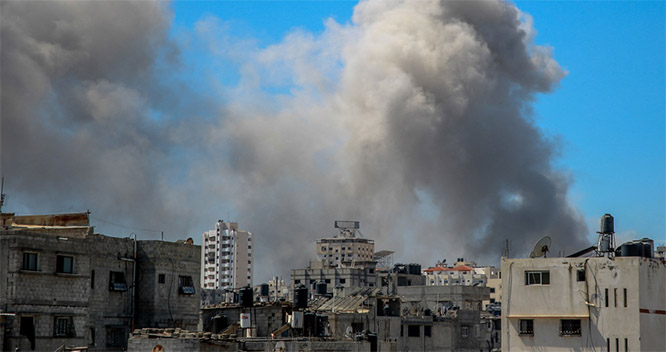
Israel continues strikes in Gaza despite UN’s ‘immediate ceasefire’ resolution

News Network
March 26, 2024

gazastrike.jpg

There is no let-up in the Israeli aggression on the Gaza Strip despite a UN Security Council resolution demanding an “immediate ceasefire.”

Israel carried out air raids and artillery strikes on several parts of Gaza on Tuesday, hitting residential buildings and gatherings of displaced people, “killing and wounding hundreds of people”, the Palestinian Information Center said.

Among the victims are 15 people, including four women and children, who were killed in an attack on a house in the neighborhood of Mosbeh, north of Rafah.

Media reports also said that fighting on the ground continued unabated.

That’s while the UN Security Council on Monday adopted a resolution for an “immediate ceasefire” for the ongoing Muslim holy month of Ramadan.

The resolution was put forward by the 10 non-permanent members of the UN Security Council. The US abstained and the 14 other council members all voted in favor of it.

After the vote, UN Secretary-General Antonio Guterres wrote on social media platform X that failing to implement the resolution “would be unforgivable.”

Palestinian resistance movements have welcomed the resolution, but Israel’s minister for military affairs Yoav Gallant said Israel will not stop its attacks in Gaza. 

“We will operate against Hamas everywhere – including in places where we have not yet been,” Gallant said.

Israel’s foreign minister, Israel Katz, also said in a post on X that the attacks will continue until all the captives taken by Hamas during its October 7 blitz are released.

Israel unleashed its war on Gaza on October 7 after the Palestinian Hamas resistance group carried out Operation Al-Aqsa Storm against the usurping entity in retaliation for its intensified atrocities against the Palestinian people.

Since the start of the offensive, the Tel Aviv regime has killed more than 32,300 Palestinians and injured over 74,000 others.

The Tel Aviv regime has also imposed a “complete siege” on the territory, cutting off fuel, electricity, food, and water to the more than two million Palestinians living there.

Francesca Albanese, the UN special rapporteur on human rights in the Palestinian territories, said Israel has committed acts of genocide in Gaza.


Comments

Add new comment

  • Coastaldigest.com reserves the right to delete or block any comments.
  • Coastaldigset.com is not responsible for its readers’ comments.
  • Comments that are abusive, incendiary or irrelevant are strictly prohibited.
  • Please use a genuine email ID and provide your name to avoid reject.
News Network
December 6,2025

pilot.jpg

New Delhi: IndiGo, India’s largest airline, faced major operational turbulence this week after failing to prepare for new pilot-fatigue regulations issued by the Directorate General of Civil Aviation (DGCA). The stricter rules—designed to improve flight safety—took effect in phases through 2024, with the latest implementation on November 1. IndiGo has acknowledged that inadequate roster planning led to widespread cancellations and delays.

Below are the key DGCA rules that affected IndiGo’s operations:

1. Longer Mandatory Weekly Rest

Weekly rest for pilots has been increased from 36 hours to 48 hours.

The government says the extended break is essential to curb cumulative fatigue. This rule remains in force despite the current crisis.

2. Cap on Night Landings

Pilots can now perform only two night landings per week—a steep reduction from the earlier limit of six.

Night hours, defined as midnight to early morning, are considered the least alert period for pilots.

Given the disruptions, this rule has been temporarily relaxed for IndiGo until February 10.

3. Reduced Maximum Night Flight Duty

Flight duty that stretches into the night is now capped at 10 hours.

This measure has also been kept on hold for IndiGo until February 10 to stabilize operations.

4. Weekly Rest Cannot Be Replaced With Personal Leave

Airlines can no longer count a pilot’s personal leave as part of the mandatory 48-hour rest.

Pilots say this closes a loophole that previously reduced actual rest time.

Currently, all airlines are exempt from this rule to normalise travel.

5. Mandatory Fatigue Monitoring

Airlines must submit quarterly fatigue reports along with corrective actions to DGCA.

This system aims to create a transparent fatigue-tracking framework across the industry.

The DGCA has stressed that these rules were crafted to strengthen flight safety and align India with global fatigue-management standards. The temporary relaxations are expected to remain until February 2025, giving IndiGo time to stabilise its schedules and restore normal air travel.

Comments

Add new comment

  • Coastaldigest.com reserves the right to delete or block any comments.
  • Coastaldigset.com is not responsible for its readers’ comments.
  • Comments that are abusive, incendiary or irrelevant are strictly prohibited.
  • Please use a genuine email ID and provide your name to avoid reject.