



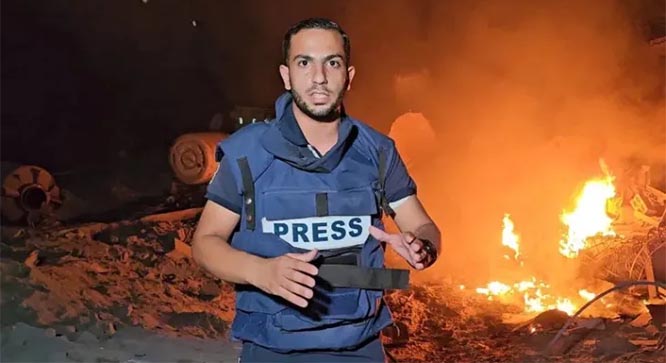
Al Jazeera journalist Anas al-Sharif, known for his fearless reporting from northern Gaza, was killed late Sunday night alongside four of his colleagues when an Israeli strike targeted a tent housing journalists outside Gaza City’s al-Shifa Hospital.
Seven people died in the attack. Among them were Al Jazeera correspondent Mohammed Qreiqeh and camera operators Ibrahim Zaher, Mohammed Noufal, and Moamen Aliwa. The tent, located near the hospital’s main gate, had been used as a base for press coverage of Israel’s ongoing offensive.
His Final Hours
Moments before his death, 28-year-old al-Sharif posted on X about the “intense, concentrated bombardment” raining down on Gaza City’s east and south—what the military calls “fire belts.” In a final video, the sounds of relentless missile fire echo against the night, flashes of orange lighting the sky.
“Nonstop bombing… For the past two hours, the Israeli aggression on Gaza City has intensified,” he wrote.
The Final Message
In a final message, written on April 6, to be published in the event of his death, al-Sharif said he “lived the pain in all its details” and “tasted grief and loss repeatedly”.
“Despite that, I never hesitated to convey the truth as it is, without distortion or misrepresentation, hoping that God would witness those who remained silent, those who accepted our killing, and those who suffocated our very breaths,” he said.
“Not even the mangled bodies of our children and women moved their hearts or stopped the massacre that our people have been subjected to for over a year and a half.”
He also expressed sorrow for having had to leave his wife, Bayan, behind, and for not seeing his son, Salah, and daughter, Sham, grow up.
‘Premeditated Attack’
In a statement, Al Jazeera Media Network called the killings “yet another blatant and premeditated attack on press freedom”.
“The order to assassinate Anas al-Sharif, one of Gaza’s bravest journalists, and his colleagues, is a desperate attempt to silence the voices exposing the impending seizure and occupation of Gaza,” the network said.
It urged the international community to take decisive action to halt the war and end what it described as the “deliberate targeting of journalists.” The network warned that Israel’s immunity from accountability only emboldens further attacks on those documenting the war.
Al Jazeera correspondent Hani Mahmoud, who was one block away during the strike, said reporting on al-Sharif’s death was the hardest task in his 22 months covering the conflict.
“They were killed because of their relentless reporting on starvation, famine, and malnutrition—because they were bringing the truth of this crime to everyone,” Mahmoud said.
Disputed Claims of Hamas Ties
Israel’s military claimed al-Sharif headed a Hamas cell and was involved in planning rocket attacks, alleging it had “unequivocal proof.” Rights advocates have rejected these claims as baseless.
Muhammed Shehada of the Euro-Med Human Rights Monitor said there was “zero evidence” al-Sharif participated in hostilities.
“His entire daily routine was standing in front of a camera from morning to evening,” Shehada told Al Jazeera.
The United Nations Special Rapporteur on freedom of expression, Irene Khan, had already warned in March that the Israeli army’s repeated threats against al-Sharif were alarming.
“Fears for al-Sharif’s safety are well-founded,” she said, citing growing evidence that journalists in Gaza are targeted based on unsubstantiated claims of Hamas affiliation.
Al Jazeera has repeatedly accused Israel of fabricating evidence to justify attacks on its reporters and of running a “campaign of incitement” against them. Last month, the Committee to Protect Journalists said it was gravely concerned for al-Sharif’s safety amid what it called an Israeli military smear campaign.
Part of a Pattern
Since the war began in October 2023, more than 200 reporters and media workers have been killed in Gaza, many alongside their families. Israel has often claimed that Palestinian journalists are Hamas operatives, a charge human rights groups say is part of an effort to discredit coverage of alleged war crimes.
For Gaza’s journalists, the risk has become a near certainty. Al-Sharif’s final words reflect both the cost and the conviction that have defined their work: a commitment to document the reality around them, even at the highest personal price.


Comments
Add new comment