Masks come off in Israel as the country vaunts covid-19 victory

Agencies
April 19, 2021

israel.jpg

Tel Aviv, Apr 19: Israelis stepped into the streets without masks on Sunday for the first time in a year, a key milestone as the country vaccinates its way out of a coronavirus nightmare.

"It's very strange but it's very nice," said Eliana Gamulka, 26, after getting off a bus near the busy Jerusalem shopping boulevard of Jaffa Street and removing her face covering.

"You can't pretend that you don't know anyone any more," she smiled.

With over half the population fully vaccinated in one of the world's fastest anti-Covid 19 inoculation campaigns, the health ministry announced on Thursday that masks would no longer be required in public outdoor spaces.
For Gamulka, a project manager, the good news came at the perfect time: just two weeks before her wedding.

It will be "very nice to celebrate with everyone, now without masks," she said. "The pictures will be great! I'm very relieved. We can start living again."

The vaccination of close to five million people has sent Israel's coronavirus caseload tumbling from some 10,000 new infections per day as recently as mid-January, to around 200 cases a day.

That has allowed the re-opening of schools, bars, restaurants and other indoor gatherings -- although masks are still required in indoor public spaces.

And even before Health Minister Yuli Edelstein's announcement came into effect, punters in the popular bars of Jerusalem's Mahane Yehuda market were mask-free and smiling on Thursday evening.

Yet on Sunday, office worker Ester Malka said she wasn't quite ready to let down her guard.

"We're allowed, but I'm still afraid, I got used to (wearing a mask)," she said.

"I feel like it's part of my life. We'll see what happens when everyone has taken them off. If it goes well for a couple of months, then I'll remove mine."

Israel just months ago had the world's highest infection rate, a coronavirus outbreak that left 6,300 people dead among 836,000 cases.

But the Jewish state sent its coronavirus caseload tumbling after striking a deal for a vast stock of Pfizer/BioNTech jabs.

In exchange, it agreed to pay above market price and share data it gathers on the recipients, using one of the world's most sophisticated medical data systems.

Since December, some 53 per cent of Israel's 9.3 million people have received both doses of the jab, including around four-fifths of the population aged over 20.

As recently as January it was registering 10,000 cases per day.

But as the effects of mass vaccination kicked in, by March it was able to implement a gradual re-opening.

"There's no better advertisement for Pfizer," said Shalom Yatzkan, a computer programmer who had been in quarantine after catching the virus.

"I was sick for three days, I had neck pains and felt weak," he said as he walked through central Jerusalem. "I just hope the new variants don't catch up with us."

Another Sunday landmark in Israel's exit from coronavirus restrictions was the full resumption of the country's educational system, without restrictions on the numbers of pupils in classrooms.

Speaking at a Jerusalem high school, Prime Minister Benjamin Netanyahu hailed the "festivity" of the day for the schools, while warning of complacency.

"We're not done with the coronavirus yet, since it can return," he said, stressing the need to obtain "millions more vaccinations".

"Sooner or later, we'll need another vaccination (dose)," he said.

The situation in Israel is in stark contrast to the occupied West Bank and the blockaded Gaza Strip, where infection rates remain high and vaccinations are low.

Gaza, which is ruled by the Islamist movement Hamas, said on Sunday it had recorded 23 deaths over the past 24 hours -- the highest ever daily coronavirus toll, with 761 deaths since the start of the pandemic.

Rights groups have urged Israel to supply vaccines to the 4.8 million Palestinians living there, but Israel says that falls under the Palestinian Authority's responsibility.

It has however vaccinated over 105,000 Palestinian workers who hold permits for employment in Israel and the settlements.

In Jerusalem, meanwhile, Gamulka was enjoying the simple pleasure of new-found freedoms.

"It's nice not to have something on your face any more," she said.

Comments

Add new comment

  • Coastaldigest.com reserves the right to delete or block any comments.
  • Coastaldigset.com is not responsible for its readers’ comments.
  • Comments that are abusive, incendiary or irrelevant are strictly prohibited.
  • Please use a genuine email ID and provide your name to avoid reject.
News Network
November 29,2025

DKSsiddu.jpg

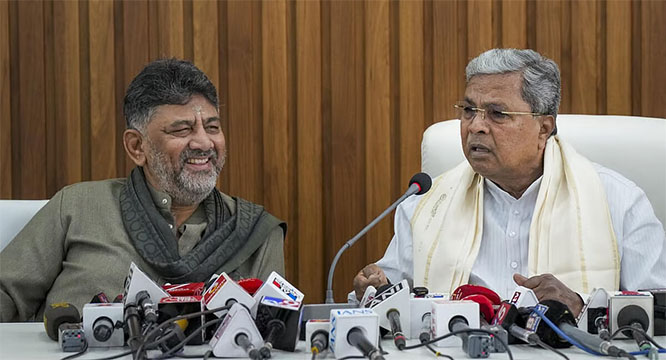
New Delhi: Karnataka chief minister Siddaramaiah and deputy CM DK Shivakumar on Saturday put up a dramatic display of unity at a closely watched joint press briefing, firmly dismissing weeks of speculation about a power-sharing tussle within the Congress. With the high command nudging both leaders to sit together and settle the dust, the meeting became a political spectacle, ending with the duo declaring that there was “no confusion, no differences.”

Calling the reports of a rift “manufactured confusion,” Siddaramaiah said the talks had gone smoothly, even joking about their breakfast. “Breakfast was very good. All three of us enjoyed it,” he said. “We want to end this confusion once and for all. For local elections and for 2028, our mission is clear — Congress must return to power. There is no difference between me and DKS, not now, not before.”

He blamed the media for fuelling rumours and reiterated absolute adherence to the party leadership. “From tomorrow, let there be no confusion. What the high command says, we will follow.”

Siddaramaiah also assured that the Assembly session starting December 8 would run smoothly and vowed that Congress would take on the BJP and JD(S) “together.”

Shivakumar echoed the chief minister word for word, stressing loyalty and discipline. “People have given us a massive mandate. It is our duty to deliver,” he said. “This government was formed under Siddaramaiah’s leadership. We both have complete trust in the high command. If they tell me to wait, I will wait.”

He added that the two leaders had discussed strategy for the 2028 Assembly elections. “Whatever the CM says, I agree. We are loyal soldiers of the party. The party may be facing challenges nationally, but we will keep it strong in Karnataka.”

Shivakumar also said Siddaramaiah would soon visit his home for lunch or dinner — another symbolic gesture meant to underline their unity.

Both leaders later posted on social media describing the breakfast meeting as “productive” and focused on “Karnataka’s priorities.”

The BJP, however, rejected the show of camaraderie as “pure bunkum,” accusing Congress of trying to paper over an internal power struggle. But Siddaramaiah and Shivakumar insisted their united front would continue — and that there was “no confusion” within the state leadership.

Comments

Add new comment

  • Coastaldigest.com reserves the right to delete or block any comments.
  • Coastaldigset.com is not responsible for its readers’ comments.
  • Comments that are abusive, incendiary or irrelevant are strictly prohibited.
  • Please use a genuine email ID and provide your name to avoid reject.
News Network
December 7,2025

envoy.jpg

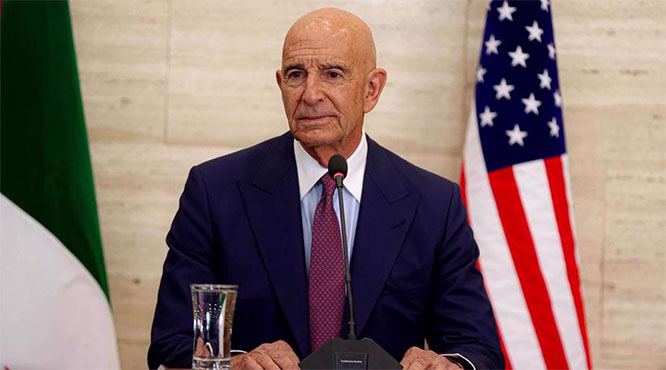
Since 1946, the United States has attempted 93 coups or “regime change” operations across the world — including two in Iran, US Special Envoy for Syria Tom Barrack has admitted.

Speaking to the UAE-based IMI Media Group, in remarks published by The National, Barrack said Washington tried twice to overthrow the Iranian government but failed both times. 

“For (Trump) then to be imputed with regime change — we had two regime changes in Iran already. Neither one worked. So I think wisely leave it to the region to solve,” said Barrack, who also serves as the US ambassador to Turkey.

His comments come six months after the US joined Israel in airstrikes against Iran during ongoing indirect nuclear negotiations between Tehran and Washington.

On June 13, Israel launched an attack on Iran that killed at least 1,064 people and hit civilian infrastructure. Days later, the United States targeted three nuclear facilities — Fordow, Natanz and Isfahan — in what Iran called a clear violation of international law. Iranian retaliation eventually forced a halt to the assault on June 24.

Barrack further claimed that US President Donald Trump and Foreign Secretary Marco Rubio are “not into regime change” and prefer a regional approach driven by Middle Eastern countries themselves. According to him, regional dialogue and non-interference by outside powers offer a more durable path forward.

He added that Washington is still open to an agreement with Tehran if Iranian authorities show “seriousness” and willingness to engage constructively.

However, Iran maintains the US has not shown readiness for meaningful talks. In an interview with Japan’s Kyodo News, Iranian Foreign Minister Abbas Araghchi said negotiations could advance only if Washington acknowledges Iran’s right to peaceful nuclear energy and lifts unilateral sanctions.

Comments

Add new comment

  • Coastaldigest.com reserves the right to delete or block any comments.
  • Coastaldigset.com is not responsible for its readers’ comments.
  • Comments that are abusive, incendiary or irrelevant are strictly prohibited.
  • Please use a genuine email ID and provide your name to avoid reject.