



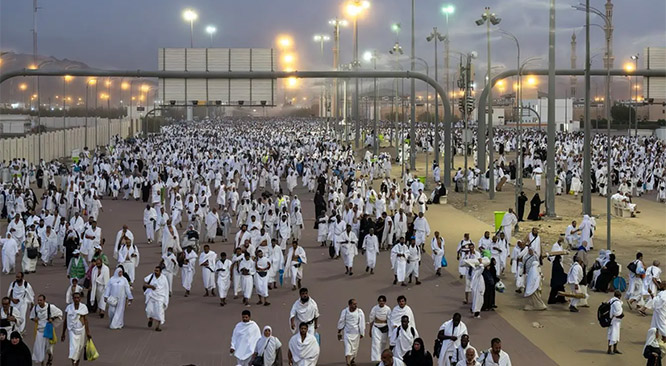
Masses of pilgrims on Sunday, May 16, embarked on a symbolic stoning of the devil in Saudi Arabia. The ritual marks the final days of Hajj pilgrimage and the start of the Eid Al-Adha celebrations for Muslims around the world.
The stoning is among the final rites of the Hajj, which is one of the Five Pillars of Islam. It came a day after more than 1.8 million pilgrims congregated on a sacred hill in Mount Ararat outside the holy city of Makkah, which Muslim pilgrims visit to perform the annual five-day rituals of Hajj.
The pilgrims left Mount Arafat on Saturday evening to spend their night in a nearby site known as Muzdalifa, where they collected pebbles they have used in the symbolic stoning of pillars representing the devil.
The pillars are in another sacred place in Makkah, called Mina, where Muslims believe Ibrahim’s faith was tested when God commanded him to sacrifice his only son Ismail. Ibrahim was prepared to submit to the command, but then God stayed his hand, sparing his son. In the Christian and Jewish version of the story, Abraham is ordered to kill his other son, Isaac.
Pilgrims will spend the next three days in Mina, where they walk long distances on pedestrian-only streets toward a multi-story complex housing large pillars. There, they cast seven pebbles each at three pillars in a ritual meant to symbolize the casting away of evil and sin.
While in Mina, they will visit Makkah to perform “tawaf,” circumambulation, which is circling the Kaaba in the Grand Mosque counterclockwise seven times. They will make another circumambulation, known as Farewell Tawaf, at the end of Hajj and as they prepare to leave the holy city.
The rites coincide with the four-day Eid Al-Adha, which means “Feast of Sacrifice,” when Muslims with the financial means commentate Ibrahim’s test of faith through slaughtering livestock and animals and distributing the meat to the poor.
Once the Hajj is over, men are expected to shave their heads and remove the shroud-like white garments worn during the pilgrimage, and women to snip a lock of hair in a sign of renewal and rebirth.
Most of the pilgrims then leave Makkah for the city of Madinah, about 340 kilometers away, to pray in Prophet Muhammad’s tomb, the Sacred Chamber. The tomb is part of the prophet’s mosque, which is one of the three holiest sites in Islam, along with the Grand Mosque in Makkah and the Al-Aqsa Mosque in Jerusalem.
All Muslims are required to make the Hajj once in their lives if they are physically and financially able to do so. Many wealthy Muslims make the pilgrimage more than once. The rituals largely commemorate the accounts of Prophet Ibrahim and his son Prophet Ismail, Ismail’s mother Hajjar and Prophet Muhammad, according to the Qur’an, Islam’s holy book.
More than 1.83 million Muslims performed Hajj in 2024, Saudi Hajj and Umrah Minister Tawfiq bin Fawzan Al-Rabiah said in a briefing, slightly less than last year’s figures when 1.84 million made the rituals.
Most of the Hajj rituals are held outdoors with little if any shade. It is set for the second week of Dhu Al-Hijjah, the last month in the Islamic lunar calendar, so its time of the year varies. And this year the pilgrimage fell in the burning summer of Saudi Arabia. The heat soared to 47 degrees Celsius (116.6 F) at Mount Arafat on Saturday.
This year’s Hajj came against the backdrop of the devastating Israel-Hamas war, which has pushed the Middle East to the brink of a regional conflict.

Comments
Add new comment