



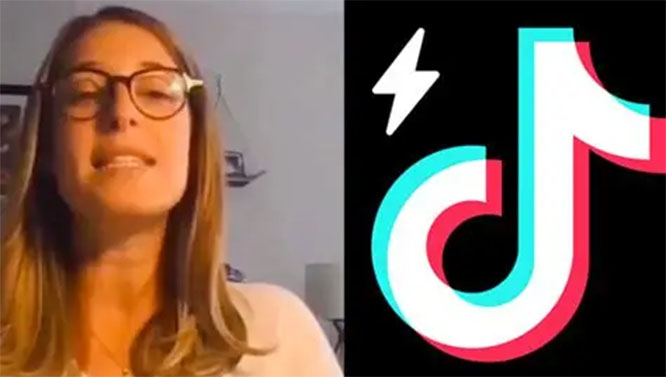
Facing political heat in the U.S. and pressure from pro-Israel lobbying groups, TikTok has appointed Erica Mindel, an American Zionist and former Israeli military instructor, as its Public Policy Manager for Hate Speech. The move, announced in July 2025, has sparked global criticism, with many seeing it as a step toward curbing pro-Palestinian voices on the platform.
Mindel’s role centers on shaping TikTok’s hate speech guidelines, with an emphasis on “combating antisemitism.” However, critics argue this emphasis could be used to label criticism of Israel as hate speech, effectively shielding the regime from online scrutiny during its ongoing war on Gaza.
From Israeli Army to TikTok Headquarters
Public details about Mindel’s early life are limited, but she describes herself as a “proud American Jew.” She holds degrees in political science from the University of Michigan and public policy from Johns Hopkins University.
After immigrating to the occupied Palestinian territories, she served for two and a half years as an instructor in the Armored Corps of the Israeli military’s spokesperson unit—an arm heavily involved in hasbara (state propaganda). This service preceded her work at the U.S. State Department, where she was a contractor for Ambassador Deborah Lipstadt, the Biden administration’s Special Envoy to Monitor and Combat Antisemitism.
TikTok reportedly hired Mindel after lobbying by the Anti-Defamation League (ADL), which has long pushed for tighter moderation of pro-Palestinian content online. The ADL had named TikTok the “worst offender” for antisemitic content after October 7, 2023, when Israel launched its ongoing offensive in Gaza.
Based in New York City, Mindel earns an estimated £280,000 annually in her new role.
Political Pressure and Platform Policy
TikTok has been under threat of a U.S. ban for more than two years, fueled by claims from pro-Israel lawmakers and conservative pundits that the app amplifies Palestinian perspectives and undermines American support for Israel.
A 2024 Northeastern University study found that pro-Palestinian posts significantly outnumbered pro-Israeli ones on TikTok, suggesting a sustained grassroots movement rather than coordinated manipulation. Still, opponents of the platform have seized on the disparity to demand tighter controls.
Mindel’s appointment is widely seen as TikTok’s attempt to placate U.S. political pressure. Critics argue her personal and professional background makes her incapable of objectively moderating content about Israel and Palestine.
Accusations of Silencing Dissent
The Palestinian Youth Movement (PYM), along with several digital rights groups, has condemned the hiring, warning that pro-Palestinian activism will be disproportionately targeted under the guise of combating antisemitism.
Since 2023, TikTok says it has removed over 850,000 videos and accounts for hate speech. While the company denies targeting specific political viewpoints, users have reported increased scrutiny of hashtags like #FreePalestine in recent months. The platform insists removals are consistent with existing rules.
The Electronic Frontier Foundation (EFF) has warned of a “chilling effect” on political speech, particularly when one category of hate—antisemitism—is given policy priority over others without transparency on enforcement standards.
The lack of clarity on Mindel’s moderation framework has deepened concerns. Critics point out that she has not addressed how antisemitism policies will avoid conflating criticism of Israel with hatred toward Jewish people—a distinction many free speech advocates say is vital.
Growing Backlash
Protests outside TikTok’s New York office in late July 2025 drew attention to Mindel’s Israeli military service and her settlement ties. Online petitions demanding her removal have gathered over 50,000 signatures. The American Civil Liberties Union (ACLU) has suggested possible legal action if her policies disproportionately censor protected speech.
Observers note similarities to the case of Elon Musk’s platform X, which, after political pressure, ramped up moderation of anti-Zionist content under the banner of combating antisemitism.
For now, Mindel remains in position, but the controversy threatens TikTok’s image as a politically neutral space—especially among its younger and more diverse audience, many of whom have been vocal in supporting Palestinian rights online.
Whether TikTok’s leadership can balance political demands with its stated commitment to free expression remains an open question. What is clear is that Mindel’s appointment marks a decisive moment in the battle over who gets to shape the global conversation on Israel and Palestine in the digital age.


Comments
Add new comment