



60,000 Saudis unable to repay their debts

February 6, 2013

60000_Saudis

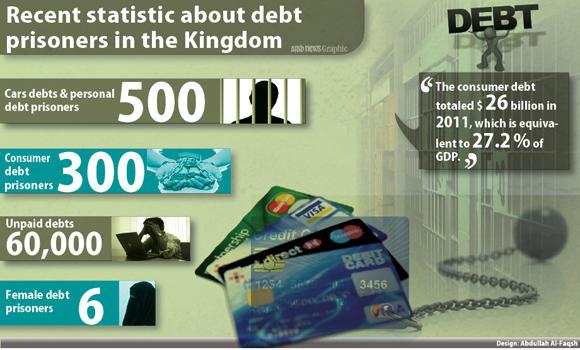
Jeddah, Feb 6: About 60,000 Saudis are unable to pay off their loans, said Abdullah Marei bin Mahfouz, chairman of the Jeddah branch of the national committee for the care of prisoners and their families.

Bin Mahfouz said that currently about 300 Saudis are imprisoned in the Kingdom who are unable to settle their bank debts. In addition, about 500 prisoners are unable to pay off credit card debts, and car installments.

Between 2009 and 2011 the increased effectiveness of the payment system — which protects the rights of banks — contributed to lowering the number of people who borrowed money to buy consumer goods, he said.

“I think Saudis are becoming more cautious about getting indebted due to the strict procedures that banks are following. Still, too many Saudis make debts to fund their summer vacation or to buy a luxurious car,” he said.

He added, “The majority of Saudis who are unable to refund their debts, start looking for another source of money, like car companies. They buy two or three cars on an installment system. Then they sell these cars for cash. In most cases the borrowers are unable to refund the car installments.”

According to Bin Mahfouz, sometimes husbands make their wives borrow money for them.

“We currently have six women in prison that were unable to repay their debts. They work as teachers and their husbands forced them to take out bank loans, knowing they would be unable to refund it,” he said.

The bank system is extremely strict in collecting the debts on time.

“When the money is not repaid in due time, the bank freezes the account, stops all electronic transactions of the debtor, and then sends them notifications through the police department,” said Bin Mahfouz.

He added, “Most convicts who are in jail because they couldn’t repay, are Saudis. Expatriates are committed to settling their debts. There are a few Filipino debtors in prison. These are locked up because of credit card debts for amounts starting around SR 10,000. In contrast, Saudis debtors in jail run debts from SR 100,000 and more.”

The Saudi Arabian Monetary Agency (SAMA) recently issued a report on consumer debts. It said these reached SR 246.9 billion in the first quarter of 2012. Compared to the same period in the previous year, the number was up by 19 percent.

SAMA had warned banks against rescheduling unpaid debts of individuals, saying that 45 percent of the debts should be repayable within three years.

Saudi Banker Fadhel Albu Ainain told Arab News that the ratio of consumer debts is high; many people are in debt. He expected the ratio to decrease with the entrance of the mortgage law.

“In Saudi Arabia the rate of consumer debts, used to buy consumer goods, is estimated at about 75 percent. This is unhealthy for the Saudi market. A healthy market would show that most of the loans are used for acquiring stable commercial investments and real estate. Unfortunately, most of the borrowers are employees whose their salaries can’t cover these loans,” he said. “The problem in Saudi Arabia is that people who earn a low wage often tend to incur debts to live a luxurious life.”

Albu Ainain is opposed to increasing the payment period to more than five years.

“Some people are now calling for expanding the debts repayment period to more than five years. There are also calls to increase the maximum amount people can borrow. This is would increase the size of loans and weaken people’s ability to repay their debts,” he said.

Comments

Shana
 - 
Sunday, 4 Jun 2017

Today, I went tto the beach with my kids. I found a sea shell and gave
it to my 4 year old daughter and said \You can hear the ocean if you put this to your ear.\" She placed the shelol to her ear and
screamed. There was a hermit crab inside and it pinched her ear.

She never wants to goo back! LoL I know this is entirely off topic but I had too tell someone!

my webpage

Add new comment

  • Coastaldigest.com reserves the right to delete or block any comments.
  • Coastaldigset.com is not responsible for its readers’ comments.
  • Comments that are abusive, incendiary or irrelevant are strictly prohibited.
  • Please use a genuine email ID and provide your name to avoid reject.
News Network
November 28,2025

fire.jpg

Several Syrians were killed and more than two dozen others injured in Israeli strikes on the outskirts of Damascus, amid intensified incursions by the occupying regime since the fall of former president Bashar al-Assad and the rise of Hayat Tahrir al-Sham (HTS) rule.

Syrian state TV reported that the casualties occurred during an overnight Israeli assault involving helicopters and drones on the town of Beit Jinn in the Damascus countryside. The attack followed an Israeli military unit’s entry into the town, where they were surrounded by local residents, leading to gunfire and direct confrontations.

According to the report, “The occupation army’s helicopters and artillery shelled Beit Jinn, located at the foothills of Mount Hermon, resulting in 13 martyrs and 25 injured civilians.” The broadcaster did not specify the full extent of damage.

Al-Ikhbariyah Syria confirmed that the shelling coincided with Israeli soldiers entering Beit Jinn, while artillery pounded surrounding areas. The broadcaster stated that the escalation began after local residents clashed with an Israeli patrol that had infiltrated the southern town and “kidnapped” three young men.

Following a two-hour exchange of heavy fire, Israeli forces withdrew and repositioned on the hill of Butt al-Warda at the town’s outskirts.

Israeli media acknowledged that six soldiers were wounded in the clashes—three of them seriously—describing the confrontation as a “sudden ambush” that forced the deployment of reserve units and air support to secure an exit route. No further details were provided.

The aggression has fueled renewed displacement from Beit Jinn, with residents fleeing to nearby villages amid increasingly frequent Israeli attacks.

The raid came just a day after Israeli troops carried out another ground incursion into Umm al-Luqas village in Quneitra province. According to SANA, an Israeli unit in four vehicles entered the village, raided several homes, and later withdrew.

Syria condemned the repeated incursions as violations of the 1974 Disengagement Agreement and UN resolutions, urging the international community to enforce compliance and pressure Israel to halt its operations and withdraw fully.

Israel has expanded its attacks across Syrian territory following the collapse of the Assad government last year. Prime Minister Benjamin Netanyahu has reportedly instructed his forces to push deeper into Syrian territory and seize strategic positions.

Meanwhile, critics say the HTS-led interim government’s inaction and growing normalization gestures toward Israel have emboldened Tel Aviv to intensify its military operations. HTS, formerly linked to al-Qaeda, seized control of Damascus last December, formally ending Assad’s rule.

Comments

Add new comment

  • Coastaldigest.com reserves the right to delete or block any comments.
  • Coastaldigset.com is not responsible for its readers’ comments.
  • Comments that are abusive, incendiary or irrelevant are strictly prohibited.
  • Please use a genuine email ID and provide your name to avoid reject.
News Network
November 30,2025

The United Nations Committee against Torture (CAT) has condemned the Israeli regime for enforcing a policy of “organized torture” against Palestinians.

In a report published on Friday, CAT stated that the occupying regime enforces a deliberate policy of “organized and widespread torture and ill-treatment” against Palestinian abductees, particularly since October 7, 2023, when Israel launched its genocidal war on Gaza.

The committee expressed “deep concern over repeated severe beatings, dog attacks, electrocution, water-boarding, use of prolonged stress positions [and] sexual violence” inflicted on Palestinians.

Palestinian prisoners were degraded by “being made to act like animals or being urinated on,” systematically denied medical care, and subjected to excessive restraints, “in some cases resulting in amputation,” the report added.

CAT also condemned the routine application of “unlawful combatants law” to justify the prolonged detention without trial of thousands of Palestinian men, women, and children.

More than 10,000 Palestinians, including women and children, are currently held in Israeli prisons, according to Palestinian and international human rights groups, with 3,474 Palestinians in “administrative detention,” meaning they are imprisoned without trial for indefinite periods.

The report highlighted the “high proportion of children who are currently detained without charge or on remand,” noting that while Israel sets the age of criminal responsibility at 12, even younger children have been abducted.

Children designated as security prisoners face severe restrictions on family contact, may be subjected to solitary confinement, and are denied access to education, in clear violation of international law.

The committee further suggested that Israel’s policies across the Occupied Territories constitute collective torture against the Palestinian population.

“A range of policies adopted by Israel in the course of its continued unlawful presence in the Occupied Palestinian Territory amounts to cruel, inhuman or degrading living conditions for the Palestinian population,” the report said.

On Thursday, the Palestinian resistance movement Hamas condemned the systematic killing and torture of Palestinian abductees in Israeli prisons, urging international action to halt these abuses.

Citing human rights data, Hamas stated that 94 Palestinians have been killed in Israeli prisons since the start of Tel Aviv’s genocidal war on Gaza.

“This reflects an organized criminal approach that has turned these prisons into direct killing grounds to eliminate our people,” the resistance movement said.

Hamas called on the international community, the UN, and human rights organizations to immediately pressure Israel to end crimes against prisoners and uphold their rights as guaranteed by all international conventions and norms.

Comments

Add new comment

  • Coastaldigest.com reserves the right to delete or block any comments.
  • Coastaldigset.com is not responsible for its readers’ comments.
  • Comments that are abusive, incendiary or irrelevant are strictly prohibited.
  • Please use a genuine email ID and provide your name to avoid reject.