



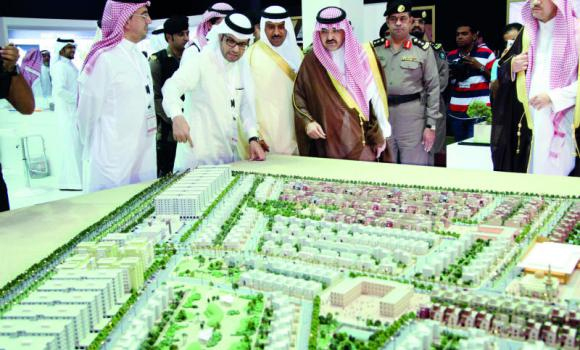
Jeddah, Mar 3: Top private sector developers yesterday at Cityscape Jeddah called on the government to work with them to streamline several processes that cause delays, making it nearly impossible to develop affordable housing projects to solve the housing crisis.
“Among the limits and challenges facing Saudi developers, is for example the regulations concerning the Municipality’s issuance of licenses, which must have a shorter processing time from the current minimum of at least two years up to a maximum of four years. In addition, the government should revise the mortgage law further, as we feel that the implementation of the current draft will have a negative effect on developers and financing companies,” said Riyad Ahmed Al-Thaqafi, CEO, Ewaan, said as he gave the keynote address called.
He added that there is a need for the government to appoint an agency that will regulate land prices to stop price escalation and manipulation. The government should also work to change the community culture of a majority of the population’s belief that they need a 200 or more square-meter home in order to own a house.
Al-Thaqafi also said that the two factors that would affect the housing sector through 2025 is rising population growth and decreasing income levels. In Saudi Arabia and the GCC, the main driver causing a housing crisis in major cities is urbanization or the migration of rural residents to live in the cities of Jeddah, Riyadh and Dammam.
“It is expected by 2025 that urbanization will increase the population of large cities by between 52 and 58 percent, causing more demand for housing that very few will be able to afford due to increased inflation and a lower income level,” Al-Thaqafi said.
A lack of affordable housing and the increase of unemployment are the main social instigators underlying the social unrest over the past two years in the Arab world.
Among solutions offered by Al-Thaqafi is to improve development management processes such as an increased use of construction technology, stoppage of land prices speculation and education of consumers to prefer and enjoy living in smaller and more affordable residences.
He said that another idea could be the implementation of a new governmental body for financing real estate projects backed by the Capital Market Authority (CMA) that could provide project financing in place of banks, which usually do not want to offer financing for most projects.
Overall, Al-Thaqafi reiterated that among participants to events such as Cityscape Jeddah, government regulators should be present to discuss solutions.
“The government must realize that it cannot compete with the private sector in this matter, but must work with private sector developers in finding solutions,” Al-Thaqafi said.
Ewaan is developing a residential complex, Al- Fareeda, in North Jeddah, which includes 1,800 villas with full infrastructure services and facilities.
Representing a semi- government-back project, Mohammed Bawaked, executive vice president, Jeddah Development & Urban Regeneration Company, owned by the Jeddah Municipality, spoke about their new development in Jeddah called, Salman Bay.
The mega-housing project is being developed on an inland bay about 20 kilometers north of Jeddah on about 3.2 million square meters of land as part of the city’s future development plans. It will accommodate 25,000 units of apartment buildings dedicated to affordable housing. It will cater to 95,000 residents.
“While working to develop this project, we found many obstacles such as mainly financing issues with banks not wanting to offer financing,” Bawaked said. “We ended up overcoming this by finding internal financing by proposing to the contracting company to implement the work with no down payment, in which they accepted.”
He also said that other challenges lie in choosing the appropriate design to be of a comfortable size that consumers would like and still be deemed, “affordable.”
“It was difficult. We performed the study many times and had to change the design several times before coming up with a suitable design. In addition, we have arranged deals with the Saudi Electric Company (SEC), National Water Company (NWC) and stakeholders to come up with high level, but reasonably priced housing,” he said.
said that he agrees that there are many changes that must be made in order to find solutions, the most important being the public and private sector’s mutual participation in solving the housing crisis. The second, that instead of blaming the government, all developers must realize they have a role to play in cooperating. “We are all capable of making positive changes if we all take up the responsibility,” he said.
Meanwhile, Cityscape featured more than more than 50 local and regional exhibitors displaying their projects and services to an expected 10,000 visitors.
Major real estate companies were present at the event but most visible were Saudi banks and home finance companies.
“This signals the huge demand for home financing in Saudi Arabia,” said Hussain Al-Harthi, managing director of National Exhibitions Company. “The surge of activity comes in response to the approval of the mortgage law and the three laws published by SAMA last week, which obviously triggered developers and financiers to take swift actions and get ready to provide innovative solutions in lines with the new passed laws.”
Rayadah Investment Company, the real estate arm of the Saudi Public Pension Agency, showcased its mega residential project in north Jeddah, which is expected to cover 10 percent of the total real estate market needs for the next 10 years. Located in Obhur, Al Raeda Residential project comprises 8,000 units on a 2.5 million-square-meter site.
It is divided into 10 neighborhoods, five allocated for residential buildings, and five for villas, in addition to central zone for multipurpose usages. The project also comprises 24 schools, 15 mosques, general hospital, health club and a hotel supported with commercial shops to service guests.
Maceen Capital, a specialized and dynamic investment group, is present at Cityscape Jeddah this year to promote its SR 83 million real estate fund invested in developing a residential project in north Jeddah -Villatee Residential Project consisting of 52 upscale villas in a unique location in Obhur. The villas are available in five different architectural designs and sizes catering to different tastes and lifestyles.
“The location was selected very carefully to offer a unique living experience where new Jeddah is being shaped,” said Bader Al-Hammad, CEO of Maceen Capital. “The project is scheduled to be completed in two years and all services and facilities are available in location to guarantee a quiet, flexible and successful lifestyle.”
Samoa Real Estate Company is once again the principal sponsor of Cityscape Jeddah. This year the company revealed a new and ambitious project in the Western Province, Dahiat Sumou.
“Bawabat Makkah is a visionary city to be built on the western edge of the Makkah Holy Region, adjacent to the boundary line of the Jeddah-Makkah Expressway. The area of the city will occupy approximately 1.8 square km land and will provide much needed suitable residential housing to an estimated population of 25,000 people,” Khaled Al-Telmesani, CEO of Sumou stated.
Masharef Residential Project, developed by Kinan International Real Estate Development, also grabbed visitors’ attention. The 1 million M2 project site is located north of Jeddah and offers a wide range of products such as villas, apartments and residential/commercial lands. Kinan’s project targets the mid-income segment and the first two phases of the project has already been sold. Handover of units for the first phase began at the end of 2012.


Comments
Add new comment