



Modi to visit Ramallah on February 10, will be first ever Indian PM in Palestine

Agencies
February 5, 2018

New Delhi, Feb 5: Prime Minister Narendra Modi will be on a historic visit to Palestine starting Saturday. During his visit, he will hold a meeting with the Palestinian President Mahmoud Abbas.

Apart from visiting Oman and the United Arab Emirates (UAE), the prime minister will also go to the Palestinian capital, Ramallah.

In July 2017, he was on a three-day visit to Israel on a special invitation from his Israeli counterpart Benjamin Netanyahu, however, he did not visit Palestine then.

Modi will be in the UAE on February 10 and 11 and will address the sixth World Government Summit in Dubai. This will be Modi's second visit to the UAE after August 2015.

According to authorities and business leaders, this visit of the Prime Minister signifies the special importance that India attaches to its ties with the oil-rich nation and will help in furthering cooperation in diplomatic, economic and security issues.

"Prime Minister Narendra Modi?s second visit to UAE is an indication of the special importance we attach to the India- UAE relationship," India's Ambassador to the UAE Navdeep Singh Suri said.

According to him, the visit builds in the momentum that has developed since India hosted Crown Prince of Abu Dhabi Sheikh Mohammed bin Zayed as chief guest on Republic Day in 2017.

Besides bilateral engagements, Prime Minister Modi is scheduled to address members of the Indian community at the Dubai Opera House.

"During the year, we have seen major UAE investments into India, a significant increase in defence and security cooperation, a transformation in our energy ties from a buyer-seller relationship to a strategic partnership.

"For the community, the first Hindu temple in Abu Dhabi will be great news," Suri said.

Echoing Suri's sentiments, the UAE ambassador to India Ahmed Al-Banna said the visit "tells us the direction that India and the UAE have in mind and also the characteristics of our respective leaderships."

"The leadership has put us on a challenging and interesting track where the relationship is very important, on many sectors, and our leaders are pushing to rewrite future plans for both nations," Al-Banna said.

While Ambassador Suri highlighted the trade and investment component of this rapidly-evolving relationship, Ambassador Al-Banna chose to emphasise on the connectivity aspect of it.

"There are 1,076 flights a week between India and the UAE, which is the largest operation of its kind. More than 50 per cent of Indians, who travel outside India to different destinations, such as Europe or America, use Dubai and Abu Dhabi as their transit hub," he said.

It is obvious that both sides are banking on prime minister's visit to go over and above the 17 bilateral agreements signed in January 2016, and 14 agreements in February 2017.

With an eye on India, some leading Gulf businesses with Indians at the helm see this as realisation of long-held dreams.

Yusuffali MA, chairman Lulu Group International and member of Abu Dhabi Chamber of Commerce, said India had been on an aggressive forward march with regard to attracting FDIs.

"The recent report by leading rating agencies and financial institutions have all lauded India?s fiscal policies and ease of doing business, so obviously India does look like a hot destination for investment.

As far Indo-UAE business relationship is concerned, it is at all time high with both countries being each other's top trading partner," Yusuffali said.

According to him, till recently India was seen as an investment destination only, but of late UAE has been trying to woo Indian businesses to invest and set up operations here.

"This move shows the kind of confidence UAE has on Indian economy and I am sure business houses in both countries will be eagerly looking forward to this visit to open up new areas of co-operation," Yusuffali said.

Manoj Prasad, Executive Chairman, of DIFC-based investment banking firm, Que Capital Limited, believes this visit truly signifies the seriousness among top Indian leadership toward making an ever growing relationship between two countries more meaningful.

"The ambition is obviously growth to which both countries have already started contributing, be it through India investing in infrastructure or the bilateral investment fund which is in the process of being setup," says Prasad.

According to him, businesses among the two countries have witnessed unprecedented growth in recent years.

"The comfort and mutual respect for leaders of both the countries are clearly visible and the visit of Prime Minister Modi to the land with highest NRI diaspora in the world would further enhance it," he said.

A wide spectrum of companies stands to gain from improving bilateral relations facilitating business climate on both sides, he said.

Kulwant Singh, the founder and managing director of Lama Hospitality group, feels the visit signifies that we are serious about our relationship and take our commitments, business associations, joint opportunities, and strategic tie-ups seriously.

"We see the formula of successful businesses matching with the perfect platform of opportunities available in India. With the new budget in place, NRIs will have huge opportunities in sectors like healthcare, education, and infrastructure," Singh said.

Prasanth Manghat, CEO and Executive Director, NMC Health Plc, says the visit will not only develop his outreach to the Arab world but also offer a prospect to further the strategic partnerships in the region.

According to him, the visit is seen by many as cementing the close relationship Modi shares with the UAE leadership, also furthering cooperation in diplomatic, economic and security issues.

"At the ground level of delivery, the strategic partnership is being expanded and the UAE has announced plans to invest USD 75 billion over a decade to meet India?s infrastructure needs," he said.

Indian expatriates in the UAE actively participate in projects toward the development of the UAE and this visit will help further evolve the deep and historic relationship shared between the two countries, said Mehirr Nath Choppra, CEO Qasbah Group.

"It would certainly help to get an overview of the projects that have been announced in the past and their current status so serious players can set their timelines accordingly," Choppra said.

Comments

Add new comment

  • Coastaldigest.com reserves the right to delete or block any comments.
  • Coastaldigset.com is not responsible for its readers’ comments.
  • Comments that are abusive, incendiary or irrelevant are strictly prohibited.
  • Please use a genuine email ID and provide your name to avoid reject.
News Network
December 16,2025

Mangaluru, Dec 16: The Mangaluru City police have significantly escalated their campaign against drug trafficking, arresting 25 individuals and booking 12 cases under the Narcotic Drugs and Psychotropic Substances (NDPS) Act between November 30 and December 13. The crackdown resulted in the seizure of a substantial quantity of illicit substances, including 685.6 grams of MDMA and 1.5 kg of ganja.

The success of this recent drive has been significantly boosted by the city’s innovative, QR code-based anonymous reporting system.

"The anonymous reporting system has received an encouraging response. Several recent arrests were made based on inputs received through this system, helping police tighten the noose around drug peddlers," said the City Police Commissioner.

The latest arrests contribute to a robust year-to-date record, underscoring the police's relentless commitment to combating the drug menace.

Up to December 14 this year, the police have registered a total of 107 cases of drug peddling, leading to the arrest of 219 peddlers. Furthermore, they have booked 562 cases of drug consumption, resulting in the arrest of 671 individuals.

The scale of the seizure for the year reflects the magnitude of the problem being tackled: police have seized 320.6 kg of ganja worth ₹88.7 lakh and 1.4 kg of MDMA valued at ₹1.2 crore. Other significant seizures include hydro-weed ganja worth ₹94.7 lakh and cocaine worth ₹1.9 lakh, among others.

The Commissioner emphasized a policy of rigorous enforcement: "We ensure that peddlers are caught red-handed so that they cannot later dispute the case or claim innocence."

To counter the rising trend of substance abuse among youth, the Mangaluru City police have rolled out uniform guidelines for random drug testing across educational institutions.

As part of the drive, tests were conducted in approximately 100 institutions, screening an estimated 5,500 to 6,000 students in the first phase. 20 students tested positive for drug consumption during the initial screening.

Students who tested positive have been provided counselling and are scheduled for re-testing in the second quarter. The testing will also be expanded to students not covered in the first phase. In a move to ensure strict implementation, police personnel were deployed in mufti in some institutions. Reiterating a zero-tolerance stance, the Commissioner confirmed that random testing will continue, and colleges have also been instructed to conduct drug tests at the time of admission to deter substance abuse from an early stage.

Comments

Add new comment

  • Coastaldigest.com reserves the right to delete or block any comments.
  • Coastaldigset.com is not responsible for its readers’ comments.
  • Comments that are abusive, incendiary or irrelevant are strictly prohibited.
  • Please use a genuine email ID and provide your name to avoid reject.
News Network
December 2,2025

DKSsiddu.jpg

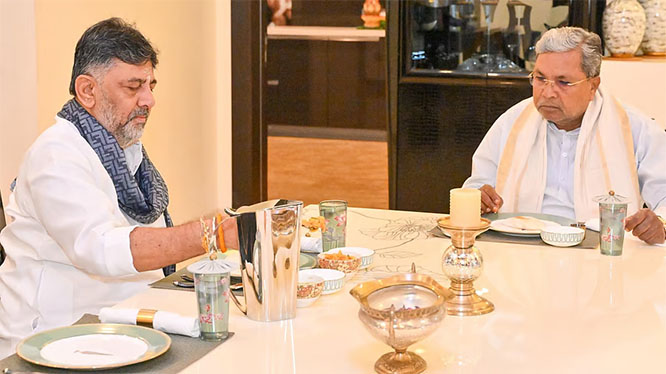
Bengaluru: 'Nati koli saaru' (country chicken curry) considered one of Chief Minister Siddaramaiah’s favourites along with steaming hot idlis was on the breakfast menu at Deputy CM D K Shivakumar’s residence on Tuesday, according to official sources.

The spread also included 'nati koli' fry, vada and pongal, among other items, they said.

In an apparent show of unity, Siddaramaiah visited Shivakumar’s residence for breakfast, just days after the two leaders shared a meal amid a simmering power tussle in the state Congress.

Siddaramaiah drove to the Deputy CM’s residence in Sadashivanagar, where he was received by Shivakumar and his brother D K Suresh, who is a former Congress MP.

Suresh and Kunigal MLA H D Ranganath, a relative of Shivakumar, joined them for breakfast, which featured a mix of vegetarian and non-vegetarian dishes.

Speaking to reporters later, Siddaramaiah said Shivakumar had invited him during his visit to the CM’s residence for breakfast on Saturday.

Asked about the difference between the two meals, the chief minister said, "At his (Shivakumar’s) house it was non-veg, while at my house it was veg. He is a vegetarian, I am a non-vegetarian. I had not prepared non-veg. I told DK to get chicken from the village as you won’t get the original in Bengaluru."

Shivakumar said he had initially invited Siddaramaiah to his residence, but the CM had suggested visiting his place first and reciprocating later. "It was a vegetarian breakfast at the CM’s house on Saturday," he noted.

"Today, I invited him (the CM) to my house. He enjoyed the breakfast, which had his Mysuru taste," Shivakumar added. At this point, Siddaramaiah remarked that Shivakumar’s wife is also from Mysuru.

Saturday’s breakfast at Siddaramaiah’s official residence, held as part of efforts by the Congress high command to ease tensions in the leadership dispute between the two, reportedly included idlis and sambar, according to official sources.

Comments

Add new comment

  • Coastaldigest.com reserves the right to delete or block any comments.
  • Coastaldigset.com is not responsible for its readers’ comments.
  • Comments that are abusive, incendiary or irrelevant are strictly prohibited.
  • Please use a genuine email ID and provide your name to avoid reject.
News Network
December 13,2025

New Delhi: School-going children are picking up drug and smoking habits and engaging in consumption of alcohol, with the average age of introduction to such harmful substances found to be around 13 years, suggesting a need for earlier interventions as early as primary school, a multi-city survey by AIIMS-Delhi said.

The findings also showed substance use increased in higher grades, with grade XI/XII students two times more likely to report use of substances when compared with grade VIII students. This emphasised the importance of continued prevention and intervention through middle and high school.

The study led by Dr Anju Dhawan of AIIMS's National Drug Dependence Treatment Centre, published in the National Medical Journal of India this month, looks at adolescent substance use across diverse regions.

The survey included 5,920 students from classes 8, 9, 11 and 12 in urban government, private and rural schools across 10 cities -- Bengaluru, Chandigarh, Delhi, Dibrugarh, Hyderabad, Imphal, Jammu, Lucknow, Mumbai, and Ranchi. The data were collected between May 2018 and June 2019.

The average age of initiation for any substance was 12.9 (2.8) years. It was lowest for inhalants (11.3 years) followed by heroin (12.3 years) and opioid pharmaceuticals (without prescription; 12.5 years).

Overall, 15.1 per cent of participants reported lifetime use, 10.3 per cent reported past year use, and 7.2 per cent reported use in the past month of any substance, the study found.

The most common substances used in the past year, after tobacco (4 per cent) and alcohol (3.8 per cent), were opioids (2.8 per cent), followed by cannabis (2 per cent) and inhalants (1.9 per cent). Use of non-prescribed pharmaceutical opioids was most common among opioid users (90.2 per cent).

On being asked, 'Do you think this substance is easily available for a person of your age' separately for each substance category, nearly half the students (46.3 per cent) endorsed that tobacco products and more than one-third of the students (36.5 per cent) agreed that a person of their age can easily procure alcohol products.

Similarly, for Bhang (21.9 per cent), ganja/charas (16.1 per cent), inhalants (15.2 per cent), sedatives (13.7 per cent), opium and heroin (10 per cent each), the students endorsed that these can be easily procured.

About 95 per cent of the children, irrespective of their grade, agreed with the statement that 'drug use is harmful'.

The rates of substance use (any) among boys were significantly higher than those of girls for substance use (ever), use in the past year and use in the past 30 days. Compared to grade VIII students, grade IX students were more likely, and grade XI/XII students were twice as likely to have used any substance (ever).

The likelihood of past-year use of any substance was also higher for grade IX students and for grade XI/XII students as compared to grade VIII students.

About 40 per cent of students mentioned that they had a family member who used tobacco or alcohol each. The use of cannabis (any product) and opioid (any product) by a family member was reported by 8.2 per cent and 3.9 per cent of students, respectively, while the use of other substances, such as inhalants/sedatives by family was 2-3 per cent, the study found.

A relatively smaller percentage of students reported use of tobacco or alcohol among peers as compared to among family members, while a higher percentage reported inhalants, sedatives, cannabis or opioid use among peers.

Children using substances (past year) compared to non-users reported significantly higher any substance use by their family members and peers.

There were 25.7 per cent students who replied 'yes' to the question 'conflicts/fights often occur in your family'. Most students also replied affirmatively to 'family members are aware of how their time is being spent' and 'damily members are aware of with whom they spend their time'.

Comments

Add new comment

  • Coastaldigest.com reserves the right to delete or block any comments.
  • Coastaldigset.com is not responsible for its readers’ comments.
  • Comments that are abusive, incendiary or irrelevant are strictly prohibited.
  • Please use a genuine email ID and provide your name to avoid reject.