



'Modicare' to cost Rs 11K crore a year, claim govt sources

Agencies
February 3, 2018

New Delhi, Feb 3: Prime Minister Narendra Modi's plan to provide health insurance for about half the country would require an estimated Rs 11, 000 crore in central and state funding each year, sources familiar with the matter said.

The National Health Protection Scheme, which the government dubs "Modicare", was announced in Thursday's budget for 2018/19 and would provide 100 million families, or about 500 million poor people, with health cover of Rs 50, 0000 per year for free treatment of serious illnesses.

Several states now offer health insurance but these schemes are generally small and poorly implemented. Modi faces a national election next year and the new health programme is seen as a signature initiative to woo voters in the countryside, many of whom struggle with high healthcare costs.

The government estimates the cost of insuring each family under the new scheme at about Rs 1,100, said a government official who had direct knowledge of the matter and did not want to be identified.

Officials at NITI Aayog, India's federal think tank, on Friday said the government's estimated premium for insuring each family would be 1,000-1,200 rupees, confirming the funding would be shared between federal and state governments.

"This is a turning point for the health sector," Vinod K Paul, a member of NITI Aayog, told reporters.

Officials have said "the world's largest government funded health care programme" would have a central allocation of 20 billion rupees in 2018-19, but added that more funds would be made available as the programme is rolled out over the year.

Some critics have raised doubts whether 20 billion rupees in federal funding is enough to support the programme for 2018-19.

However, the government official said of the Rs 11000 crore in premiums required to fund the programme, the federal government would contribute about 70 billion rupees with the 29 states providing the rest.

The 50 billion rupees in federal funding on top of the budget allocation of Rs 2, 000 crore would be made available as the scheme details are worked out over the coming months, the official said.

"Government health insurance companies have readily agreed to fund the programme (at this cost)," the official said.

A second source familiar with the planning said the government could also partly use the funds raised from a newly imposed 1 percent health cess on taxable incomes, and the health scheme would also benefit from the planned merger of three state-run insurance firms announced in Thursday's budget.

"It's a big pool (of people). When you have a mammoth insurance company, the task becomes easier," said the source, adding that the government's premium payments for the scheme were expected to be low and manageable.

Modi's government on Thursday also raised the federal health budget by 11.5 percent for 2018-19.

The measures are Modi's latest attempt to reform a public health system that faces a shortage of hospitals and doctors. The government has also in recent years capped prices of critical drugs and medical devices and increased health funding.

Still, India spends only about 1 percent of its GDP on public health, among the world's lowest, and the health ministry estimates such funding leads to "catastrophic" expenses that push 7 percent of the population into poverty each year.

A top official at a state-run insurance company said the government would take 4 to 6 months to finalize the contours of the health plan since it would take time to get hospitals on board.

Nevertheless, a government-sponsored health programme will come as a major boost for the private hospital sector in India. Overburdened public hospitals mean nearly 70 percent of healthcare delivery is in the hands of private players.

The scheme "will be a game changer", said Prathap Reddy, chairman of Apollo Hospitals Enterprise Ltd.

Comments

Add new comment

  • Coastaldigest.com reserves the right to delete or block any comments.
  • Coastaldigset.com is not responsible for its readers’ comments.
  • Comments that are abusive, incendiary or irrelevant are strictly prohibited.
  • Please use a genuine email ID and provide your name to avoid reject.
News Network
December 3,2025

arrival.jpg

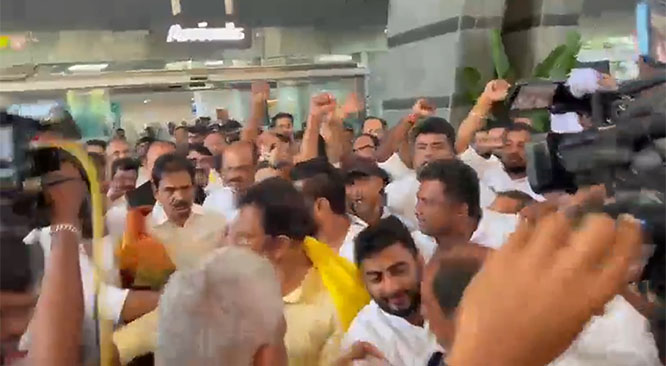
Mangaluru, Dec 3: A group of Congress workers gathered at the Mangaluru International Airport on Wednesday to welcome AICC general secretary K C Venugopal, but the reception quickly turned into a display of support for Deputy Chief Minister D K Shivakumar.

Venugopal arrived in the city to participate in the centenary commemoration of the historic dialogue between Mahatma Gandhi and Narayana Guru. The event, organised by the Sivagiri Mutt, Varkala, in association with the Mangalore University Sri Narayana Guru Study Chair, is being held on the university’s Konaje campus.

KPCC general secretary Mithun Rai and several party workers had assembled at the airport to receive Venugopal. However, the moment he stepped out, workers began raising slogans backing Shivakumar.

The university programme will be inaugurated by Chief Minister Siddaramaiah.

This show of support comes just a day after Siddaramaiah remarked that Shivakumar would lead the government “when the high command decides.” The chief minister made the comment after a breakfast meeting at Shivakumar’s residence—another public display of camaraderie between the two leaders amid ongoing attempts by the party high command to downplay their leadership rivalry.

Comments

Add new comment

  • Coastaldigest.com reserves the right to delete or block any comments.
  • Coastaldigset.com is not responsible for its readers’ comments.
  • Comments that are abusive, incendiary or irrelevant are strictly prohibited.
  • Please use a genuine email ID and provide your name to avoid reject.
News Network
December 6,2025

pilot.jpg

New Delhi: IndiGo, India’s largest airline, faced major operational turbulence this week after failing to prepare for new pilot-fatigue regulations issued by the Directorate General of Civil Aviation (DGCA). The stricter rules—designed to improve flight safety—took effect in phases through 2024, with the latest implementation on November 1. IndiGo has acknowledged that inadequate roster planning led to widespread cancellations and delays.

Below are the key DGCA rules that affected IndiGo’s operations:

1. Longer Mandatory Weekly Rest

Weekly rest for pilots has been increased from 36 hours to 48 hours.

The government says the extended break is essential to curb cumulative fatigue. This rule remains in force despite the current crisis.

2. Cap on Night Landings

Pilots can now perform only two night landings per week—a steep reduction from the earlier limit of six.

Night hours, defined as midnight to early morning, are considered the least alert period for pilots.

Given the disruptions, this rule has been temporarily relaxed for IndiGo until February 10.

3. Reduced Maximum Night Flight Duty

Flight duty that stretches into the night is now capped at 10 hours.

This measure has also been kept on hold for IndiGo until February 10 to stabilize operations.

4. Weekly Rest Cannot Be Replaced With Personal Leave

Airlines can no longer count a pilot’s personal leave as part of the mandatory 48-hour rest.

Pilots say this closes a loophole that previously reduced actual rest time.

Currently, all airlines are exempt from this rule to normalise travel.

5. Mandatory Fatigue Monitoring

Airlines must submit quarterly fatigue reports along with corrective actions to DGCA.

This system aims to create a transparent fatigue-tracking framework across the industry.

The DGCA has stressed that these rules were crafted to strengthen flight safety and align India with global fatigue-management standards. The temporary relaxations are expected to remain until February 2025, giving IndiGo time to stabilise its schedules and restore normal air travel.

Comments

Add new comment

  • Coastaldigest.com reserves the right to delete or block any comments.
  • Coastaldigset.com is not responsible for its readers’ comments.
  • Comments that are abusive, incendiary or irrelevant are strictly prohibited.
  • Please use a genuine email ID and provide your name to avoid reject.
News Network
December 4,2025

Mangaluru: Chaos erupted at Mangaluru International Airport (MIA) after IndiGo flight 6E 5150, bound for Mumbai, was repeatedly delayed and ultimately cancelled, leaving around 100 passengers stranded overnight. The incident highlights the ongoing country-wide operational disruptions affecting the airline, largely due to the implementation of new Flight Duty Time Limitations (FDTL) norms for crew.

The flight was initially scheduled for 9:25 PM on Tuesday but was first postponed to 11:40 PM, then midnight, before being cancelled around 3:00 AM. Passengers expressed frustration over last-minute communication and the lack of clarity, with elderly and ailing travellers particularly affected. “Though the airline arranged food, there was no proper communication, leaving us confused,” said one family member.

An IndiGo executive at MIA cited the FDTL rules, designed to prevent pilot fatigue by limiting crew working hours, as the cause of the cancellation. While alternative arrangements, including hotel stays, were offered, about 100 passengers chose to remain at the airport, creating tension. A replacement flight was arranged but also faced delays due to the same constraints, finally departing for Mumbai around 1:45 PM on Wednesday. Passengers either flew, requested refunds, or postponed their travel.

The Mangaluru delay is part of a broader crisis for IndiGo. The airline has been forced to make “calibrated schedule adjustments”—a euphemism for widespread cancellations and delays—after stricter FDTL norms came into effect on November 1.

While an IndiGo spokesperson acknowledged unavoidable flight disruptions due to technology issues, operational requirements, and the updated crew rostering rules, the DGCA has intervened, summoning senior airline officials to explain the chaos and outline corrective measures.

The ripple effect has been felt across the country, with major hubs like Bengaluru and Mumbai reporting numerous cancellations. The Mangaluru incident underscores the systemic operational strain currently confronting India’s largest carrier, leaving passengers nationwide grappling with uncertainty and delays.

Comments

Add new comment

  • Coastaldigest.com reserves the right to delete or block any comments.
  • Coastaldigset.com is not responsible for its readers’ comments.
  • Comments that are abusive, incendiary or irrelevant are strictly prohibited.
  • Please use a genuine email ID and provide your name to avoid reject.
