Modi's roadshow after voting earns ire; Election Commission called BJP’s puppet

Agencies
December 14, 2017

Ahmedabad/New Delhi, Dec 14: Prime Minister Narendra Modi's 'roadshow' after casting his vote in the second phase of Gujarat Assembly elections has created a fresh controversy with senior Congress leader P Chidambaram accusing the Election Commission of allowing a 'political campaign'.

Modi exercised his franchise on Thursday at Nishan School in Ranip area of Sabarmati Assembly constituency where BJP's sitting legislator Arvind Patel is fighting against Congress candidate Jitubhai Patel.

After voting, Modi came out of the polling booth to acknowledge a massive crowd. He walked down the road showing his inked finger to the crowd that roared with "Modi! Modi!" slogans. The prime minister after acknowledging the crowd drove off.

Congress leader P Chidambaram has accused the Election Commission of allowing the prime minister a "roadshow", saying it is a gross violation of rules and that the Commission was "sleeping on the job". "It is an election campaign. What is the EC doing?" he tweeted, reacting Modi displaying his inked finger.

The prime minister had violated the model code of conduct by holding a "roadshow" after voting in the Gujarat Assembly polls, Congress chief spokesperson Randeep Singh Surjewala alleged.

Addressing a press conference, he said the poll panel was a "puppet and frontal organisation" of the ruling BJP as it took no action against Modi.

"It is a sad day for the country as EC has denigrated the Constitution," Surjewala said.

Modi had created a similar controversy in 2014 as a prime ministerial candidate for taking a selfie with his party symbol and interacting with journalists after casting his vote.

When the Gujarat Chief Electoral Officer B B Swain was asked about the complaint lodged by Congress against the road show organised by the prime minister while casting his vote and it being aired by television channels, the CEO said, "I will have to look in to it."

On Thursday, about 2.2 crore voters were expected to cast their votes across 93 constituencies (40 Central Gujarat and 53 North Gujarat) at 25,558 polling booths to decide the fate of 851 candidates, including 782 males and 69 women candidates.

"The elections so far are going on peacefully, with minor reports of skirmishes between couple of persons outside polling areas. There were some defects with EVMs or VVPATs during mock testing and we have replaced them. However, defects are much lower than what we saw in the first phase," Swain said. "There is also complaint of bluetooth getting connected to EVM at a booth in Ghatlodia. We have initiated a process in the issue."

Informal reports coming in from various quarters suggest that almost 45% of electorate have cast their votes till 1 pm. Voting began at 8 am.

Among the prominent personalities who cast their votes in the second phase include Deputy Chief Minister Nitin Patel who cast his vote from his Mehsana constituency with his spouse; Prime Minister Narendra Modi's mother Hiraba in Gandhinagar; BJP president Amit Shah at Kameshwar in Naranpura constituency with his wife and son Jay Shah; former chief minister Anandiben at Shilaj; Union finance minister Arun Jaitley at Vejalpur constituency in Ahmedabad and Governor O P Kohli in Gandhinagar.

Among key opposition members, former chief minister Shankarsinh Vaghela cast his vote at Vasaniya Mahadev in Gandhinagar. State Congress chief Bharatsinh Solanki also excercised his franchise in the morning. Meanwhile, Patel quota stir leader Hardik Patel and his parents cast their votes from Viramgam constituency in North Gujarat.

State bureaucrats, including Gujarat chief electoral officer B B Swain and state chief secretary J N Singh were seen casting their votes.

Comments

Add new comment

  • Coastaldigest.com reserves the right to delete or block any comments.
  • Coastaldigset.com is not responsible for its readers’ comments.
  • Comments that are abusive, incendiary or irrelevant are strictly prohibited.
  • Please use a genuine email ID and provide your name to avoid reject.
News Network
December 3,2025

indigo.jpg

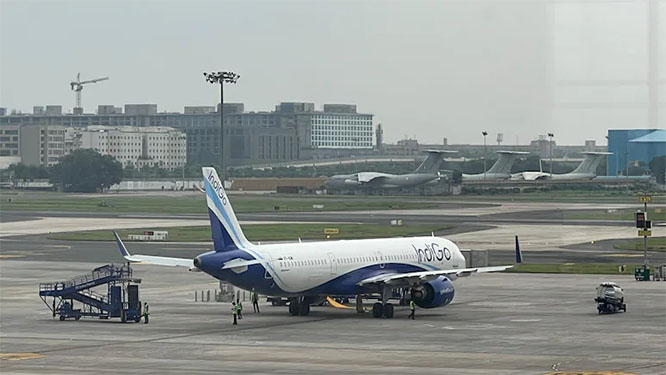
IndiGo, India’s largest airline, is battling one of its worst operational disruptions in recent years, with hundreds of delays and cancellations throwing domestic travel into chaos.

Government data on Tuesday showed its on-time performance plunging to 35%, an unusual dip for a carrier long associated with punctuality.

By Wednesday afternoon, airports in Delhi, Mumbai, Bengaluru and Hyderabad had collectively reported close to 200 cancellations, stranding travellers across the country.

Crew Shortage After New Duty Norms

A major trigger behind the meltdown is a severe crew shortage, especially among pilots, following the rollout of revised Flight Duty Time Limitation (FDTL) norms last month.

The rules mandate longer rest hours and more humane rosters — a shift IndiGo has struggled to incorporate across its vast network.

Sources said several flights were grounded due to lack of cabin crew, while some delays stretched upwards of eight hours.

With IndiGo controlling over 60% of India’s domestic aviation market, the ripple effect has impacted airports nationwide.

IndiGo Issues Apology, Lists “Compounding Factors”

In a statement, IndiGo acknowledged the large-scale disruption:

“We sincerely apologise to customers. A series of unforeseen operational challenges — technology glitches, winter schedule changes, adverse weather, system congestion and updated FDTL norms — created a compounding impact that could not have been anticipated.”

To stabilise operations, the airline has begun calibrated schedule adjustments for the next 48 hours, aiming to restore punctuality. Affected passengers are being offered refunds or alternate travel arrangements, IndiGo said.

What the FDTL Rules Require

The FDTL norms, designed to reduce pilot fatigue, cap duty and flying hours as follows:
•    Maximum 8 hours of flying per day
•    35 hours per week
•    125 hours per month
•    1,000 hours per year

Crew must also receive rest equalling twice the flight duration, with a minimum 10-hour rest period in any 24-hour window.

The DGCA introduced these limits to enhance flight safety.

Hyderabad: 33 Flights Cancelled, Long Queues Reported

Hyderabad’s Rajiv Gandhi International Airport saw heavy early-morning crowds as 33 IndiGo flights (arrivals and departures) were cancelled.

The airport clarified on X that operations were normal, advising passengers to contact IndiGo directly for latest flight status.

Cancellations included flights to and from Visakhapatnam, Goa, Ahmedabad, Delhi, Bengaluru, Chennai, Madurai, Hubli, Bhopal and Bhubaneswar.

Bengaluru: 42 Flights Disrupted

Bengaluru’s Kempegowda International Airport recorded 42 cancellations — 22 arrivals and 20 departures — affecting routes to Delhi, Mumbai, Chennai, Hyderabad, Goa, Kolkata and Lucknow.

Passengers Vent on Social Media

Irate travellers took to X to share their experiences. One passenger stranded in Hyderabad wrote: “I have been here since 3 a.m. and missed an important meeting.”

Another said: “My flight was pushed from 1:55 PM to 2:55 PM and now 4:35 PM. I was informed only three minutes before entering the airport.”

Delhi Airport Hit by Tech Glitch

At Delhi Airport, the disruption deepened due to a slowdown in the Amadeus system — used for reservations, check-ins and departure control.

The technical issue led to longer queues and sluggish processing, adding to delays already worsened by staff shortages.

Comments

Add new comment

  • Coastaldigest.com reserves the right to delete or block any comments.
  • Coastaldigset.com is not responsible for its readers’ comments.
  • Comments that are abusive, incendiary or irrelevant are strictly prohibited.
  • Please use a genuine email ID and provide your name to avoid reject.
News Network
November 30,2025

girlnomore.jpg

Mangaluru, Nov 30: A 22-year-old college student succumbed to her injuries at a private hospital in Mangaluru today, days after she was hit by a goods tempo while crossing a road in Padubidri.

The deceased has been identified as Preksha, a resident of Nadsalu Billitota in Padubidri. The fatal incident occurred as Preksha, who was returning home after completing her examination, attempted to cross the service road towards Mangaluru. She was struck by a goods tempo approaching from the Udupi side, causing her to fall and sustain a severe head injury.

Prompt action from local residents ensured she received immediate first aid before being rushed to a hospital in Mangaluru for specialised treatment. Despite medical efforts, she passed away while undergoing care.

Preksha was a student at Karavali College, Vamanjoor on the outskirts of Mangaluru city. The tragedy is compounded by the fact that she belonged to a financially vulnerable family, having previously lost her father. She is survived by her mother and brother.

A case related to the accident has been registered at the Padubidri police station, and an investigation is underway to determine the exact circumstances that led to the collision. The incident highlights the growing concerns over road safety, particularly on busy service roads, and serves as a tragic reminder of the human cost of traffic accidents.

Comments

Add new comment

  • Coastaldigest.com reserves the right to delete or block any comments.
  • Coastaldigset.com is not responsible for its readers’ comments.
  • Comments that are abusive, incendiary or irrelevant are strictly prohibited.
  • Please use a genuine email ID and provide your name to avoid reject.
News Network
December 6,2025

pilot.jpg

New Delhi: IndiGo, India’s largest airline, faced major operational turbulence this week after failing to prepare for new pilot-fatigue regulations issued by the Directorate General of Civil Aviation (DGCA). The stricter rules—designed to improve flight safety—took effect in phases through 2024, with the latest implementation on November 1. IndiGo has acknowledged that inadequate roster planning led to widespread cancellations and delays.

Below are the key DGCA rules that affected IndiGo’s operations:

1. Longer Mandatory Weekly Rest

Weekly rest for pilots has been increased from 36 hours to 48 hours.

The government says the extended break is essential to curb cumulative fatigue. This rule remains in force despite the current crisis.

2. Cap on Night Landings

Pilots can now perform only two night landings per week—a steep reduction from the earlier limit of six.

Night hours, defined as midnight to early morning, are considered the least alert period for pilots.

Given the disruptions, this rule has been temporarily relaxed for IndiGo until February 10.

3. Reduced Maximum Night Flight Duty

Flight duty that stretches into the night is now capped at 10 hours.

This measure has also been kept on hold for IndiGo until February 10 to stabilize operations.

4. Weekly Rest Cannot Be Replaced With Personal Leave

Airlines can no longer count a pilot’s personal leave as part of the mandatory 48-hour rest.

Pilots say this closes a loophole that previously reduced actual rest time.

Currently, all airlines are exempt from this rule to normalise travel.

5. Mandatory Fatigue Monitoring

Airlines must submit quarterly fatigue reports along with corrective actions to DGCA.

This system aims to create a transparent fatigue-tracking framework across the industry.

The DGCA has stressed that these rules were crafted to strengthen flight safety and align India with global fatigue-management standards. The temporary relaxations are expected to remain until February 2025, giving IndiGo time to stabilise its schedules and restore normal air travel.

Comments

Add new comment

  • Coastaldigest.com reserves the right to delete or block any comments.
  • Coastaldigset.com is not responsible for its readers’ comments.
  • Comments that are abusive, incendiary or irrelevant are strictly prohibited.
  • Please use a genuine email ID and provide your name to avoid reject.