To the Moon and back: 50 years on, a giant leap

Agencies
July 14, 2019

Washington, Jul 14: The first four days of Apollo 11's journey to the Moon had gone according to plan, but just twenty minutes before landing, the atmosphere grew tense as the crew encountered a series of problems.

It was July 20, 1969, and as the world followed the spacecraft's progress, it briefly lost radio contact with mission control in Houston. Then, as the lunar module Eagle was in the middle of its descent, piloted by Edwin "Buzz" Aldrin and mission commander Neil Armstrong, an alarm bell began ringing.

Eagle had detached two hours earlier from the main part of the vessel, the command module, Columbia, where the third crew member Michael Collins remained in orbit.

It was an anxious moment for Armstrong. "Give us a reading on the 1202 Programme Alarm," he radios to mission control. They are told to keep going. Houston realizes the onboard computer is experiencing an overflow, but all systems are functional.

Below them, the Moon's craters are zipping by fast. Too fast, realizes Armstrong: at this rate, they will overshoot the landing site by several miles.

He switches to manual control and starts to scope out a new landing site from his porthole. But there's trouble finding the perfect spot, and it's going to be tight.

Aldrin continues to tell him speed and altitude readings from the computer. "Coming down nicely," he says.

Meanwhile, the fuel is rapidly depleting. Houston continues to announce the number of seconds left to the "Bingo fuel call" -- the point at which Eagle will have 20 seconds left to land, or abort the mission. It is now 30 seconds left to Bingo.

Armstrong, summoning all his experience, is silent as he concentrates.

The module comes to a rest on the ground. "Contact Light," says Aldrin, meaning one of the leg's foot sensors has touched down. The engines are switched off.

"Houston, Tranquility Base here. The Eagle has landed," announces Armstrong.

"We copy you on the ground. You got a bunch of guys about to turn blue. We're breathing again. Thanks a lot," replies Charlie Duke, the CapCom or capsule communicator on the ground.

In 1961, President John F Kennedy called upon his vice president Lyndon Johnson to beat the Soviets in space.

Johnson reaches out to the godfather of NASA's space program: Wernher von Braun. The former card-carrying Nazi was the inventor of the V-2 rockets that rained destruction on London in World War II. Toward the end of the war, he surrendered himself to the Americans, who brought him and a hundred of his best engineers to Alabama, as part of the secret "Operation Paperclip."

Braun told Johnson that while the US was well behind, they could conceivably beat the Russians if they immediately started work on a giant booster rocket.

Eight years later, Richard Nixon was president when the goal was realized.

Between October 1968 and May 1969, four preparatory Apollo missions were launched. Armstrong was chosen in December 1968 to command the eleventh.

Months from launch, Armstrong told Aldrin he was pulling rank and would be the first to set foot on the lunar surface.

When the monstrous rocket designed by Braun launched with the Apollo 11 capsule at its summit on July 16, 1969, one million people flocked to the beach to watch.

But many had doubts that they'd succeed in landing on the Moon on the first attempt. For those in America, the final descent would take place on Sunday evening.

In Europe, it was already nighttime, but everyone was glued to their televisions, though they could only hear crackling radio communications until Armstrong set up his black and white camera ahead of his first step.

As he climbed down to the foot of the ladder, he observed that Eagle's footpads had sunk into the ground by only an inch or two, and the surface appeared very fine grained. "It's almost like a powder," he recalled.

Then, over the radio: "Okay. I'm going to step off the LM now." A pause, and then the immortal words: "That's one small step for man; one giant leap for mankind."

According to Armstrong, the line wasn't scripted. "I thought about it after landing," he would say in an oral history recorded by NASA in 2001.

One problem: without the indefinite article ("a man"), it wasn't grammatically correct. Armstrong said he meant to say it, but agreed it was inaudible.

What does the Moon look like, up close?

Its colour varies with the angle of the Sun: from brown to grey to black as coal. And the lower level of gravity takes getting used to.

"I started jogging around a bit, and it felt like I was moving in slow motion in a lazy lope, often with both of my feet floating in the air," Aldrin wrote in a book in 2009.

Over the course of two-and-a-half hours, Armstrong picks up piles and piles of Moon rocks and takes photographs. Aldrin installs a seismometer and two other scientific instruments.

They plant the US flag, and leave behind a host of items including a medal honouring the first man in space, Russia's Yuri Gagarin.

Happily, the lunar module's engine worked, it rendezvoused back with Columbia, and the trio began the long journey home.

On July 24, it enters the atmosphere, becoming for a while a fireball in the sky before deploying three parachutes and splashing down safely into the Pacific.

At their first press conference, three weeks later, reporters asked the three men, now global heroes, whether they would ever consider returning to the Moon.

"In the Lunar Receiving Laboratory, we had very little time for meditation," replied Armstrong, ever to the point.

None of them would go back to space ever again.

After six more missions, the Apollo programme was terminated in 1972.

It was not until Donald Trump came to office that the US would decide to return to the Moon, under the Artemis program, named for Apollo's twin sister.

Comments

Add new comment

  • Coastaldigest.com reserves the right to delete or block any comments.
  • Coastaldigset.com is not responsible for its readers’ comments.
  • Comments that are abusive, incendiary or irrelevant are strictly prohibited.
  • Please use a genuine email ID and provide your name to avoid reject.
News Network
November 26,2025

Mangaluru, Nov 26: Assembly Speaker and local MLA U.T. Khader has initiated a high-level push to resolve one of Mangaluru’s longest-standing traffic headaches: the narrow, high-density stretch of National Highway-66 between Nanthoor and Talapady.

He announced on Tuesday that a formal proposal has been submitted to the Union Ministry of Road Transport and Highways (MoRTH) seeking approval to prepare a Detailed Project Report (DPR) for the widening of this crucial corridor.

The plan specifically aims to expand the existing 45-meter road width to a full 60 meters, coupled with the construction of dedicated service roads. Khader highlighted that land for a 60-meter highway was originally acquired during the initial four-laning project, but only 45 meters were developed, leading to a perpetual bottleneck.

"With vehicle density rising sharply, the expansion has become unavoidable," Khader stated, stressing that the upgrade is essential for ensuring smoother traffic flow and improving safety at the city's main entry and exit points.

The stretch between Nanthoor and Talapady is a vital link on the busy Kochi-Panvel coastal highway and connects to major city junctions. The move to utilize the previously acquired land for the full 60-meter width is seen as a necessary measure to catch up with the region's rapid vehicular growth and prevent further traffic gridlocks.

Comments

Add new comment

  • Coastaldigest.com reserves the right to delete or block any comments.
  • Coastaldigset.com is not responsible for its readers’ comments.
  • Comments that are abusive, incendiary or irrelevant are strictly prohibited.
  • Please use a genuine email ID and provide your name to avoid reject.
News Network
December 4,2025

Mangaluru: Chaos erupted at Mangaluru International Airport (MIA) after IndiGo flight 6E 5150, bound for Mumbai, was repeatedly delayed and ultimately cancelled, leaving around 100 passengers stranded overnight. The incident highlights the ongoing country-wide operational disruptions affecting the airline, largely due to the implementation of new Flight Duty Time Limitations (FDTL) norms for crew.

The flight was initially scheduled for 9:25 PM on Tuesday but was first postponed to 11:40 PM, then midnight, before being cancelled around 3:00 AM. Passengers expressed frustration over last-minute communication and the lack of clarity, with elderly and ailing travellers particularly affected. “Though the airline arranged food, there was no proper communication, leaving us confused,” said one family member.

An IndiGo executive at MIA cited the FDTL rules, designed to prevent pilot fatigue by limiting crew working hours, as the cause of the cancellation. While alternative arrangements, including hotel stays, were offered, about 100 passengers chose to remain at the airport, creating tension. A replacement flight was arranged but also faced delays due to the same constraints, finally departing for Mumbai around 1:45 PM on Wednesday. Passengers either flew, requested refunds, or postponed their travel.

The Mangaluru delay is part of a broader crisis for IndiGo. The airline has been forced to make “calibrated schedule adjustments”—a euphemism for widespread cancellations and delays—after stricter FDTL norms came into effect on November 1.

While an IndiGo spokesperson acknowledged unavoidable flight disruptions due to technology issues, operational requirements, and the updated crew rostering rules, the DGCA has intervened, summoning senior airline officials to explain the chaos and outline corrective measures.

The ripple effect has been felt across the country, with major hubs like Bengaluru and Mumbai reporting numerous cancellations. The Mangaluru incident underscores the systemic operational strain currently confronting India’s largest carrier, leaving passengers nationwide grappling with uncertainty and delays.

Comments

Add new comment

  • Coastaldigest.com reserves the right to delete or block any comments.
  • Coastaldigset.com is not responsible for its readers’ comments.
  • Comments that are abusive, incendiary or irrelevant are strictly prohibited.
  • Please use a genuine email ID and provide your name to avoid reject.
coastaldigest.com news network
November 29,2025

health1.jpg

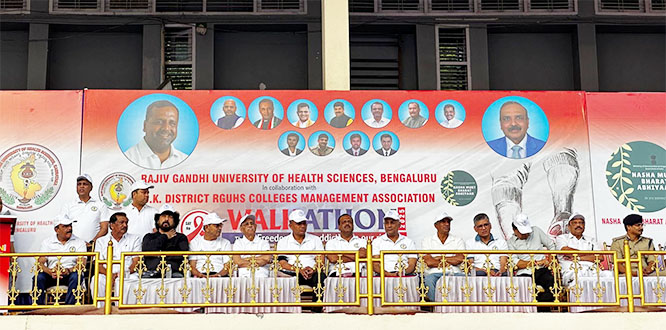
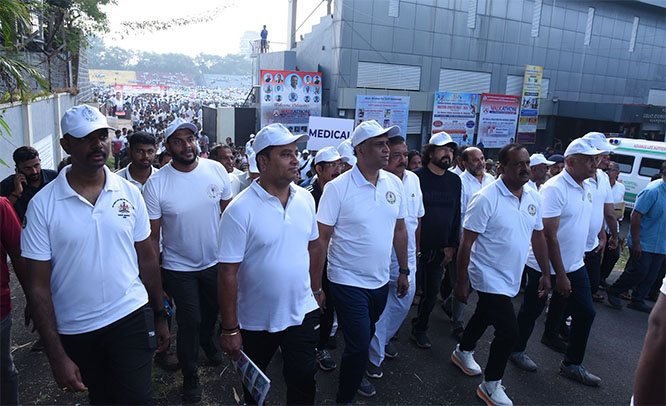
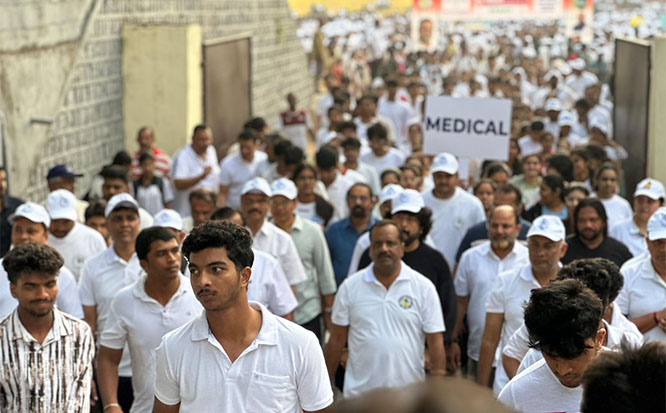
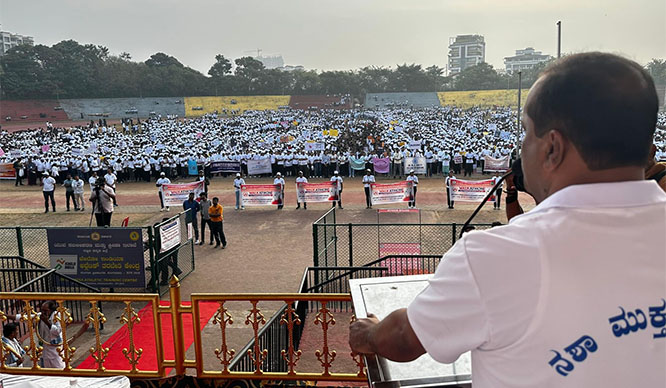
Mangaluru, Nov 29: Around 12,500 healthcare students from Medical, Dental, AYUSH, Pharmacy, Nursing, Physiotherapy and Allied Health Sciences colleges of Dakshina Kannada, affiliated to Rajiv Gandhi University of Health Sciences (RGUHS), took part in a massive walkathon to promote awareness on Organ Donation and Nasha Mukth Bharat.

The inaugural ceremony was held at Mangala Stadium. Dr Bhagavan B C, Hon’ble Vice-Chancellor of RGUHS, delivered the welcome address. The walkathon was flagged off by Shri U T Khader, Hon’ble Speaker of the Karnataka Legislative Assembly, and presided over by Shri Dinesh Gundu Rao, Hon’ble Minister for Health, Family Welfare and Dakshina Kannada District In-charge. Dakshina Kannada MP Shri Brijesh Chowta also addressed the students.

Music director Guru Kiran, MLA Dr Bharat Shetty (Mangalore North), Police Commissioner Shri Sudheer Kumar Reddy, Shri Manjunath Bhandary and Shri Harish Kumar were among those present.

Institution heads including Dr Haji U K Monu (Kanachur Colleges), Dr Shantharam Shetty (Tejaswini College), Dr Bhaskar Shetty (City Group of Colleges), Mr Abdul Rahiman (Kanachur Institute of Medical Sciences), and the District Health Officer, Mangalore, also participated.

The vote of thanks was delivered by Prof U T Ifthikar Fareed, Syndicate Member, RGUHS.

The event was organised by Dr U T Ifthikar Ali and Dr Shiva Sharan (Syndicate Members), Prof Vaishali (Senate Member), Prof Mohammad Suhail (Chairman, BOS Physiotherapy), Dr Sharan Shetty (Former Senate Member), along with principals and faculty of various colleges.

Students marched from Mangala Stadium to Karavali Grounds via MCC and Lalbagh signal. The event set a record as one of the largest gatherings of healthcare students for a social cause in the RGUHS Dakshina Kannada Zone.

health7.jpg

health6.jpg

health5.jpg

health4.jpg

health3.jpg

health2.jpg

Comments

Add new comment

  • Coastaldigest.com reserves the right to delete or block any comments.
  • Coastaldigset.com is not responsible for its readers’ comments.
  • Comments that are abusive, incendiary or irrelevant are strictly prohibited.
  • Please use a genuine email ID and provide your name to avoid reject.