



Dakshina Kannada Joins Elite Club of India’s Top 10 Richest Districts, Overtakes Mumbai and Ahmedabad

coastaldigest.com news network
August 23, 2025

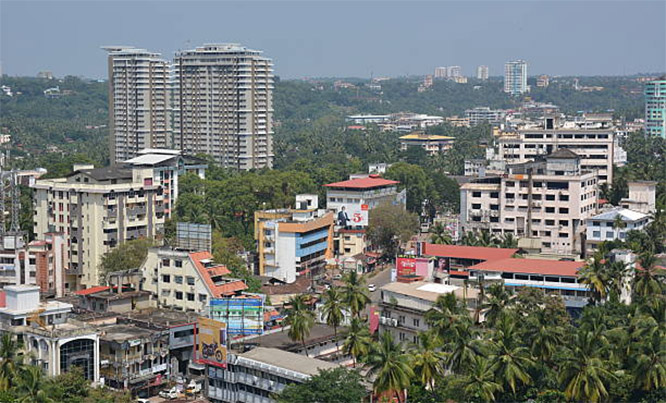
mangalurucity.jpg

Bengaluru, Aug 23: Dakshina Kannada has stunned observers by emerging among the top 10 richest districts in India, overtaking financial powerhouses like Mumbai and Ahmedabad. According to the Economic Survey 2024–25, released by the Union Ministry of Finance, the coastal Karnataka district recorded a per capita GDP of ₹6.69 lakh during the fiscal year 2024–25, placing it eighth on the national list.

Dakshina Kannada’s Formula for Prosperity

The district’s rise is rooted in a unique mix of trade, education, finance, and services:

•    Port-led trade: Mangaluru’s New Mangalore Port serves as a vital gateway for petroleum, iron ore, fertilizers, and container cargo, fuelling large-scale commerce.

•    Education hub: Home to reputed medical, engineering, and management institutions, the district attracts students nationwide and internationally, building a knowledge-driven economy.

•    Banking legacy: Known as the birthplace of major banks like Canara Bank, Corporation Bank, and Syndicate Bank, Dakshina Kannada has a long-standing financial culture.

•    Agriculture & fisheries: Marine exports, cashew processing, and plantation crops like coffee and areca nut continue to drive rural prosperity.

•    Emerging IT & services: With IT parks in Mangaluru and a young talent pool, the district is steadily expanding its digital economy.
This balanced model has made Dakshina Kannada one of the few non-metro regions to compete with India’s most industrialized and financial districts.

India’s Top 10 Richest Districts (2024–25)

The survey highlights how services, IT, industry, and tourism are shaping regional prosperity. The top performers include both mega metros and smaller but highly specialized economies:

1.    Rangareddy, Telangana – ₹11.46 lakh (per capita GDP)
Hyderabad’s IT corridor, pharma hub, and expansive tech parks make Rangareddy the undisputed leader.

2.    Gurgaon, Haryana – ₹9.05 lakh (per capita GDP)
A corporate magnet with MNCs, startups, and real estate fueling its rapid rise.

3.    Bengaluru Urban, Karnataka – ₹8.93 lakh (per capita GDP)
India’s Silicon Valley, driven by IT exports, R&D, and a deep talent base.

4.    Gautam Buddha Nagar (Noida), Uttar Pradesh – ₹8.48 lakh (per capita GDP)
A growth dynamo blending IT, manufacturing, and real estate.

5.    Solan, Himachal Pradesh – ₹8.10 lakh (per capita GDP)
A surprise industrial powerhouse, thanks to food processing and pharmaceuticals.

6.    North & South Goa – ₹7.63 lakh (per capita GDP)
Beaches, tourism, hospitality, and lifestyle economy keep Goa among the richest.

7.    Gangtok, Namchi, Mangan & Gyalshing, Sikkim – ₹7.46 lakh (per capita GDP)
Sustainable tourism and eco-friendly growth drive Sikkim’s prosperity.

8.    Dakshina Kannada, Karnataka – ₹6.69 lakh (per capita GDP)
A coastal powerhouse balancing port trade, education, banking, and IT.

9.    Mumbai, Maharashtra – ₹6.57 lakh (per capita GDP)
The nation’s financial capital, home to stock markets, corporate HQs, and services.

10.    Ahmedabad, Gujarat – ₹6.54 lakh (per capita GDP)
An industrial giant blending textiles, manufacturing, and modern services.

The Bigger Picture

The Economic Survey 2024–25 underlines that India’s richest districts are not limited to metros. While cities like Bengaluru, Gurgaon, and Noida thrive on IT and corporate services, districts like Solan, Goa, Sikkim, and Dakshina Kannada prove that specialized industries, tourism, and knowledge-based economies can rival traditional giants.

For Dakshina Kannada, the ranking is more than just a number—it is a recognition of how a coastal district with strong institutions and trade networks can stand shoulder-to-shoulder with India’s biggest metros in driving national growth.

Comments

Add new comment

  • Coastaldigest.com reserves the right to delete or block any comments.
  • Coastaldigset.com is not responsible for its readers’ comments.
  • Comments that are abusive, incendiary or irrelevant are strictly prohibited.
  • Please use a genuine email ID and provide your name to avoid reject.
News Network
January 23,2026

Karnataka Governor Thaawarchand Gehlot read only three lines from the 122-paragraph address prepared by the Congress-led state government while addressing the joint session of the Legislature on Thursday, effectively bypassing large sections critical of the BJP-led Union government.

The omitted portions of the customary Governor’s address outlined what the state government described as a “suppressive situation in economic and policy matters” under India’s federal framework. The speech also sharply criticised the Centre’s move to replace the Mahatma Gandhi National Rural Employment Guarantee Act (MGNREGA) with the Viksit Bharat–Guarantee for Rozgar and Ajeevika Mission (Gramin) Act, commonly referred to as the VB-GRAM (G) Act.

Governor Gehlot had earlier conveyed his objection to several paragraphs that were explicitly critical of the Union government. On Thursday, he confined himself to the opening lines — “I extend a warm welcome to all of you to the joint session of the State legislature. I am extremely pleased to address this august House” — before jumping directly to the concluding sentence of the final paragraph.

He ended the address by reading the last line of paragraph 122: “Overall, my government is firmly committed to doubling the pace of the State’s economic, social and physical development. Jai Hind — Jai Karnataka.”

According to the prepared speech, the Karnataka government demanded the scrapping of the VB-GRAM (G) Act, describing it as “contractor-centric” and detrimental to rural livelihoods, and called for the full restoration of MGNREGA. The state government argued that the new law undermines decentralisation, weakens labour protections, and centralises decision-making in violation of constitutional norms.

Key points from the unread sections of the speech:

•    Karnataka facing a “suppressive” economic and policy environment within the federal system

•    Repeal of MGNREGA described as a blow to rural livelihoods

•    VB-GRAM (G) Act accused of protecting corporate and contractor interests

•    New law alleged to weaken decentralised governance

•    Decision-making said to be imposed by the Centre without consulting states

•    Rights of Adivasis, women, backward classes and agrarian communities curtailed

•    Labourers allegedly placed under contractor control

•    States facing mounting fiscal stress due to central policies

•    VB-GRAM (G) Act accused of enabling large-scale corruption

Comments

Add new comment

  • Coastaldigest.com reserves the right to delete or block any comments.
  • Coastaldigset.com is not responsible for its readers’ comments.
  • Comments that are abusive, incendiary or irrelevant are strictly prohibited.
  • Please use a genuine email ID and provide your name to avoid reject.
News Network
January 23,2026

Mangaluru: The Karnataka Government Polytechnic (KPT), Mangaluru, has achieved autonomous status from the All India Council for Technical Education (AICTE), becoming the first government polytechnic in the country to receive such recognition in its 78-year history. The status was granted by AICTE, New Delhi, and subsequently approved by the Karnataka Board of Technical Education in October last year.

Officials said the autonomy was conferred a few months ago. Until recently, AICTE extended autonomous status only to engineering colleges, excluding diploma institutions. However, with a renewed national focus on skill development, several government polytechnics across India have now been granted autonomy.

KPT, the second-largest polytechnic in Karnataka, was established in 1946 with four branches and has since expanded to offer eight diploma programmes, including computer science and polymer technology. The institution is spread across a 19-acre campus.

Ravindra M Keni, the first dean of the institution, told The Times of India that AICTE had proposed autonomous status for polytechnic institutions that are over 25 years old. “Many colleges applied. In the first round, 100 institutions were shortlisted, which was further narrowed down to 15 in the second round. We have already completed one semester after becoming an autonomous institution,” he said. He added that nearly 500 students are admitted annually across eight three-year diploma courses.

Explaining the factors that helped KPT secure autonomy, Keni said the institution has consistently recorded 100 per cent admissions and placements for its graduates. He also noted its strong performance in sports, with the college emerging champions for 12 consecutive years, along with active student participation in NCC and NSS activities.

Autonomous status allows KPT to design industry-oriented curricula, conduct examinations, prepare question papers, and manage academic documentation independently. The institution can also directly collaborate with industries and receive priority funding from AICTE or the Ministry of Education. While academic autonomy has been granted, financial control will continue to rest with the state government.

“There will be separate committees for examinations, question paper setting, boards of studies, and boards of examiners. The institution will now have the freedom to conduct admissions without government notifications and issue its own marks cards,” Keni said, adding that new academic initiatives would be planned after a year of functioning under the autonomous framework.

Comments

Add new comment

  • Coastaldigest.com reserves the right to delete or block any comments.
  • Coastaldigset.com is not responsible for its readers’ comments.
  • Comments that are abusive, incendiary or irrelevant are strictly prohibited.
  • Please use a genuine email ID and provide your name to avoid reject.
News Network
January 23,2026

Karnataka Governor Thaawarchand Gehlot read only three lines from the 122-paragraph address prepared by the Congress-led state government while addressing the joint session of the Legislature on Thursday, effectively bypassing large sections critical of the BJP-led Union government.

The omitted portions of the customary Governor’s address outlined what the state government described as a “suppressive situation in economic and policy matters” under India’s federal framework. The speech also sharply criticised the Centre’s move to replace the Mahatma Gandhi National Rural Employment Guarantee Act (MGNREGA) with the Viksit Bharat–Guarantee for Rozgar and Ajeevika Mission (Gramin) Act, commonly referred to as the VB-GRAM (G) Act.

Governor Gehlot had earlier conveyed his objection to several paragraphs that were explicitly critical of the Union government. On Thursday, he confined himself to the opening lines — “I extend a warm welcome to all of you to the joint session of the State legislature. I am extremely pleased to address this august House” — before jumping directly to the concluding sentence of the final paragraph.

He ended the address by reading the last line of paragraph 122: “Overall, my government is firmly committed to doubling the pace of the State’s economic, social and physical development. Jai Hind — Jai Karnataka.”

According to the prepared speech, the Karnataka government demanded the scrapping of the VB-GRAM (G) Act, describing it as “contractor-centric” and detrimental to rural livelihoods, and called for the full restoration of MGNREGA. The state government argued that the new law undermines decentralisation, weakens labour protections, and centralises decision-making in violation of constitutional norms.

Key points from the unread sections of the speech:

•    Karnataka facing a “suppressive” economic and policy environment within the federal system

•    Repeal of MGNREGA described as a blow to rural livelihoods

•    VB-GRAM (G) Act accused of protecting corporate and contractor interests

•    New law alleged to weaken decentralised governance

•    Decision-making said to be imposed by the Centre without consulting states

•    Rights of Adivasis, women, backward classes and agrarian communities curtailed

•    Labourers allegedly placed under contractor control

•    States facing mounting fiscal stress due to central policies

•    VB-GRAM (G) Act accused of enabling large-scale corruption

Comments

Add new comment

  • Coastaldigest.com reserves the right to delete or block any comments.
  • Coastaldigset.com is not responsible for its readers’ comments.
  • Comments that are abusive, incendiary or irrelevant are strictly prohibited.
  • Please use a genuine email ID and provide your name to avoid reject.