Halal row: Circular from Animal Husbandry Dept says ‘stunning’ of animal must before slaughter

News Network
April 2, 2022

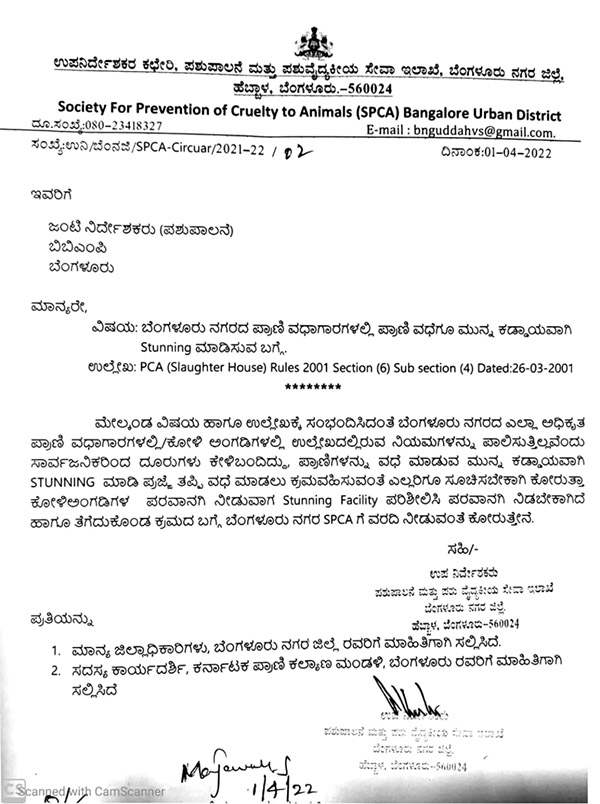
As the saffron outfits are intensifying campaign against halal meat, the Department of Animal Husbandry and Veterinary Services in Karnataka has mandated in a circular dated April 1, that animals have to ‘stunned’ before they can be slaughtered for meat.

This comes after animal lovers pointed towards the Prevention of Cruelty to Animals Rules, which were drafted in 2001. These rules state that animals need to stunned before they can be slaughtered.

The stunning process ensures the animal is unconscious and insensible to pain before being bled out at the slaughter house.

As per Section 6 in The Prevention of Cruelty to Animals (Slaughter House) Rules, 2001, rule number 4, 'every slaughter house as soon as possible shall provide a separate space for stunning of animals prior to slaughter, bleeding and dressing of the carcasses.'

The order was passed by the Union government in 2001, and the rule has since then existed in books, however, after activists brought it back in the public eye, it is being pressed for implementation.

It is being reported that Bangalore Urban District AHVS Deputy Director and SPCA Member Dr. Umapathi has issued circulars to all Societies for the Prevention of Cruelty to Animals (SPCAs) in Bengaluru Urban District on Friday for following mandatory stunning of animals and making them unconscious before slaughtering them as per PCA (Slaughter House) Rules 2001.

Following this, the Animal Husbandry department also mandated the rule, asking the BBMP to supervise if meat shops are equipped with the stunning facilities. The department also asked BBMP to submit a report to the Society for Prevention of Cruelty to Animals whether or not the practice of 'stunning' is being followed or not.

However, Prabhu Chauhan, the Minister of State for Animal Husbandry Department told TV9 that his department has not issued the mandatory ‘stunning’ order. "No orders have been issued by our department. Stunning is not mandatory. There was only a letter written that Halal cut should not be practiced. There was no order issued. I will review the letter," he said.

The controversy began when some right-wing groups gave a call to boycott 'Halal' meat, with the Hindu Janajagrithi Samithi, a hindutva organisation in Karnataka, starting a campaign against the purchase of Halal meat.

The BJP's National General Secretary C T Ravi added fuel to this, comparing Halal meat to ‘economic jihad’, saying that ‘halal’ is used like a jihad so that Muslims should not do business with others. This came amid a flurry of messages on social media, appealing to Hindus to shun Halal meat, especially after the festival of Ugadi, which is being celebrated on April 2, Saturday this year.

In reference to the controversy, Karnataka Chief Minister Basavaraj Bommai said that the state government will look into the halal meat issue as "serious objections" have been raised about it, a day after which, some Bajrang Dal activists allegedly attacked a Muslim vendor in Bhadravathi for selling halal meat.

animal.jpg

Comments

Add new comment

  • Coastaldigest.com reserves the right to delete or block any comments.
  • Coastaldigset.com is not responsible for its readers’ comments.
  • Comments that are abusive, incendiary or irrelevant are strictly prohibited.
  • Please use a genuine email ID and provide your name to avoid reject.
News Network
December 6,2025

pilot.jpg

New Delhi: IndiGo, India’s largest airline, faced major operational turbulence this week after failing to prepare for new pilot-fatigue regulations issued by the Directorate General of Civil Aviation (DGCA). The stricter rules—designed to improve flight safety—took effect in phases through 2024, with the latest implementation on November 1. IndiGo has acknowledged that inadequate roster planning led to widespread cancellations and delays.

Below are the key DGCA rules that affected IndiGo’s operations:

1. Longer Mandatory Weekly Rest

Weekly rest for pilots has been increased from 36 hours to 48 hours.

The government says the extended break is essential to curb cumulative fatigue. This rule remains in force despite the current crisis.

2. Cap on Night Landings

Pilots can now perform only two night landings per week—a steep reduction from the earlier limit of six.

Night hours, defined as midnight to early morning, are considered the least alert period for pilots.

Given the disruptions, this rule has been temporarily relaxed for IndiGo until February 10.

3. Reduced Maximum Night Flight Duty

Flight duty that stretches into the night is now capped at 10 hours.

This measure has also been kept on hold for IndiGo until February 10 to stabilize operations.

4. Weekly Rest Cannot Be Replaced With Personal Leave

Airlines can no longer count a pilot’s personal leave as part of the mandatory 48-hour rest.

Pilots say this closes a loophole that previously reduced actual rest time.

Currently, all airlines are exempt from this rule to normalise travel.

5. Mandatory Fatigue Monitoring

Airlines must submit quarterly fatigue reports along with corrective actions to DGCA.

This system aims to create a transparent fatigue-tracking framework across the industry.

The DGCA has stressed that these rules were crafted to strengthen flight safety and align India with global fatigue-management standards. The temporary relaxations are expected to remain until February 2025, giving IndiGo time to stabilise its schedules and restore normal air travel.

Comments

Add new comment

  • Coastaldigest.com reserves the right to delete or block any comments.
  • Coastaldigset.com is not responsible for its readers’ comments.
  • Comments that are abusive, incendiary or irrelevant are strictly prohibited.
  • Please use a genuine email ID and provide your name to avoid reject.
News Network
December 4,2025

Mangaluru: Chaos erupted at Mangaluru International Airport (MIA) after IndiGo flight 6E 5150, bound for Mumbai, was repeatedly delayed and ultimately cancelled, leaving around 100 passengers stranded overnight. The incident highlights the ongoing country-wide operational disruptions affecting the airline, largely due to the implementation of new Flight Duty Time Limitations (FDTL) norms for crew.

The flight was initially scheduled for 9:25 PM on Tuesday but was first postponed to 11:40 PM, then midnight, before being cancelled around 3:00 AM. Passengers expressed frustration over last-minute communication and the lack of clarity, with elderly and ailing travellers particularly affected. “Though the airline arranged food, there was no proper communication, leaving us confused,” said one family member.

An IndiGo executive at MIA cited the FDTL rules, designed to prevent pilot fatigue by limiting crew working hours, as the cause of the cancellation. While alternative arrangements, including hotel stays, were offered, about 100 passengers chose to remain at the airport, creating tension. A replacement flight was arranged but also faced delays due to the same constraints, finally departing for Mumbai around 1:45 PM on Wednesday. Passengers either flew, requested refunds, or postponed their travel.

The Mangaluru delay is part of a broader crisis for IndiGo. The airline has been forced to make “calibrated schedule adjustments”—a euphemism for widespread cancellations and delays—after stricter FDTL norms came into effect on November 1.

While an IndiGo spokesperson acknowledged unavoidable flight disruptions due to technology issues, operational requirements, and the updated crew rostering rules, the DGCA has intervened, summoning senior airline officials to explain the chaos and outline corrective measures.

The ripple effect has been felt across the country, with major hubs like Bengaluru and Mumbai reporting numerous cancellations. The Mangaluru incident underscores the systemic operational strain currently confronting India’s largest carrier, leaving passengers nationwide grappling with uncertainty and delays.

Comments

Add new comment

  • Coastaldigest.com reserves the right to delete or block any comments.
  • Coastaldigset.com is not responsible for its readers’ comments.
  • Comments that are abusive, incendiary or irrelevant are strictly prohibited.
  • Please use a genuine email ID and provide your name to avoid reject.
News Network
December 4,2025

Udupi: A 40-year-old NRI from Udupi has reportedly lost more than Rs 12.25 lakh in an online investment scam operated through Telegram.

According to a complaint filed at the CEN police station, Leo Jerome Mendonsa, who has been working in Dubai for the past 15 years in computer accessories sales, maintains NRI accounts in Karkala and Nitte.

On November 12, 2025, Mendonsa was added to a Telegram group called Instaflow Earnings by unknown individuals. Users identified as Priya and Dipannita persuaded him to invest in “Revenue Tasks.” Initially, Mendonsa transferred Rs 1,100 multiple times and received the promised returns, encouraging him to continue.

On November 14, another user, Nishmitha Shetty, directed him to register on a website, digitvisionuoce.cc, and invest Rs 4 lakh in various shares. Over the next few days, he made multiple transfers totaling Rs 12,25,000, including Rs 50,000 via Google Pay, believing the scheme was legitimate.

After receiving the money, the alleged handlers stopped responding, and neither the invested amount nor the promised profits were returned.

The CEN police have registered a case under Sections 66(C) and 66(D) of the IT Act and Section 318(4) of the Bharatiya Nyaya Sanhita (BNS), and investigations are ongoing.

Comments

Add new comment

  • Coastaldigest.com reserves the right to delete or block any comments.
  • Coastaldigset.com is not responsible for its readers’ comments.
  • Comments that are abusive, incendiary or irrelevant are strictly prohibited.
  • Please use a genuine email ID and provide your name to avoid reject.