



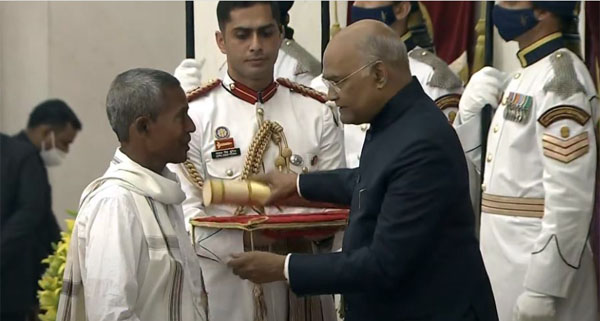
Harekala Hajabba receives Padma Shri Award at Rashtrapati Bhawan

coastaldigest.com news network
November 8, 2021

hajabbaharekala.jpg

New Delhi, Nov 8: Harekala Hajabba, the real life hero of coastal Karnataka, today formally received the Padma Shri Award 2020.

President Ramanath Kovind conferred the prestigious honour at the Rashtrapati Bhavan in the presence of Prime Minister Narendra Modi and Home Minister Amit Shah among others.

Hajabba, the orange seller who saved money to build a school in his village, was declared the recipient of one of the highest civilian honours of India on January 25, 2020. Hajabba received a letter intimating that the certificate signed by the President will be presented to him in March, but the ceremony was delayed due to the pandemic.

“I have been in touch with the office of the Dakshina Kannada MP Nalin Kumar Kateel to make necessary arrangements for my travel to New Delhi for the ceremony. I will preserve this prestigious honour bestowed on me in my house along with other awards, mementos and certificates that I received from more than 500 organisations,” he said.

Hajabba, 65, an illiterate fruit vendor who is popularly known as ‘Akshara Santa’ (Saint of Letters), was successful in building a school to educate children of his village in New Padpu, Harekala, located about 35 km from Mangaluru city. Deeply pained that he could not study as his village did not have a school, he took it up as a challenge and his journey towards building a school in Harekala began in 1995. 

He left no stone unturned to get land for the school and for approval from the education department. His dream turned into reality when Dakshina Kannada zilla panchayat sanctioned a school in 1999.

Initially, Dakshina Kannada Zilla Panchayat Lower Primary School popular as ‘Hajabba avara Shale’ (Hajabba’s school) was functioning in a mosque. Later, Hajabba built classrooms for the school on 40 cents of land sanctioned by the district administration.


Comments

ummar
 - 
Monday, 8 Nov 2021

I really appreciate him. He is the real hero of the KARNATAKA

Add new comment

  • Coastaldigest.com reserves the right to delete or block any comments.
  • Coastaldigset.com is not responsible for its readers’ comments.
  • Comments that are abusive, incendiary or irrelevant are strictly prohibited.
  • Please use a genuine email ID and provide your name to avoid reject.
News Network
December 6,2025

pilot.jpg

New Delhi: IndiGo, India’s largest airline, faced major operational turbulence this week after failing to prepare for new pilot-fatigue regulations issued by the Directorate General of Civil Aviation (DGCA). The stricter rules—designed to improve flight safety—took effect in phases through 2024, with the latest implementation on November 1. IndiGo has acknowledged that inadequate roster planning led to widespread cancellations and delays.

Below are the key DGCA rules that affected IndiGo’s operations:

1. Longer Mandatory Weekly Rest

Weekly rest for pilots has been increased from 36 hours to 48 hours.

The government says the extended break is essential to curb cumulative fatigue. This rule remains in force despite the current crisis.

2. Cap on Night Landings

Pilots can now perform only two night landings per week—a steep reduction from the earlier limit of six.

Night hours, defined as midnight to early morning, are considered the least alert period for pilots.

Given the disruptions, this rule has been temporarily relaxed for IndiGo until February 10.

3. Reduced Maximum Night Flight Duty

Flight duty that stretches into the night is now capped at 10 hours.

This measure has also been kept on hold for IndiGo until February 10 to stabilize operations.

4. Weekly Rest Cannot Be Replaced With Personal Leave

Airlines can no longer count a pilot’s personal leave as part of the mandatory 48-hour rest.

Pilots say this closes a loophole that previously reduced actual rest time.

Currently, all airlines are exempt from this rule to normalise travel.

5. Mandatory Fatigue Monitoring

Airlines must submit quarterly fatigue reports along with corrective actions to DGCA.

This system aims to create a transparent fatigue-tracking framework across the industry.

The DGCA has stressed that these rules were crafted to strengthen flight safety and align India with global fatigue-management standards. The temporary relaxations are expected to remain until February 2025, giving IndiGo time to stabilise its schedules and restore normal air travel.

Comments

Add new comment

  • Coastaldigest.com reserves the right to delete or block any comments.
  • Coastaldigset.com is not responsible for its readers’ comments.
  • Comments that are abusive, incendiary or irrelevant are strictly prohibited.
  • Please use a genuine email ID and provide your name to avoid reject.