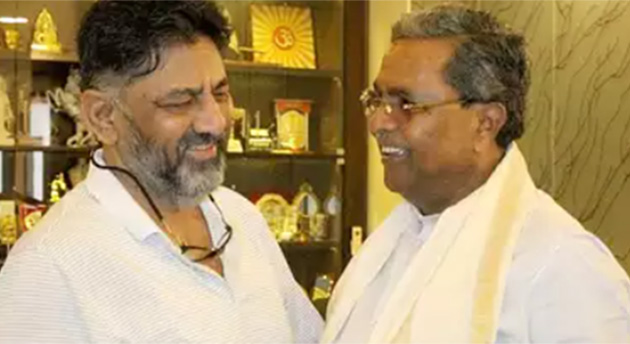
Karnataka CM race: SWOC analysis of DKS and Siddaramaiah

News Network
May 15, 2023

SidDKS.jpg

After the Congress's emphatic 135-seat win in the May 10 Karnataka Assembly polls, the focus has now shifted to the all-important question, "who will be the Chief Minister."

And the race for the top post has heated up between old warhorses Siddaramaiah and DK Shivakumar, with both leaders making no secret of their ambition to lead the southern state. The Congress Legislature Party (CLP) has unanimously authorised All India Congress Committee (AICC) President M Mallikarjun Kharge to pick its leader, who will be the next chief minister of the state.

Here is a SWOT (Strengths, Weaknesses, Opportunities and Challenges) analysis of the two aspiring CMs.

Siddaramaiah:

Strengths:
•    Mass appeal across the state
•    Popular among a large section of Congress legislators
•    Experience of having run a full-term government as Chief Minister (2013-18).
•    Able administrator with experience of having presented 13 budgets.
•    Clout among the AHINDA (Kannada acronym for minorities, backward classes and Dalits).
•    Strong ability to take on BJP and JD(S), most importantly PM Modi and his government on issues.
•    Considered close to Rahul Gandhi and apparently has his backing.

Weaknesses: 
•    Not so much organisationally connected with the party.
•    Failure in bringing the Congress government back to power in 2018 under his leadership.
•    Still considered an outsider by a section of Congress old guard. He was formerly with the JD(S).
•    Age factor- Sidddaramiah is 75.

Opportunities: 
*Acceptability, appeal and experience to take along every one to run a government with a decisive mandate, and strengthen Congress for the 2024 Lok Sabha polls.
* IT, ED and CBI cases against opponent Shivakumar, who is also eyeing the CM post.
*Last election and last chance to become CM.
 
Challenges:
•    Uniting of senior Congress old guards like Mallikarjun Kharge, G Parameshwara, who have missed becoming CM because of Siddaramaiah, also B K Hariprasad, K H Muniyappa among others against him.
•    Call for a Dalit CM. *Shivakumar's organisational strength, party's 'troubleshooter' tag, loyalty image across the country, and closeness to Gandhi family, especially Sonia Gandhi and Priyanka Gandhi Vadra.

D K Shivakumar: 

Strengths:
•    Strong organisational capabilities and having led the party to victory in elections.
•    Known for party loyalty.
•    Considered Congress' ace troubleshooter during difficult times.
•    Resourceful leader.
•    Has the backing of the dominant Vokkaliga community, its influential seers and leaders.
•    Closeness to Gandhi family. * Age factor on his side.
•    Long political experience; has handled various portfolios.

Weaknesses:
•     Cases against him before IT, ED and CBI.
•    Jail term in Tihar
•    Lesser mass appeal and experience compared to Siddaramaiah. 
•    Clout by and large limited to the Old Mysuru region.
•    Not having much backing from other communities.

Opportunities: 
•    Congress' domination of the Old Mysuru region would go to Shivakumar, a Vokkaliga.
•    KPCC President, as the natural choice to be the CM, like in the case of SM Krishna and Veerendra Patil.
•    Chances of the party old guard backing him.

Challenges:
•    Siddaramaiah's experience, seniority and mass appeal.
•    Chances of large number of MLAs backing Siddaramaiah.
•    Legal hurdles because of cases filed by central agencies.
•    Call for a Dalit or Lingayat CM.
•    Rahul Gandhi's apparent backing of Siddaramaiah.

Comments

Add new comment

  • Coastaldigest.com reserves the right to delete or block any comments.
  • Coastaldigset.com is not responsible for its readers’ comments.
  • Comments that are abusive, incendiary or irrelevant are strictly prohibited.
  • Please use a genuine email ID and provide your name to avoid reject.
News Network
December 15,2025

Mangaluru, Dec 15: Air India Express has announced that it will resume direct flight services between Mangaluru and Muscat from March 2026, restoring an important international air link for passengers from the coastal region.

Airport authorities said the service will operate twice a week—on Sundays and Tuesdays—from March 1. The initial flights are scheduled on March 3, 8 and 10, followed by March 15 and 17, with the same operating pattern to continue thereafter. The flight duration is approximately three hours and 25 minutes.

The Mangaluru–Muscat route was earlier operated under the 2025 summer schedule, with services beginning on July 14. At that time, Air India Express had operated four flights a week before suspending the service.

Officials said the summer schedule will come into effect from March 29, after which changes in flight timings and departure schedules from Mangaluru are expected. Passengers have been advised to check the latest schedules while planning their travel.

The resumption of direct flights to Muscat is expected to significantly benefit expatriates, business travellers and others, further strengthening Mangaluru’s air connectivity with the Gulf region.

Comments

Add new comment

  • Coastaldigest.com reserves the right to delete or block any comments.
  • Coastaldigset.com is not responsible for its readers’ comments.
  • Comments that are abusive, incendiary or irrelevant are strictly prohibited.
  • Please use a genuine email ID and provide your name to avoid reject.
News Network
December 3,2025

arrival.jpg

Mangaluru, Dec 3: A group of Congress workers gathered at the Mangaluru International Airport on Wednesday to welcome AICC general secretary K C Venugopal, but the reception quickly turned into a display of support for Deputy Chief Minister D K Shivakumar.

Venugopal arrived in the city to participate in the centenary commemoration of the historic dialogue between Mahatma Gandhi and Narayana Guru. The event, organised by the Sivagiri Mutt, Varkala, in association with the Mangalore University Sri Narayana Guru Study Chair, is being held on the university’s Konaje campus.

KPCC general secretary Mithun Rai and several party workers had assembled at the airport to receive Venugopal. However, the moment he stepped out, workers began raising slogans backing Shivakumar.

The university programme will be inaugurated by Chief Minister Siddaramaiah.

This show of support comes just a day after Siddaramaiah remarked that Shivakumar would lead the government “when the high command decides.” The chief minister made the comment after a breakfast meeting at Shivakumar’s residence—another public display of camaraderie between the two leaders amid ongoing attempts by the party high command to downplay their leadership rivalry.

Comments

Add new comment

  • Coastaldigest.com reserves the right to delete or block any comments.
  • Coastaldigset.com is not responsible for its readers’ comments.
  • Comments that are abusive, incendiary or irrelevant are strictly prohibited.
  • Please use a genuine email ID and provide your name to avoid reject.
News Network
December 6,2025

pilot.jpg

New Delhi: IndiGo, India’s largest airline, faced major operational turbulence this week after failing to prepare for new pilot-fatigue regulations issued by the Directorate General of Civil Aviation (DGCA). The stricter rules—designed to improve flight safety—took effect in phases through 2024, with the latest implementation on November 1. IndiGo has acknowledged that inadequate roster planning led to widespread cancellations and delays.

Below are the key DGCA rules that affected IndiGo’s operations:

1. Longer Mandatory Weekly Rest

Weekly rest for pilots has been increased from 36 hours to 48 hours.

The government says the extended break is essential to curb cumulative fatigue. This rule remains in force despite the current crisis.

2. Cap on Night Landings

Pilots can now perform only two night landings per week—a steep reduction from the earlier limit of six.

Night hours, defined as midnight to early morning, are considered the least alert period for pilots.

Given the disruptions, this rule has been temporarily relaxed for IndiGo until February 10.

3. Reduced Maximum Night Flight Duty

Flight duty that stretches into the night is now capped at 10 hours.

This measure has also been kept on hold for IndiGo until February 10 to stabilize operations.

4. Weekly Rest Cannot Be Replaced With Personal Leave

Airlines can no longer count a pilot’s personal leave as part of the mandatory 48-hour rest.

Pilots say this closes a loophole that previously reduced actual rest time.

Currently, all airlines are exempt from this rule to normalise travel.

5. Mandatory Fatigue Monitoring

Airlines must submit quarterly fatigue reports along with corrective actions to DGCA.

This system aims to create a transparent fatigue-tracking framework across the industry.

The DGCA has stressed that these rules were crafted to strengthen flight safety and align India with global fatigue-management standards. The temporary relaxations are expected to remain until February 2025, giving IndiGo time to stabilise its schedules and restore normal air travel.

Comments

Add new comment

  • Coastaldigest.com reserves the right to delete or block any comments.
  • Coastaldigset.com is not responsible for its readers’ comments.
  • Comments that are abusive, incendiary or irrelevant are strictly prohibited.
  • Please use a genuine email ID and provide your name to avoid reject.