Karnataka: Cong govt rolls out 'Gruha Lakshmi'; Rahul Gandhi transfers amount to beneficiaries

News Network
August 30, 2023

GL.jpg

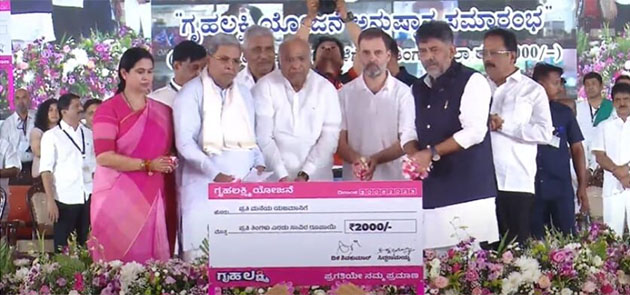
Mysuru, Aug 30: The Congress-ruled Karnataka government rolled out the 'Gruha Lakshmi' scheme today i.e. on 30 August. This scheme is part of one among the five poll promises made by the party during its election campaign. Congress MP Rahul Gandhi who arrived in Bengaluru ahead of the launch of the scheme transferred the amount into the bank accounts of the beneficiaries of Gruha Lakshmi Yojana, through direct benefit transfer (DBT). 

The scheme was out at a public function in Mysuru in the presence of state Chief Minister Siddaramiah and Congress national president Mallikarjun Kharge among other senior leaders of the party.

While addressing the event, the Congress MP said, “Before the elections, Congress party had made five promises to Karnataka. We had said that when Congress party and its leaders say something, they do it. Today, when we clicked on the tablet, crores of women received ₹2000 directly into their bank accounts."

Key points

1. Congress MP Rahul Gandhi transferred the amount into the bank accounts of the beneficiaries of Gruha Lakshmi Yojana, through direct benefit transfer (DBT).

2. Under the scheme, the state government will provide ₹2000 monthly assistance to the woman head of BPL familes. For this scheme, Karnataka has allocated a substantial ₹32,000 crore annually to support this scheme.

3. Women listed as family heads on Antyodaya, Below Poverty Line (BPL), and Above Poverty Line (APL) ration cards are eligible for the Gruha Lakshmi Scheme. Only one woman in a family will be the beneficiary of this scheme.

4. With the launch of the scheme, it is offering a monthly assistance of ₹2,000 to about 1.1 crore women who are heads of their households.

5. According to KC Venugopal, Congress General Secretary, it will be the "world's largest-ever welfare scheme for women". "Through this revolutionary scheme, the Karnataka government led by Siddaramiah will be distributing ₹2000 to 1.28 crore women. When Women are empowered-India is stronger," he said in a post on X.

6. Women government employees taxpayers and families whose husbands pay income tax or file GST returns are not eligible for the scheme.

7. The objective of this project is to achieve gender balance cultivating financial support to housewives who are eligible for household duties.

8. The Women head of the families who has Above Poverty Line card (APL)/Below Poverty Line (BPL)/Antyodaya card and Bank linked Aadhaar card, Bank details, Aadhaar-linked phone number. If someone does not have their bank account linked with Aadhaar, then they can produce a passbook

9. Registration for the Gruha Lakshmi Scheme can be done both online and offline. For online registration, one can visit to portal.

10. Congress during its poll campaign in Karnataka this year had announced the five main guarantees to the people of Karnataka. The five 'main' guarantees are 200 units of free power to all households (Gruha Jyoti); ₹2,000 monthly assistance to the woman head of every family (Gruha Lakshmi); 10 kg of rice free to every member of a BPL household (Anna Bhagya); ₹3,000 every month for unemployed graduate youth and ₹1,500 for unemployed diploma holders (both in the age group of 18-25) for two years (Yuva Nidhi) and free travel for women in public transport buses (Uchita Prayana).

Meanwhile, the fifth guarantee ‘Yuva Nidhi’ (Youth Fund) which promises to give ₹3000 and ₹1,500 a month to the unemployed graduates and diploma holders, respectively, who failed to get a job even after six months of clearing the exam in the 2022-23 academic year will be launched in December, officials said 

Comments

Add new comment

  • Coastaldigest.com reserves the right to delete or block any comments.
  • Coastaldigset.com is not responsible for its readers’ comments.
  • Comments that are abusive, incendiary or irrelevant are strictly prohibited.
  • Please use a genuine email ID and provide your name to avoid reject.
News Network
January 20,2026

iran.jpg

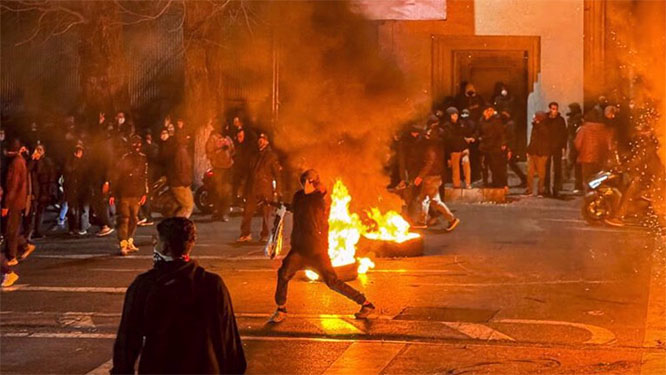
Iranian security and intelligence forces have captured more than 470 individuals in three provinces, identified as key figures behind the recent wave of violent unrest and terrorist activities linked to foreign-backed networks.

The Intelligence Ministry's provincial office in Khorasan Razavi announced on Monday the arrest of 192 armed terrorists, identified as the main agents behind recent riots in the region. 

According to an official statement, the detainees were involved in the killing of several security personnel and civilians, setting fire to mosques, public service facilities, and buses, as well as attacks on military and law enforcement centers.

The seized items from the group include several bulletproof vests, Kalashnikov rifles, hunting weapons, Winchester rifles, and various cold weapons such as daggers, swords, brass knuckles, tactical knives, crossbows, and chains.

Evidence indicates that some of the individuals were tied to hostile movements and terrorist organizations, with links overseas. Others were identified as members of violent criminal gangs, actively taking part in the unrest alongside their associates.

Simultaneously, in the western province of Lorestan, the IRGC announced the arrest of 134 individuals as the main leaders and influential field agents of a US-Israeli terrorist network.

The IRGC statement stated that these individuals formed terrorist cells during the recent unrest, committing "Daesh-like" acts.

They wounded security forces with firearms and cold weapons, and burned and destroyed public and private properties, including mosques, shops, banks, and private and public vehicles.

In the northwestern province of Zanjan, the police reported detaining 150 people identified as principal leaders and agents behind recent riots.

Authorities noted that these individuals were responsible for destroying public and private property and intentionally setting fire to vehicles in the province's squares.

Their crimes include shedding the blood of innocent people, destroying public and private property, attempting to enter military sites, disrupting public order, and spreading terror among citizens.

A variety of cold weapons were reportedly seized from the detainees.

What began late last month as peaceful protests over economic hardship across Iran turned violent after public statements by US and Israeli regime figures encouraged vandalism and disorder.

During the unrest, foreign-backed mercenaries rampaged through cities, killing security forces and civilians and damaging public property.

Comments

Add new comment

  • Coastaldigest.com reserves the right to delete or block any comments.
  • Coastaldigset.com is not responsible for its readers’ comments.
  • Comments that are abusive, incendiary or irrelevant are strictly prohibited.
  • Please use a genuine email ID and provide your name to avoid reject.
News Network
February 1,2026

Bengaluru: The Karnataka High Court has refused to quash an investigation against a WhatsApp group administrator accused of allowing the circulation of obscene and offensive images depicting Hindutva politicians and idols in 2021.

Justice M Nagaprasanna observed that, prima facie, the ingredients of the offence under Section 295A of the Indian Penal Code were made out. “The offence under Section 295A of the IPC is met to every word of its ingredient, albeit prima facie,” the judge said.

The petitioner, Sirajuddin, a resident of Belthangady taluk in Dakshina Kannada district, had challenged the FIR registered against him at the CEN (Cyber, Economics and Narcotics) police station, Mangaluru, for offences under Section 295A of the IPC and Section 67 of the Information Technology Act. Section 295A relates to punishment for deliberate and malicious acts intended to outrage the religious feelings of any class of citizens.

According to the complaint filed by K Jayaraj Salian, also a resident of Belthangady taluk, he received a WhatsApp group link from an unknown source and was added to the group after accessing it. The group reportedly had six administrators and around 250 participants, where obscene and offensive images depicting Hindu deities and certain political figures were allegedly circulated repeatedly.

Sirajuddin was arrested in connection with the case and later released on bail on February 16, 2021. He argued before the court that he was being selectively targeted, while other administrators—including the creator of the group—were neither arrested nor investigated. He also contended that the Magistrate could not have taken cognisance of the offence under Section 295A without prior sanction under Section 196(1) of the CrPC.

Rejecting the argument, Justice Nagaprasanna held that prior sanction is required only at the stage of taking cognisance, and not at the stage of registration of the crime or during investigation.

The judge noted that the State had produced the entire investigation material before the court. “A perusal of the material reveals depictions of Hindu deities in an extraordinarily obscene, demeaning and profane manner. The content is such that its reproduction in a judicial order would itself be inappropriate,” the court said, adding that the material, on its face, had the tendency to outrage religious feelings and disturb communal harmony.

Observing that the case was still at the investigation stage, the court said it could not interdict the probe at this juncture. However, it expressed concern that the investigating officer appeared to have not proceeded uniformly against all administrators. The court clarified that if the investigation revealed the active involvement of any member in permitting the circulation of such content, they must also be proceeded against.

“At this investigative stage, any further observation by this Court would be unnecessary,” the order concluded.

Comments

Add new comment

  • Coastaldigest.com reserves the right to delete or block any comments.
  • Coastaldigset.com is not responsible for its readers’ comments.
  • Comments that are abusive, incendiary or irrelevant are strictly prohibited.
  • Please use a genuine email ID and provide your name to avoid reject.
News Network
January 23,2026

Mangaluru: The Karnataka Government Polytechnic (KPT), Mangaluru, has achieved autonomous status from the All India Council for Technical Education (AICTE), becoming the first government polytechnic in the country to receive such recognition in its 78-year history. The status was granted by AICTE, New Delhi, and subsequently approved by the Karnataka Board of Technical Education in October last year.

Officials said the autonomy was conferred a few months ago. Until recently, AICTE extended autonomous status only to engineering colleges, excluding diploma institutions. However, with a renewed national focus on skill development, several government polytechnics across India have now been granted autonomy.

KPT, the second-largest polytechnic in Karnataka, was established in 1946 with four branches and has since expanded to offer eight diploma programmes, including computer science and polymer technology. The institution is spread across a 19-acre campus.

Ravindra M Keni, the first dean of the institution, told The Times of India that AICTE had proposed autonomous status for polytechnic institutions that are over 25 years old. “Many colleges applied. In the first round, 100 institutions were shortlisted, which was further narrowed down to 15 in the second round. We have already completed one semester after becoming an autonomous institution,” he said. He added that nearly 500 students are admitted annually across eight three-year diploma courses.

Explaining the factors that helped KPT secure autonomy, Keni said the institution has consistently recorded 100 per cent admissions and placements for its graduates. He also noted its strong performance in sports, with the college emerging champions for 12 consecutive years, along with active student participation in NCC and NSS activities.

Autonomous status allows KPT to design industry-oriented curricula, conduct examinations, prepare question papers, and manage academic documentation independently. The institution can also directly collaborate with industries and receive priority funding from AICTE or the Ministry of Education. While academic autonomy has been granted, financial control will continue to rest with the state government.

“There will be separate committees for examinations, question paper setting, boards of studies, and boards of examiners. The institution will now have the freedom to conduct admissions without government notifications and issue its own marks cards,” Keni said, adding that new academic initiatives would be planned after a year of functioning under the autonomous framework.

Comments

Add new comment

  • Coastaldigest.com reserves the right to delete or block any comments.
  • Coastaldigset.com is not responsible for its readers’ comments.
  • Comments that are abusive, incendiary or irrelevant are strictly prohibited.
  • Please use a genuine email ID and provide your name to avoid reject.