Karnataka tops states, UTs in providing access to justice: IJR 2022

News Network
April 4, 2023

Bengaluru, Apr 4: Karnataka tops the list of states and Union Territories in providing access to justice and three other southern states figure among the best five, according to the India Justice Report 2022.

The IJR, which was released here on Tuesday, said except for Delhi and Chandigarh, no state or union territory spends more than one per cent of its total annual expenditure on judiciary where the vacancy of judges in high courts stands at 30 per cent.

The IJR, an initiative of the Tata Trusts launched in 2019, said as of December 2022, the country had 19 judges for every 10 lakh people and a backlog of 4.8 crore cases. The Law Commission had suggested, as early as in 1987, that there should be 50 judges for every 10 lakh people in a decade’s time.

The statistics were shared in IJR which ranked states and UTs on various parameters like vacancies in judiciary, budgetary allocations, infrastructure, human resources, legal aid, condition of prisons, functioning of police and state human rights commissions.

The Tata Trusts website describes IJR as a "unique initiative" that "ranks individual Indian states in relation to their capacity to deliver access to justice".

While Karnataka topped the chart among 18 large and mid-size states having a population of over 1 crore each, it was followed by Tamil Nadu, Telangana, Gujarat and Andhra Pradesh.

The list of seven small states, having a population of less than one crore each, was headed by Sikkim, followed by Arunachal Pradesh and Tripura.

“The justice system as a whole remains affected by low budgets. Except for two union territories, Delhi and Chandigarh, no state spends more than 1 per cent of its total annual expenditure on the judiciary.

“Vacancy is an issue across the police, prison staff, legal aid, and judiciary. For 1.4 billion (140 crore) people, India has about 20,076 judges with about 22 per cent sanctioned posts vacant. Vacancy among high court judges is at 30 per cent.

“In the police, women are only about 11.75 per cent, despite their numbers doubling in the last decade. About 29 per cent of the officer positions are vacant. The police to population ratio is 152.8 per lakh. The international standard is 222,” the report said.

It said prisons are over-occupied at over 130 per cent and more than two-thirds of the prisoners (77.1 per cent) are awaiting the completion of investigation or trial.

The IJR said most of the states have not fully utilised funds given to them by the Centre and their own increase in spending on the police, prisons, and judiciary has not kept pace with overall increase in state expenditure.

Retired Supreme Court judge Justice Madan B Lokur said, “The third IJR shows that states are making a substantive improvement over the last two ones in terms of adding new dimensions on diversity, training, and infrastructure. Some states have dramatically improved their performance but there is a lot that needs to be done on the whole.”

“So far as the police is concerned there does appear to be a shortage of women officers in police. Legal aid is doing better but still a lot of people need to be provided quality free legal aid, we need to increase the confidence that people have in our services,” he said.

Maja Daruwala, Chief Editor of IJR 2022, said as a member of the comity of nations and, more importantly, as a commitment to itself, India has promised that by 2030 it will have ensured access to justice for all and built effective, accountable, and inclusive institutions at all levels.

“But the official statistics brought together in the IJR this year show that we still have a long way to go. I would again urge that the provision of affordable, efficient and accessible justice services to each one of us be treated as necessary as food, education, or health.

"For this to happen more resources need to be ploughed into it, much more capacity built and much more attention paid to curing long standing deficiencies,” she said.

The report said Karnataka remains the only state to have consistently met its quota for SC, ST and OBC positions, both among police officers and the constabulary.

“In the judiciary, at the subordinate/ district court level, no state met all the three quotas. Only Gujarat and Chhattisgarh met their respective SC quotas. Arunachal Pradesh, Telangana, and Uttarakhand met their respective ST quotas. Kerala, Sikkim, Andhra Pradesh, Maharashtra, Tamil Nadu, Chhattisgarh, and Telangana met OBC quotas,” it said.

Regarding the share of women in key positions across the justice system, which includes police, prisons, judiciary and legal aid, the report states that one out of 10 is a woman.

“While the overall share of women in the police force is about 11.75 per cent, in the officer ranks it is still lower at 8 per cent. Only 13 per cent of high court judges and 35 per cent of subordinate court judges are women. Among prison staff, they are 13 per cent. A majority of states has increased the share of women panel lawyers. Nationally, the share has increased from 18 per cent to 25 per cent,” it said.

It said one in four police stations does not have a single CCTV and nearly three in 10 police stations do not have women help desks.

The report said about 30 per cent (391) of prisons record occupancy rates of above 150 per cent and 54 per cent (709) run above 100 per cent capacity.

“With the exception of Andaman and Nicobar Islands, Arunachal Pradesh, Mizoram, Tripura, and Madhya Pradesh, the undertrial population of all states and Union Territories exceeds 60 per cent," it said.

On the aspect of workload in judiciary, the report said in 28 states/ Union Territories, one in every four high court cases is pending for more than five years. In district courts of 11 states/UTs, one in every four cases is pending for more than five years,” the report said.

The IJR said the population per subordinate court judge and high court judge is 71,224 persons and 17,65,760 persons respectively.

With regard to budgets, it found the national per capita spend on legal aid, including the expenditure of the National Legal Services Authority (NALSA) and the state/ UT governments themselves, is a meagre Rs 4.57 per annum.

Excluding NALSA, this figure drops to Rs 3.87 and, if only NALSA’s budget (2021-22) is considered, the per capita spend is Rs 1.06 only, it said.

It said the national per capita spend on prisons is Rs 43. Nationally, the annual average spend per prisoner has gone down to Rs 38,028 from Rs 43,062. Andhra Pradesh records the highest annual spend on a prisoner at Rs 2,11,157.

“The national per capita spend on judiciary stands at Rs. 146,” it said, adding the national per capita spend on police is at Rs 1151.

“IJR 2022 has reiterated both immediate and foundational corrections. It has flagged urgent filling of vacancies and increased representation. To effect an irreversible change, it has exhorted that Justice delivery be designated as an essential service,” it concluded.

The third IJR also assessed the capacity of the 25 State Human Rights Commissions (SHRC) and found that there are 33,312 pending cases before these panels in March 2021 and the national average vacancy across 25 SHRCs is at 44 per cent.

The statistics show nine states have been working with 50 per cent or more vacancies among members in SHRCs and only six states have women in their executive staff.


Comments

Add new comment

  • Coastaldigest.com reserves the right to delete or block any comments.
  • Coastaldigset.com is not responsible for its readers’ comments.
  • Comments that are abusive, incendiary or irrelevant are strictly prohibited.
  • Please use a genuine email ID and provide your name to avoid reject.
News Network
November 30,2025

girlnomore.jpg

Mangaluru, Nov 30: A 22-year-old college student succumbed to her injuries at a private hospital in Mangaluru today, days after she was hit by a goods tempo while crossing a road in Padubidri.

The deceased has been identified as Preksha, a resident of Nadsalu Billitota in Padubidri. The fatal incident occurred as Preksha, who was returning home after completing her examination, attempted to cross the service road towards Mangaluru. She was struck by a goods tempo approaching from the Udupi side, causing her to fall and sustain a severe head injury.

Prompt action from local residents ensured she received immediate first aid before being rushed to a hospital in Mangaluru for specialised treatment. Despite medical efforts, she passed away while undergoing care.

Preksha was a student at Karavali College, Vamanjoor on the outskirts of Mangaluru city. The tragedy is compounded by the fact that she belonged to a financially vulnerable family, having previously lost her father. She is survived by her mother and brother.

A case related to the accident has been registered at the Padubidri police station, and an investigation is underway to determine the exact circumstances that led to the collision. The incident highlights the growing concerns over road safety, particularly on busy service roads, and serves as a tragic reminder of the human cost of traffic accidents.

Comments

Add new comment

  • Coastaldigest.com reserves the right to delete or block any comments.
  • Coastaldigset.com is not responsible for its readers’ comments.
  • Comments that are abusive, incendiary or irrelevant are strictly prohibited.
  • Please use a genuine email ID and provide your name to avoid reject.
News Network
November 30,2025

airportmetro.jpg

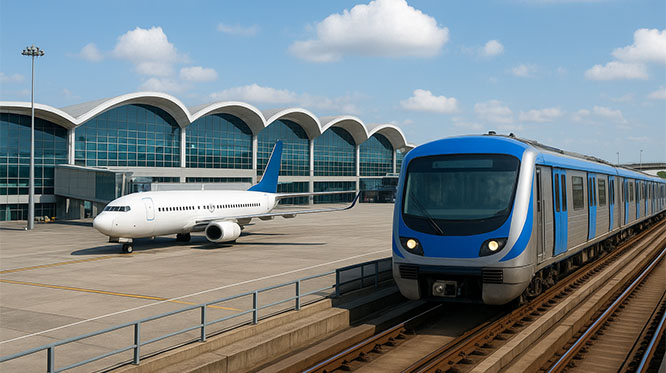
Udupi: The pontiffs of Sri Paryaya Puttige Mutt, the sacred seat of Jagadguru Shrimad Madhvacharya Moola Samsthanam, have submitted a proposal to the Prime Minister seeking comprehensive development for Udupi district. 

Proposal for International Airport

A key request is the establishment of an international airport. Highlighting that around 1,000 acres of land are available and suitable, the pontiffs noted that the existing Mangalore Airport provides limited international connectivity. They suggested the airport be developed under a Public-Private Partnership (PPP) or as a Greenfield Airport to boost trade, education, healthcare, and spiritual tourism.

Metro and Rapid Transit Connectivity

The proposal also calls for Metro Rail or Rapid Transit between Mangaluru and Udupi. The 55 km coastal stretch experiences heavy daily commuter traffic, causing congestion. The district administration is ready to prepare an initial project report for a Mass Rapid Transit corridor and requested inclusion under national urban mobility programmes to ensure safe, green, and time-efficient regional transport.

Port and Coastal Development

The pontiffs urged the development of an international-standard port with a cruise terminal along Udupi’s coast. They also requested fast-tracking of pending coastal tourism projects and revising Coastal Regulation Zone (CRZ) norms to encourage sustainable infrastructure and hospitality investment.

IT, AI and Technological Infrastructure

Support was sought for an IT and AI Innovation Park with incubation facilities under Digital India and Startup India initiatives. The proposal also emphasized the need for strengthened data security and cloud computing infrastructure to boost India’s technological independence.

Sports and Education Initiatives

The pontiffs requested national sports status for Kambala, along with financial and infrastructure support. They also sought the establishment of an AIIMS in Udupi, a new IIT campus, and approval for an IIM to promote higher education in the district.

Representation to the Prime Minister

Sri Sugunendra Tirtha Pontiff and Sri Sushrendra Tirtha Swamiji represented the pontiffs in submitting the comprehensive development proposal to the Prime Minister during his recent visit.

Comments

Add new comment

  • Coastaldigest.com reserves the right to delete or block any comments.
  • Coastaldigset.com is not responsible for its readers’ comments.
  • Comments that are abusive, incendiary or irrelevant are strictly prohibited.
  • Please use a genuine email ID and provide your name to avoid reject.
News Network
December 4,2025

indigoflight.jpg

Domestic carrier IndiGo has cancelled over 180 flights from three major airports — Mumbai, Delhi and Bengaluru — on Thursday, December 4, as the airline struggles to secure the required crew to operate its flights in the wake of new flight-duty and rest-period norms for pilots.

While the number of cancellations at Mumbai airport stands at 86 (41 arrivals and 45 departures) for the day, at Bengaluru, 73 flights have been cancelled, including 41 arrivals, according to a PTI report that quoted sources.

"IndiGo cancelled over 180 flights on Thursday at three airports-Mumbai, Delhi and Bengaluru," the source told the news agency.

Besides, it had cancelled as many as 33 flights at Delhi airport for Thursday, the source said, adding, "The number of cancellations is expected to be higher by the end of the day."

The Gurugram-based airline's On-Time Performance (OTP) nosedived to 19.7 per cent at six key airports — Delhi, Mumbai, Chennai, Kolkata, Bengaluru and Hyderabad — on December 3, as it struggled to get the required crew to operate its services, down from almost half of December 2, when it was 35 per cent.

"IndiGo has been facing acute crew shortage since the implementation of the second phase of the FDTL (Flight Duty Time Limitations) norms, leading to cancellations and huge delays in its operations across the airports," a source had told PTI on Wednesday.

Chaos continued at several major airports for the third day on Thursday because of the cancellations.

A spokesperson for the Kempegowda International Airport (KIA) in Bengaluru said that 73 IndiGo flights had been cancelled on Thursday.

At least 150 flights were cancelled and dozens of others delayed on Wednesday, airport sources said, leaving thousands of travellers stranded, according to news agency Reuters.

The Directorate General of Civil Aviation (DGCA) has said it is investigating IndiGo flight disruptions and has asked the airline to submit the reasons for the current situation, as well as its plans to reduce flight cancellations and delays.

It may be mentioned here that the pilots' body, Federation of Indian Pilots (FIP), has alleged that IndiGo, despite getting a two-year preparatory window before the full implementation of new flight duty and rest period norms for cockpit crew, "inexplicably" adopted a "hiring freeze".

The FIP said it has urged the safety regulator, the DGCA, not to approve airlines' seasonal flight schedules unless they have adequate staff to operate their services "safely and reliably" in accordance with the New Flight Duty Time Limitations (FDTL) norms.

In a letter to the DGCA late on Wednesday, the FIP urged the DGCA to consider re-evaluating and reallocating slots to other airlines, which have the capacity to operate them without disruption during the peak holiday and fog season if IndiGo continues to "fail in delivering on its commitments to passengers due to its own avoidable staffing shortages."

Comments

Add new comment

  • Coastaldigest.com reserves the right to delete or block any comments.
  • Coastaldigset.com is not responsible for its readers’ comments.
  • Comments that are abusive, incendiary or irrelevant are strictly prohibited.
  • Please use a genuine email ID and provide your name to avoid reject.