



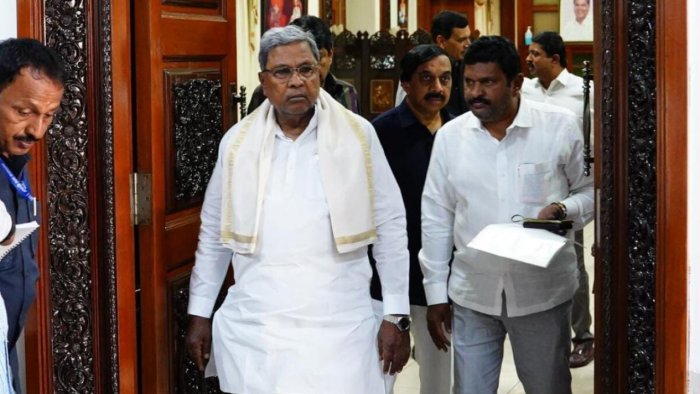
Rs 60,000 crore needed annually to implement 5 Cong guarantees: CM at new MLAs training camp

News Network
June 26, 2023

CMsiddu.jpg

Bengaluru, June 26: Karnataka Chief Minister Siddaramaiah on Monday said a total of Rs 59,000 crore to Rs 60,000 crore is required annually, for the implementation of Congress' five poll 'guarantees'. He said, the fresh budget of the new Congress government, which he will be presenting on July 7, is likely to be of the size Rs 3,35,000 crore.

The Chief Minister, who also holds the finance portfolio, was speaking after inaugurating the training camp organised for the newly elected MLAs of the 16th Legislative Assembly. 

"The first budget after independence was twenty one crore three lakh rupees, today it is about three lakh nine thousand crore rupees. I will be presenting a new budget on July 7 it may be (of the size) three lakh thirty to thirty five thousand crore rupees," Siddaramaiah said.

Addressing the newly elected legislators, he said, "the present budget is around three lakh nine thousand eight hundred and ninety six crore rupees, as I'm implementing five guarantees, I will have to provide rupees forty thousand crore for it, for the remaining period. A total of fifty nine thousand to sixty thousand crore rupees is required for five guarantees."

Noting that the previous BJP government had presented a budget in February by taking a vote on account for four months, the CM said, the budget he will be presenting on July 7 will come into force from August 1.

Urging the legislators to try to learn and understand budgets, he also asked them to learn about taxation, stating the rich should be taxed, not the poor. The five guarantees are: up to 200 units of free power to all households (Gruha Jyoti), Rs 2,000 monthly assistance to the woman head of every family (Gruha Lakshmi), 10 kg of free rice to every member of a BPL household (Anna Bhagya), Rs 3,000 every month for unemployed graduates and Rs 1,500 for unemployed diploma holders, both in the age group of 18-25 (YuvaNidhi), and free travel for women in public transport buses (Shakti).

While the government has already launched the scheme which will provide free travel for women in public transport buses, the other four schemes are in various stages of implementation, and the timeline has already been fixed for their rollout. 

Speaker of the Assembly U T Khader, Chairman of Legislative Council Basavaraja Horatti, Housing Minister Zameer Ahmed Khan, Assembly Secretary M K Vishalakshi were present at the inaugural of the training.

The Legislature Session is scheduled from July 3 to 14. Suggesting that MLAs and MPs should understand the "meaning" of budget, the CM said, "in the 12th century, 'Kayakayogi' Basavanna spoke about budget. 'Kayaka' and 'Dasoha' are the key factors of the budget. Kayaka means production, Dasoha means sharing." 

He explained that the value of the budget is just understanding where the production is and to whom we distribute it in the society. The Assembly is the temple of democracy, Siddaramaiah said, as he called upon legislators to raise people’s problems effectively in the Lower House and develop a mindset to seek solutions. Those who do not read and understand the Constitution cannot become good legislators and parliamentarians, he said, "So read the Constitution and understand its basic principles and objectives."

"We made the rules of the House ourselves. He said that if you read and understand it properly, people's problems can be brought before the house in a proper manner....We cannot make laws contrary to the Constitution. Therefore, reading the constitution is essential," he said. Out of 224 MLAs, 70 have entered the Legislative Assembly for the first time.

Former MP and former Union Minister K H Muniyappa (now minister in state government), former Minister and mining baron G Janardhana Reddy are among them.

Comments

Add new comment

  • Coastaldigest.com reserves the right to delete or block any comments.
  • Coastaldigset.com is not responsible for its readers’ comments.
  • Comments that are abusive, incendiary or irrelevant are strictly prohibited.
  • Please use a genuine email ID and provide your name to avoid reject.
News Network
February 1,2026

Bengaluru: Karnataka Deputy Chief Minister D K Shivakumar on Sunday criticised the Union Budget presented by Finance Minister Nirmala Sitharaman, claiming it offered no tangible benefit to the state.

Though he said he was yet to study the budget in detail, Shivakumar asserted that Karnataka had gained little from it. “There is no benefit for our state from the central budget. I was observing it. They have now named a programme after Mahatma Gandhi, after repealing the MGNREGA Act that was named after him,” he said.

Speaking to reporters here, the Deputy Chief Minister demanded the restoration of MGNREGA, and made it clear that the newly enacted rural employment scheme — VB-G RAM G — which proposes a 60:40 fund-sharing formula between the Centre and the states, would not be implemented in Karnataka.

“I don’t see any major share for our state in this budget,” he added.

Shivakumar, who also holds charge of Bengaluru development, said there were high expectations for the city from the Union Budget. “The Prime Minister calls Bengaluru a ‘global city’, but what has the Centre done for it?” he asked.

He also drew attention to the problems faced by sugar factories, particularly those in the cooperative sector, alleging a lack of timely decisions and support from the central government.

Noting that the Centre has the authority to fix the minimum support price (MSP) for agricultural produce, Shivakumar said the Union government must take concrete steps to protect farmers’ interests.

Comments

Add new comment

  • Coastaldigest.com reserves the right to delete or block any comments.
  • Coastaldigset.com is not responsible for its readers’ comments.
  • Comments that are abusive, incendiary or irrelevant are strictly prohibited.
  • Please use a genuine email ID and provide your name to avoid reject.
News Network
February 1,2026

US President Donald Trump on Saturday claimed that the government of India led by Prime Minister Narendra Modi has made a deal to buy Venezuelan oil, as opposed to purchasing it from Iran.

"We've already made that deal, the concept of the deal," he told reporters on Air Force One.

Trump had imposed 25% tariffs on countries buying Venezuelan oil, including India, in March 2025. He had also hit India with tariffs for buying Russian oil, saying it was "funding" President Vladimir Putin's war against Ukraine.

Trump has said that the US has taken control of the oil-rich Venezuela after capturing former President Nicolas Maduro in January.

A fleet of 18 ships loaded with crude oil bound for refineries in Texas, Louisiana, and Mississippi in January, the most since December 2024, according to a report by the news agency Bloomberg.

Combined crude deliveries to the US will reach about 2,75,000 barrels a day, more than doubling volumes seen in December last year. Shipments to China, which averaged 4,00,000 barrels a day last year, fell to zero in January.

PM Modi, Venezuelan President Agree To Expand Ties

Prime Minister Narendra Modi and Venezuela's acting President Delcy Rodriguez spoke on Friday and agreed to take the bilateral relations to "new heights" in the years ahead.

It was the first phone call between the two leaders since the capture of Maduro and his wife by the US on January 3.

"Spoke with Acting President of Venezuela, Ms. Delcy Rodriguez. We agreed to further deepen and expand our bilateral partnership in all areas, with a shared vision of taking India-Venezuela relations to new heights in the years ahead," PM Modi said in a post on X.

A statement from Prime Minister Modi's office said the two leaders agreed to further expand and deepen the India-Venezuela partnership in all areas, including trade and investment, energy, digital technology, health, agriculture, and people-to-people ties.

They exchanged views on various regional and global issues of mutual interest and underscored the importance of their close cooperation for the Global South, the statement said.

Rodriguez also said that they discussed partnerships in the fields of agriculture, science and technology, mining, and tourism, as well as the pharmaceutical and automotive industries.

Comments

Add new comment

  • Coastaldigest.com reserves the right to delete or block any comments.
  • Coastaldigset.com is not responsible for its readers’ comments.
  • Comments that are abusive, incendiary or irrelevant are strictly prohibited.
  • Please use a genuine email ID and provide your name to avoid reject.
News Network
January 20,2026

Mangaluru: In a major step towards strengthening rural innovation, the Office of the Principal Scientific Adviser (PSA) to the Government of India is supporting the establishment of RuTAGe Smart Village Centres (RSVCs) across the country through collaborations with academic institutions, civil society organisations and philanthropic partners.

As part of this national initiative, Nitte (Deemed to be University) will set up the first RSVCs in the region at Nitte GP in Udupi district and at the Nitte Health Centre, Sevanjali Trust, Farangipete, in Dakshina Kannada district. The centres will be inaugurated on January 21. In South India, the programme is being implemented by the Section Infin-8 Foundation (SI-8).

Speaking to reporters on Monday, SI-8 founder-director Vishwas US said experts from Nitte University and SI-8 would work closely with farmers, students, youth and local entrepreneurs to adapt and deploy technologies tailored to local needs.

Project head Prof Iddya Karunasagar, representing Nitte DU, said the RSVCs at Nitte and Farangipete would serve as demonstration hubs for a wide range of agriculture, energy, skill-development and assistive technologies. These include solar dryers for fruits, vegetables and crops; soil-testing solutions; power weeders and women-friendly farm tools; wind-powered devices for rural artisans; grain storage systems; grass-cutting and tree-climbing equipment; and liquid fertiliser production using cowshed waste.

SI-8 CEO Aravind C Kumar said the centres would also provide access to digital and knowledge-based platforms such as ISRO applications, government scheme portals, market linkage tools and gamified learning resources, along with assistive technologies for persons with visual impairments.

Highlighting the broader impact of the initiative, Principal Scientific Adviser Prof Ajay Kumar Sood said it demonstrated how applied research could bridge the rural–urban divide and help create self-reliant, technology-enabled villages.

The initiative has been made possible through philanthropic support from Dr NC Murthy of ACM Business Solutions, LLC, USA. Dr Sapna Poti, Director (Strategic Alliances) at the Office of the Principal Scientific Adviser, said the long-term objective is to build self-sufficient, technology-driven communities capable of generating sustainable livelihoods on their own.

Comments

Add new comment

  • Coastaldigest.com reserves the right to delete or block any comments.
  • Coastaldigset.com is not responsible for its readers’ comments.
  • Comments that are abusive, incendiary or irrelevant are strictly prohibited.
  • Please use a genuine email ID and provide your name to avoid reject.