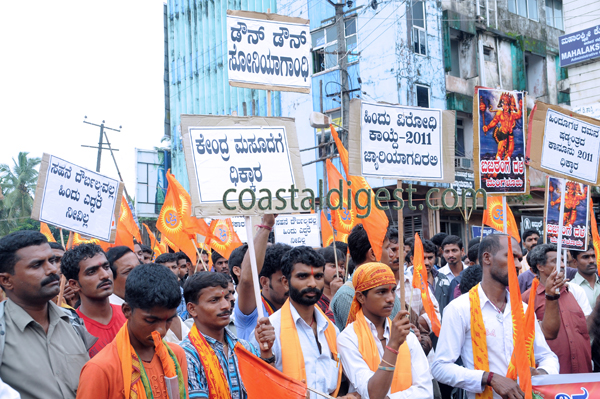
Hindutva activists burn draft of 'Violence Prevention Bill'

[email protected] (CD Network)
July 26, 2011

VHP_1


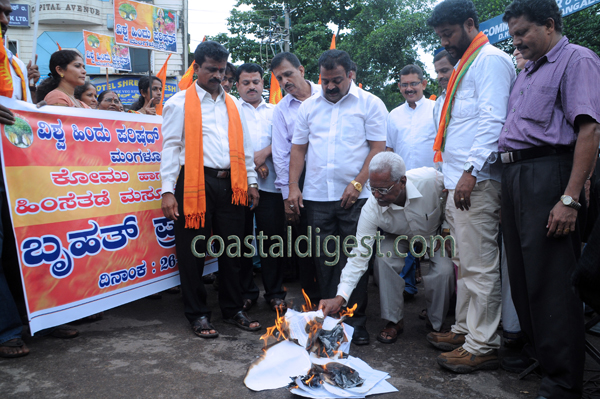
Mangalore, July 26: Raising voice against, what they termed 'minority appeasement measure by the UPA government', the hardline activists of Vishwa Hindu Parishad and Bajrangdal on Tuesday staged protest demonstration against the draft of 'Prevention of Communal and Targeted Violence Bill' in front of the Office of Deputy Commissioner here.

The angry protesters publicly burnt the copies of draft Bill.

Addressing the protesters M B Puranik, Pranth Vice President of VHP, said that the proposed Bill which is to come up in parliament session next month, would only create wider rift between communities and bring them at loggerheads destroying peace and harmony that now exists.

He said that the Bill prepared by National Advisory Council led by Sonia Gandhi with “anti-Hindu activists” like Teesta Setalvad, Harsha Mander, Anu Aga, Farah Naqvi, Sayyad Shahabuddin and others presumes that acts of communal violence could be indulged only by the majority Hindus against minorities (Muslims and Christians) and not vice versa. “The Bill was loaded against majority Hindu community,” he added.

Mr Puranik said that the provisions in the Bill were based on the premise that the majority community is always the aggressor and the minority always a victim.

He alleged that the Bill contains several draconian clauses like extending the charge-sheet period to 180 days during which suspects could be kept under custody, a separate agency to investigate and prosecute incidents of communal incidents and powers to the agency to attach property of the accused and if proven, guilty proceeds from those assets to be used for rehabilitation of riot victims.

Another local leader of VHP Jagadish Shenava went on to claim that the Bill was biased against Hindus and it was time to protest against it effectively to check the government from bringing in the legislation. He also alleged that it was part of the UPA government's policy of appeasing minority communities. “It would not be applicable in Jammu and Kashmir and to riots where communities other than Hindus are involved” he pointed out.

Hindutva activists Sharan Pampwell Manohar Thulajaram, Jagadish Shenava, Gopal Kuthar and Shivananda Mendon were among the protesters.


VHP_2

VHP_3

VHP_4

VHP_5

VHP_6

VHP_7

VHP_8

VHP_9

VHP_10

VHP_11

VHP_12

Comments

Add new comment

  • Coastaldigest.com reserves the right to delete or block any comments.
  • Coastaldigset.com is not responsible for its readers’ comments.
  • Comments that are abusive, incendiary or irrelevant are strictly prohibited.
  • Please use a genuine email ID and provide your name to avoid reject.
News Network
December 7,2025

SHRIMP.jpg

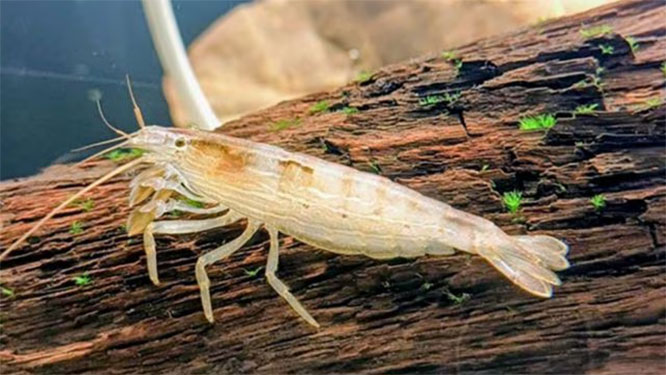
Mangaluru, Dec 7: A rare bamboo shrimp has been rediscovered on mainland India more than 70 years after it was last reported, confirming for the first time the presence of Atyopsis spinipes in the country. The find was made by researchers from the Centre for Climate Change Studies at Sathyabama Institute of Science and Technology, Chennai, during surveys in Karnataka and Odisha.

The team — shrimp expert Dr S Prakash, PhD scholar K Kunjulakshmi, and Mangaluru-based researcher Maclean Antony Santos — combined field surveys, ecological assessments and DNA analysis to identify the elusive species. Their findings, published in Zootaxa, resolve decades of taxonomic confusion stemming from a 1951 report that misidentified the species as Atyopsis moluccensis without strong evidence.

The shrimp has now been confirmed at two locations: the Mulki–Pavanje estuary near Mangaluru and the Kuakhai River in Bhubaneswar. Historical specimens from the Andaman Islands, previously labelled as A. moluccensis, were also found to be misidentified and actually belong to A. spinipes.

The rediscovery began after an aquarium hobbyist in Odisha spotted a shrimp in 2022, prompting systematic surveys across Udupi, Karwar and Mangaluru. Four female specimens were collected in Mulki and one in Odisha, all genetically matching.

Researchers warn the species may exist in very small, vulnerable populations as freshwater habitats face increasing pressure from pollution, sand mining and infrastructure development. All verified specimens have been deposited with the Zoological Survey of India for future reference.

Comments

Add new comment

  • Coastaldigest.com reserves the right to delete or block any comments.
  • Coastaldigset.com is not responsible for its readers’ comments.
  • Comments that are abusive, incendiary or irrelevant are strictly prohibited.
  • Please use a genuine email ID and provide your name to avoid reject.