Charged with terror, damned by aliases

February 9, 2012

The incredible story of boy ‘terrorist' Mohammad Aamir whose youth was destroyed because of his wrongful arrest and 14-year long incarceration

Mohammad Aamir had just turned 18, when one February day in 1998, he was ambushed by a police van. A month later, he found himself thrown against the cold, forbidding walls of a prison cell in the capital's Tihar jail. The charges were murder, terrorism and waging war against the nation.
aamir

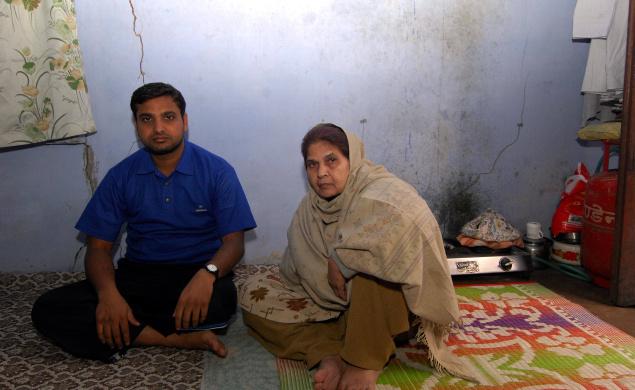
Mohammed Aamir and his mother at their home in New Delhi

Aamir, released in January this year after 14 years, was named the main accused in 20 low-intensity bomb blasts executed over 10 months — between December 1996 and October 1997 — in Delhi, Rohtak, Sonepat and Ghaziabad. The blasts led to five deaths in all. Five explosions were on moving buses, 10 occurred in the month of October 1997, five of these during a single evening in places as wide apart as Sadar Bazar in Delhi and Ghaziabad, many miles away. The Ghaziabad blasts were reported from three different coaches of the Frontier Mail.

Aamir and his co-accused Shakeel were charged with physically planting the bombs. Curiously, Shakeel, Aamir's main prop, was discharged before the start of hearing in 10 of the cases. More curiously, in 2009, he was found hanging from the ceiling of his barrack in Dasna Jail. In a further twist, then Jail Superintendent V.K. Singh was charged with Shakeel's murder.

Aamir's is an extraordinary story. His counsel and well-known criminal lawyer N.D. Pancholi says he has not seen a case like this in his career of 35 years: “It is incredible that a young boy of 18 has been named the mastermind and executor in 20 bomb blast cases on the thinnest of evidence. The case reinforces the demand for urgent police reforms.”

Isolation and release

As the charges piled up, Aamir , who was always Aamir to family and friends, acquired a bewildering array of aliases, becoming known in police and court records as Accused no 1, Md. Aamir Khan@ Kamran @Imran@ AbuAkasa @ Arif @Umer. Over the following 14 years, the darkness and isolation of Aamir's solitary high-security cell became his world even as the world outside changed unrecognisably: the capital grew flyovers and got shiny new malls and the metro. His father, in financial ruin and broken from failing to free his only son, died without Aamir knowing about it. His mother, struck down by a brain haemorrhage, lost her voice and became paralytic.

When Aamir, now 32, finally walked free, he had been acquitted in 18 of the 20 terror cases — an astonishing acknowledgement of the lack of evidence against him. Indeed without a single witness in any of the cases connecting him to the blasts, the trial court — which acquitted him in 17 cases — came up with the same line on each judgment day: “there is absolutely no incriminating evidence against the accused.” The Delhi High Court which overturned one of the three cases that went into appeal said: “the prosecution has miserably failed to adduce any evidence to connect the accused appellant with the charges framed, much less prove them.”

The trend points strongly to acquittal in the two remaining cases. In any event, there is the tragic irony of Aamir having already served more than the maximum prison term of 10 years for offences made out in each case. The first thing he did upon being released was to look up at the night sky which he had last seen as a teenager. A month after his return, his story, broken by Mohammad Ali in twocircles.net , appeared in the Urdu press. And Aamir got his revenge: he dropped copies of the papers in the homes of relatives and friends who had imposed a social boycott on the family.

For all his joy in the small things of life, including his reunion with a mother who, not being able to speak, expresses emotions through her eyes, Aamir cannot forget the nightmare of his past which began on February 20, 1998 with him being picked up and driven blindfolded to a distant getaway. A week of intense “questioning” followed by “confessions” and countless signed documents later, he was formally arrested and taken into police remand. The chargesheet filed in April 1998, said Aamir had been trained in Pakistan by the dreaded Abdul Karim ‘Tunda' gang. Further that Aamir and co-accused Shakeel collaborated to make bombs out of a factory rented by Shakil in Pilakhua in Ghaziabad. These were the bombs used in every one of the 1996-1997 blasts.

Aamir's third-floor home, described in the chargesheet as a hideout frequented by Pakistani and Bangladeshi terrorists, is a tiny 10 ft by 4 ft room in a bustling, crowded neighbourhood in Azad Market in Old Delhi.

The police story is that the hideout was visited on February 27, 1998, by two Bangladeshi terrorists. But instead of meeting Aamir there, they chose to wait six hours for him at a railway track off Sadar Bazar. The police party nabbed the two men and, through them, caught up with Aamir and Shakeel.

The seizure memo, questions

According to the seizure memo, a search of Aamir revealed a Webley & Scott revolver with several live cartridges, currency notes (in American dollars), five diaries containing details of explosive materials sourced from various suppliers, and a passport stamped with a single visa entry: to Pakistan. Shakeel carried a bag which had iron pieces, chemicals and other explosive materials.

Other wonders emerged from Aamir's briefcase: his ration card, birth certificate, school character certificate, school identity card besides fifth and seventh standard marksheets. In their “disclosure” statements, Aamir and Shakeel said that they led the police party to Shakeel's bomb-making factory in Pilakhua, from where chemicals and explosives used in the blasts were recovered.

The police produced no witness to the arrests. And the public witnesses allegedly present during the Pilakhua raid flatly refused to support the prosecution during the trial. Chandra Bhan, the prosecution's star witness, on whose evidence the entire terror case rested, maintained through rigorous cross-questioning that he had never seen Aamir and he was taken to the Chanakyapuri Police Station and made to sign on blank papers. Out of hundreds of witnesses produced by the prosecution in all the cases, only four claimed to have ever seen Aamir and not one of them said he had planted the explosives.

Several questions arise: How could an 18-year-old plant bombs by himself — on moving buses and trains, many of the blasts occurring just minutes apart? On the evening of October 1, 1997, Aamir is alleged to have planted two bombs in adjoining areas in Sadar Bazar and then travelled to Ghaziabad to place bombs in three compartments of the Frontier Mail. Would a boy terrorist trained by ‘Tunda' waste his time on low-intensity blasts? And for what earthly reason would he carry his fifth standard marksheet with him?

Of course, it is equally valid to ask why Aamir was singled out by the police. His story, borne out by his single visa stamp, is that he wanted to visit his sister who is married into a family in Pakistan. When he went to the Pakistan High Commission for his visa, he was approached by two men from the Indian intelligence — a fact he claims he learnt later — who asked him to get some documents from Pakistan in return for a small money reward. Tempted, he agreed but only to renege on the deal. Aamir left for Pakistan on December 12, 1997 and returned on February 13, 1998. A fortnight later he was arrested. Interestingly, Aamir was charged with executing the bomb blasts subsequent to his training in Pakistan. The last of the bomb blasts was in October 1997 — two months before he went on his first and last trip to Pakistan.

Aamir has his own questions: “Madamji,” he asks me, “if at 18, I became a dreaded mastermind with so many aliases, surely I would have been but a child when I started out?” And also, “I spent 14 years in jail for allegedly causing five deaths. What about the policemen who shot dead so many Muslims in cold blood in Hashimpura? What about Gujarat 2002?”

Comments

Add new comment

  • Coastaldigest.com reserves the right to delete or block any comments.
  • Coastaldigset.com is not responsible for its readers’ comments.
  • Comments that are abusive, incendiary or irrelevant are strictly prohibited.
  • Please use a genuine email ID and provide your name to avoid reject.
News Network
December 3,2025

indigo.jpg

IndiGo, India’s largest airline, is battling one of its worst operational disruptions in recent years, with hundreds of delays and cancellations throwing domestic travel into chaos.

Government data on Tuesday showed its on-time performance plunging to 35%, an unusual dip for a carrier long associated with punctuality.

By Wednesday afternoon, airports in Delhi, Mumbai, Bengaluru and Hyderabad had collectively reported close to 200 cancellations, stranding travellers across the country.

Crew Shortage After New Duty Norms

A major trigger behind the meltdown is a severe crew shortage, especially among pilots, following the rollout of revised Flight Duty Time Limitation (FDTL) norms last month.

The rules mandate longer rest hours and more humane rosters — a shift IndiGo has struggled to incorporate across its vast network.

Sources said several flights were grounded due to lack of cabin crew, while some delays stretched upwards of eight hours.

With IndiGo controlling over 60% of India’s domestic aviation market, the ripple effect has impacted airports nationwide.

IndiGo Issues Apology, Lists “Compounding Factors”

In a statement, IndiGo acknowledged the large-scale disruption:

“We sincerely apologise to customers. A series of unforeseen operational challenges — technology glitches, winter schedule changes, adverse weather, system congestion and updated FDTL norms — created a compounding impact that could not have been anticipated.”

To stabilise operations, the airline has begun calibrated schedule adjustments for the next 48 hours, aiming to restore punctuality. Affected passengers are being offered refunds or alternate travel arrangements, IndiGo said.

What the FDTL Rules Require

The FDTL norms, designed to reduce pilot fatigue, cap duty and flying hours as follows:
•    Maximum 8 hours of flying per day
•    35 hours per week
•    125 hours per month
•    1,000 hours per year

Crew must also receive rest equalling twice the flight duration, with a minimum 10-hour rest period in any 24-hour window.

The DGCA introduced these limits to enhance flight safety.

Hyderabad: 33 Flights Cancelled, Long Queues Reported

Hyderabad’s Rajiv Gandhi International Airport saw heavy early-morning crowds as 33 IndiGo flights (arrivals and departures) were cancelled.

The airport clarified on X that operations were normal, advising passengers to contact IndiGo directly for latest flight status.

Cancellations included flights to and from Visakhapatnam, Goa, Ahmedabad, Delhi, Bengaluru, Chennai, Madurai, Hubli, Bhopal and Bhubaneswar.

Bengaluru: 42 Flights Disrupted

Bengaluru’s Kempegowda International Airport recorded 42 cancellations — 22 arrivals and 20 departures — affecting routes to Delhi, Mumbai, Chennai, Hyderabad, Goa, Kolkata and Lucknow.

Passengers Vent on Social Media

Irate travellers took to X to share their experiences. One passenger stranded in Hyderabad wrote: “I have been here since 3 a.m. and missed an important meeting.”

Another said: “My flight was pushed from 1:55 PM to 2:55 PM and now 4:35 PM. I was informed only three minutes before entering the airport.”

Delhi Airport Hit by Tech Glitch

At Delhi Airport, the disruption deepened due to a slowdown in the Amadeus system — used for reservations, check-ins and departure control.

The technical issue led to longer queues and sluggish processing, adding to delays already worsened by staff shortages.

Comments

Add new comment

  • Coastaldigest.com reserves the right to delete or block any comments.
  • Coastaldigset.com is not responsible for its readers’ comments.
  • Comments that are abusive, incendiary or irrelevant are strictly prohibited.
  • Please use a genuine email ID and provide your name to avoid reject.
News Network
December 4,2025

indigoflight.jpg

Domestic carrier IndiGo has cancelled over 180 flights from three major airports — Mumbai, Delhi and Bengaluru — on Thursday, December 4, as the airline struggles to secure the required crew to operate its flights in the wake of new flight-duty and rest-period norms for pilots.

While the number of cancellations at Mumbai airport stands at 86 (41 arrivals and 45 departures) for the day, at Bengaluru, 73 flights have been cancelled, including 41 arrivals, according to a PTI report that quoted sources.

"IndiGo cancelled over 180 flights on Thursday at three airports-Mumbai, Delhi and Bengaluru," the source told the news agency.

Besides, it had cancelled as many as 33 flights at Delhi airport for Thursday, the source said, adding, "The number of cancellations is expected to be higher by the end of the day."

The Gurugram-based airline's On-Time Performance (OTP) nosedived to 19.7 per cent at six key airports — Delhi, Mumbai, Chennai, Kolkata, Bengaluru and Hyderabad — on December 3, as it struggled to get the required crew to operate its services, down from almost half of December 2, when it was 35 per cent.

"IndiGo has been facing acute crew shortage since the implementation of the second phase of the FDTL (Flight Duty Time Limitations) norms, leading to cancellations and huge delays in its operations across the airports," a source had told PTI on Wednesday.

Chaos continued at several major airports for the third day on Thursday because of the cancellations.

A spokesperson for the Kempegowda International Airport (KIA) in Bengaluru said that 73 IndiGo flights had been cancelled on Thursday.

At least 150 flights were cancelled and dozens of others delayed on Wednesday, airport sources said, leaving thousands of travellers stranded, according to news agency Reuters.

The Directorate General of Civil Aviation (DGCA) has said it is investigating IndiGo flight disruptions and has asked the airline to submit the reasons for the current situation, as well as its plans to reduce flight cancellations and delays.

It may be mentioned here that the pilots' body, Federation of Indian Pilots (FIP), has alleged that IndiGo, despite getting a two-year preparatory window before the full implementation of new flight duty and rest period norms for cockpit crew, "inexplicably" adopted a "hiring freeze".

The FIP said it has urged the safety regulator, the DGCA, not to approve airlines' seasonal flight schedules unless they have adequate staff to operate their services "safely and reliably" in accordance with the New Flight Duty Time Limitations (FDTL) norms.

In a letter to the DGCA late on Wednesday, the FIP urged the DGCA to consider re-evaluating and reallocating slots to other airlines, which have the capacity to operate them without disruption during the peak holiday and fog season if IndiGo continues to "fail in delivering on its commitments to passengers due to its own avoidable staffing shortages."

Comments

Add new comment

  • Coastaldigest.com reserves the right to delete or block any comments.
  • Coastaldigset.com is not responsible for its readers’ comments.
  • Comments that are abusive, incendiary or irrelevant are strictly prohibited.
  • Please use a genuine email ID and provide your name to avoid reject.
News Network
December 6,2025

indigoticket.jpg

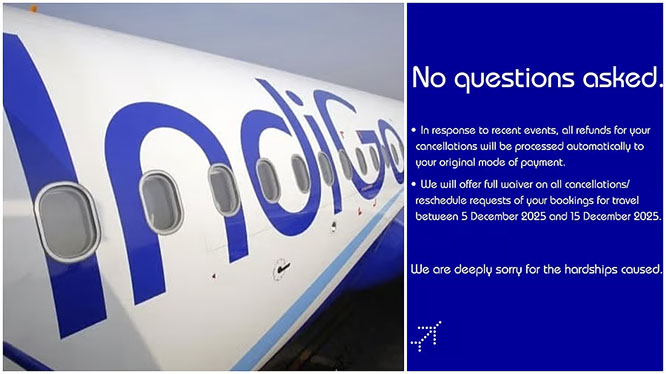
With IndiGo flight disruptions impacting thousands of passengers, the airline on Saturday said that it will offer full waiver on all cancellations/reschedule requests for travel bookings between December 5, 2025 and December 15, 2025.

Earlier in the day, the civil aviation ministry had directed the airline to complete the ticket refund process for the cancelled flights by Sunday evening, as well as ensure baggage separated from the travellers are delivered in the next two days.

In a post on X, titled 'No questions asked', IndiGo wrote, "In response to recent events, all refunds for your cancellations will be processed automatically to your original mode of payment."

"We are deeply sorry for the hardships caused," it further added.

Several passengers, however, complained of not getting full refund as promised by the airline.

Netizens have shared screenchots of getting charged for airline cancellation fee and convenience fee.

"Please tell me why u have did this airline cancellation charges when u say full amount will be refunded (sic)," a user wrote sharing a screenshot of the refund page.

"Well, but you have still debited the convenience charges," wrote another.

Passengers have also raised concerns about the "cancel" option being disabled on the IndiGo app. "First enable the 'Cancel' button on your App & offer full refund on tickets cancelled by customers between the said dates," wrote a user.

A day after the country's largest airline, IndiGo, cancelled more than 1,000 flights and caused disruptions for the fifth day on Saturday, the ministry said that any delay or non-compliance in refund processing will invite immediate regulatory action.

The refund process for all cancelled or disrupted flights must be completed by 8 pm on Sunday, the ministry said in a statement.

"Airlines have also been instructed not to levy any rescheduling charges for passengers whose travel plans were affected by cancellations," it said.

On Saturday, more than 400 flights were cancelled at various airports.

IndiGo has also been instructed to set up dedicated passenger support and refund facilitation cells.

Comments

Add new comment

  • Coastaldigest.com reserves the right to delete or block any comments.
  • Coastaldigset.com is not responsible for its readers’ comments.
  • Comments that are abusive, incendiary or irrelevant are strictly prohibited.
  • Please use a genuine email ID and provide your name to avoid reject.