



New Delhi, April 9: Having jolted the government over the critical operational gaps in its military capabilities, the Army is now pushing hard for fast-track policies and acquisitions to "enhance its combat ratio versus China" as well as "upgrade its combat edge" against Pakistan.
The defence ministry, too, is responding with alacrity for a change. Defence minister AK Antony has called another review meeting with Army chief General VK Singh and his top brass later this month, after holding two such meetings on February 28 and April 2.
It was between the earlier two meetings that the Army chief's confidential letter to the PM, about the "hollowness'' in military preparedness, found its way into the public domain much to the government's consternation.
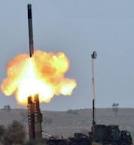
For starters, the cases for one more regiment of the 300-km range BrahMos supersonic cruise missiles, two "troops'' of Israeli medium-altitude, long endurance Heron UAVs (unmanned aerial vehicles), and several types of ammunition ranging from Konkurs anti-tank guided missiles to Invar missiles for T-90S main-battle tanks, will be finalized in this fiscal's first quarter, top sources said.
Interestingly, the new BrahMos regiment will have the missile's Block-III version, which has "steep dive capability'' to take out targets hidden behind a mountain range. After the western front, the government has approved deployment of these missile systems in Arunachal Pradesh to counter China's huge buildup of military infrastructure all along the 4,057-km Line of Actual Control.
Other projects in the pipeline for Army, which has over 100 of them at different stages, include advanced assault rifles, close-quarter battle carbines, bullet-proof jackets, ballistic helmets and light vehicles for the infantry's 359 battalions.
The mechanized forces' list stretches from TIFCS night-vision devices for T-72 tanks, upgrade of BMP-2 infantry combat vehicles and AFV (armoured fighting vehicle) protection to missiles and ammunition for all of them.
Air defence regiments, in turn, want procurement of three surface-to-air missile (SAM) systems - quick-reaction, medium range and man-portable short-range - to replace obsolete Russian-origin Kvadrat, Strela and other systems. Self-propelled air defence gun and missile systems as well as an upgrade of L-70 guns is also on the cards, in addition to the two indigenous Akash SAM regiments already ordered for Rs 14,180 crore.
The over Rs 20,000 crore 155mm artillery programme will get underway with induction of 145 ultra-light howitzers, to be followed by 1,580 towed, 180 self-propelled wheeled and 100 self-propelled tracked guns, as also more Russian Smerch multi-launch rocket systems.
In terms of infrastructure, apart from a new mountain strike corps, the Army wants completion of the earmarked development in the eastern theatre at a cost of Rs 9,243 crore by 2016-2017 as well as the Rs 26,155 crore "capability development in the northern borders'' by 2020-2021.
The force is also pushing for development of 14 strategic railway lines for "troop mobilization and logistics sustenance''. They include Murkongseld-Pasighat-Rupai, Misamari-Tawang and North Lakimpur-Along-Silapathar lines in the eastern sector.
The central sector lines are Rishikesh-Karanprayag-Chamoli, Dehradun-Uttarkashi, Tanakpur-Jauljibi and Tanakpur-Bageshwar, while the northern one includes Jammu-Akhnoor-Poonch, Pathankot-Leh and Srinagar-Kargil-Leh ones.
Then, the Army wants faster construction of the 73 all-weather roads (totaling 3,808 km) identified for construction along the three sectors of LAC -- western (Ladakh), middle (Uttarakhand, Himachal) and eastern (Sikkim, Arunachal) - since only 15 of them have been completed till now.


Comments
Add new comment