



New Delhi, April 18: With an eye on both China and Pakistan, the government on Tuesday approved a slew of measures to fast-track acquisition of weapons as well as boost infrastructure development along the borders for faster mobility of troops and equipment.
The new steps significantly include seeking the Planning Commission's sanction for 14 strategic railway lines, mostly along the western and eastern fronts, for "quick troop mobilization and logistics sustenance'' in times of conflict, sources said.
An empowered committee has also been constituted under defence secretary Shashikant Sharma to examine the "detailed project reports'' of the Army's proposed "capability development plan on the Northern Borders'', worth Rs 26,155 crore that is slated for completion by 2020-2021. There is already an ongoing Rs 9,243 crore project for "infrastructure development in the Eastern Theatre'' by 2016-2017.
All this is critical since China can now move around 30 divisions (each with over 15,000 soldiers) to the borders within 30 days to outnumber Indian forces by at least 3:1 after undertaking massive infrastructure development all along the 4,057-km Line of Actual Control. Beijing, in fact, has recently taken to holding regular air and land combat exercises in the high-altitude Qinghai-Tibet Plateau to flex its military might.
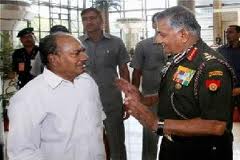
The new fast-track measures came after defence minister A K Antony held an almost two-hour long meeting with General V K Singh and his top brass on Tuesday, a day ahead of the slated testing of India's most ambitious strategic missile, the over 5,000-km range Agni-V.
This was the third review meeting to plug critical operational gaps in India's military capabilities, highlighted by Gen Singh in his confidential letter to PM Manmohan Singh on March 12, in the face of two "inimical neighbours'' and the "reality of large land borders''.
The meeting "expressed satisfaction'' at the progress of procurement cases for the 4th regiment of the BrahMos supersonic cruise missiles at a cost of Rs 4,100 crore and two regiments of the Pinaka multi-barrel rocket launchers for Rs 2,136 crore.
The new BrahMos regiment, with the missile's Block-III version that has "steep dive capability'' to take out targets hidden behind a mountain range, will be deployed in Arunachal Pradesh, with the first three catering for the western front with Pakistan.
The meeting also discussed the Army's proposed procurement of 145 M-777 ultra-light howitzers, which India is to buy from the US in a direct government-to-government deal worth $647 million.
These air-mobile artillery guns will be needed for the new mountain strike corps (70,000 soldiers) being planned after the raising of two new mountain infantry divisions, with 1,260 officers and 35,011 soldiers, in Assam and Nagaland.
MoD will also try to expedite the long-delayed over Rs 20,000 crore 155mm artillery modernization programme, which includes 1,580 towed, 180 self-propelled wheeled and 100 self-propelled tracked guns as well as more Russian Smerch multi-launch rocket systems.
It was also decided that another empowered committee would be set up on the lines of the one for the Siachen Glacier, under the Army vice-chief, to speed up acquisition of specialized equipment for the 10 battalions of Special Forces tasked for clandestine warfare deep behind enemy lines.
The weaponry for them includes advanced assault rifles and carbines, all-terrain multi-utility vehicles and GPS navigation systems, modular acquisition devices, laser range-finders, underwater vehicles and combat free-fall parachutes, among other things.
Yet another committee will be constituted to examine the Army's long-pending case of acquiring its own attack helicopters and other "combat aviation assets'', which the IAF has been opposing tooth-and-nail. "The committee will include both Army and IAF members to study the current practices in armies of developed countries,'' said an official.
FAST TRACK MEASURES
14 Strategic Railway Lines:
Eastern: Murkongseld-Pasighat-Rupai, Misamari-Tawang, North Lakimpur-Along-Silapathar.
Western: Patti-Ferozpur.
Southern: Jodhpur-Shergarh-Phalsund, Jodhpur-Jaisalmer.
Central: Rishikesh-Karanprayag-Chamoli, Dehradun-Uttarkashi, Tanakpur-Jauljibi, Tanakpur-Bageshwar
Northern: Jammu-Akhnoor-Poonch, Pathankot-Leh, Srinagar-Kargil-Leh
South-Western: Anupgarh-Chhattisgarh-Motigarh-BKN.
Committees:
Empowered committee headed by defence secretary to monitor "capability development plan on the Northern Borders'' worth Rs 26,155 crore, slated for completion by 2020-2021.
Empowered committee headed by Army vice-chief to fast-track equipment for Special Forces. These include advanced assault rifles, carbines, all-terrain multi-utility vehicles, GPS navigation systems, modular acquisition devices, laser range-finders, underwater vehicles, combat free-fall parachutes and the like.
Committee to examine Army's case for attack helicopters and other "combat aviation assets''. Army Aviation Corps wants a mix of reconnaissance, utility, tactical battle-support, armed and attack helicopters as well as tactical airlift fixed-wing aircraft in the long term.
Acquisitions:
4th regiment of BrahMos supersonic cruise missiles for Rs 4,100 crore.
Two regiments of Pinaka multi-barrel rocket launchers for Rs 2,136 crore.
10,000 Konkurs-M anti-tank guided missiles for Rs 1,223 crore from Russia.
10,000 3UBK-Invar missiles for T-90S tanks for Rs 1,386 crore from Russia.
15,000 3UBK-Invar missiles for T-90S tanks for Rs 2,079 crore from Bharat Dynamics.
66,000 "armour-piercing fin-stabilized discarding sabot'' tank shells for Rs 1,386 crore.
Two troops of Heron UAVs (unmanned aerial vehicles) for Rs 1,200 crore from Israel.
145 M-777 ultra-light howitzers for $ 647 million from US.

Comments
Add new comment