



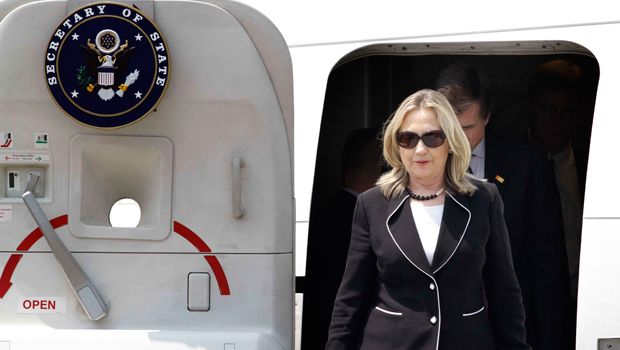
Kolkata, May 7: India: Hoping to wean India from Iranian oil imports, US Secretary of State Hillary Rodham Clinton is urging Indian leaders to explore alternative suppliers as she opens a three-day visit to the energy-starved South Asian giant that will also focus on regional security and easing trade restrictions.
Clinton arrived in the eastern city of Kolkata — the first secretary of state to visit the former colonial capital of 14 million — on Sunday after visits to China and Bangladesh as officials traveling with her said the Iranian oil imports would top an agenda that includes India’s relations with nuclear rival Pakistan and the future of Afghanistan.
India has huge energy needs to fuel its rapid growth and has made some progress in easing its dependence on Iranian oil. But a senior US official said the United States wants to see more.
The official, who spoke on condition of anonymity to preview Clinton’s private discussions in Kolkata and New Delhi, said the “trend lines are good” but “we really need to receive assurances that they are going to continue to make good progress.”
Like other major consumers of Iranian oil, India could face US sanctions by the end of June if the Obama administration determines it has not made significant cuts in imports under a law aimed at squeezing Iran’s petroleum industry to press the country to comply with international demands over its nuclear program.
A dozen European nations and Japan have already been spared from those sanctions after the administration determined they had substantially reduced their Iranian oil imports. India, along with China, South Korea, Turkey and South Africa, has still not received such waivers.
India imports around 70 percent of its oil, and about 9 percent of the imports are from Iran. The US official said India had recently stepped up imports of oil from Saudi Arabia to make up for the reduction in Iranian oil and that the US was eager to see the Indians explore other alternatives. Iran is India’s second-largest crude oil supplier after Saudi Arabia and according to media reports imports 550,000 barrels a day.
India has been pushing its oil companies to cut back their crude imports from Iran and an Indian official, speaking on condition of anonymity per custom, said the government is willing to discuss the matter. The official expressed hope India will be exempted from the sanctions.
“We believe we have a strong case, which we will put forth,” the official said.
India and Iran reached a deal earlier this year that would allow India to pay for about 45 percent its Iranian oil purchases in rupees. Iran would then use the Indian currency to buy goods from India.
International economic sanctions on Iran had made oil trade difficult, because Indian oil importers had to scramble to find banks willing to handle transactions with Tehran. The barter exchange would help India pay for the Iranian crude without resorting to dollar payments, thus bypassing international banks.
An Indian delegation visited Iran in March to promote Indian goods including machinery, iron, steel, minerals and automobiles and Clinton’s visit coincides with that of a large Iranian group that will be in New Delhi to explore Indian goods and services Tehran can buy to offset the enormous rupee payments running into billions of dollars that Iran has accumulated.
The US official downplayed the presence of the Iranian delegation, saying. “I don’t think we are too concerned about it.” The official added that the US special envoy for global energy issues, Carlos Pasqual, will visit India later in May to follow up on Clinton’s talks, the official said.
In her talks with Indian officials, Clinton will also be pressing for the country to continue economic reforms and trade liberalization, including dropping restrictions on foreign investment in the finance sector and allowing large western retailers to open up, the US official said.
Before heading to New Delhi on Monday, Clinton will meet in Kolkata with Chief Minister Mamata Banerjee, the top elected leader of West Bengal state. Banerjee, a key partner of India’s ruling coalition, has in recent months opposed many of the Prime Minister Manmohan Singh-led Congress party’s plans to carry out economic reforms.
Clinton is expected to push for expanding US investment opportunities in West Bengal and seek Banerjee’s views on the entry of WalMart-type multi-brand retailers into India. Banerjee has been a vocal opponent of opening up India’s retail sector saying it would harm poor shop owners.
In talks with Singh in New Delhi, Clinton will look at regional security issues and the India-US Strategic Dialogue meeting scheduled to be held in Washington next month. India’s major concern, however, is the security situation in Afghanistan following the drawdown of NATO troops from the war-torn country in 2014. India has been taking a lead in the reconstruction efforts in Afghanistan and plans to host a regional investors’ conference on Afghanistan in June.
The US will also be looking at trade and investment opportunities in India. With its economy expected to grow at around 7 percent over the next few years, India is an important market for US exports. Trade between the two countries is expected to cross $100 billion this year.
However, some of the sheen has worn off the high expectations from US-India relations in the years following the signing of a landmark civil nuclear deal in 2008. Washington was riled when India chose a French company for an $11 billion order for 126 fighter jets for the Indian air force. India has sourced numerous other big ticket defense purchases from US companies.
There is also a growing perception in Washington that the Indian government has not delivered on economic reforms and has been dragging its feet on implementing key nuclear legislation that would enable US companies to invest in India.
Over the past year, Singh’s government has been bogged down by a series of scandals and resistance from its coalition partners that have brought economic reforms to a halt.


Comments
Add new comment