



Dolhara (Thane District), May 10: Many myths surround the death of 41-year-old Parvati Jadhav, an adivasi woman in Dolhara. Officials attribute it to a heat stroke, and some say it was a cardiac arrest, but people in the village have no doubts about the reason. “Parvati was a sacrifice to the severe shortage of water here,” says Yashoda Wargade.
“Why don't they just poison us instead of killing us without water,” she laments. “Parvati was breathless when she was brought back from the well and couldn't even drink water,” she adds. At home, Parvati's husband Ramu, son Hiraman and four young daughters, the eldest Savita is 14 and youngest Sandhya, eight, try to reconcile with her death. A garlanded photograph of Parvati is brought out to show visitors. Her daughter-in-law Madhuri has given birth to a second daughter only a month ago.
Shocking incident
Filling water occupies most of the women's lives and the incident has come as a severe shock. They wait for six to eight hours sometimes for their turn at the well and even the men chip in at night since it is dangerous to be out alone. “Parvati made several trips in the heat and she died because of that,” says Shakuntala Jadhav.
Parvati like other women used to spend most of the mornings waiting for the elusive tanker which empties about 4,000 litres into the well, about one kilometre from her house. That Sunday morning on April 22, she rushed as usual to the well and made two trips in the baking heat carrying several steel pots each time. She was in the middle of preparing lunch for her family.
The heat and stress became a fatal combination for her. There is never enough water and it was during her third trip that she fell in a faint. Women bringing her back to the house recall that her pulse was fading and her eyes had rolled upwards. Her nephew Pundalik Jadhav says filling water repeatedly sapped her life.
She had no known ailments, confirms Kailash Jadhav, Additional Collector, Thane, who submitted a report to the Maharashtra government saying Parvati died of a heat stroke and her death was not due to water scarcity or a stampede.
Mokhada taluka in which Dolhara is situated has faced acute scarcity conditions since March this year and tanker supply has been erratic. There is chronic water shortage here. Yet, Thane is not on the government list of 15 scarcity-affected districts. People spend all day and night collecting water which forms a trickle at the bottom of bone dry wells.
The village had asked for a well closer to the village and a dam. The police patil Shankar Patil had even donated some land for a dam near the village. It was approved 10 years ago at a cost of Rs. 1.5 core but no one came forward to construct it, he rues. Villagers in disgust had boycotted elections but it was of no use. “How many more must die for water?” asks Yashoda.
The women have to amass bundles of unwashed clothes every week and wait for a State transport bus to ferry them 10 km away to a rivulet for washing. “The conductor does not let us enter with these smelly clothes even though we pay Rs. 7 per head,” says Ms. Jadhav.
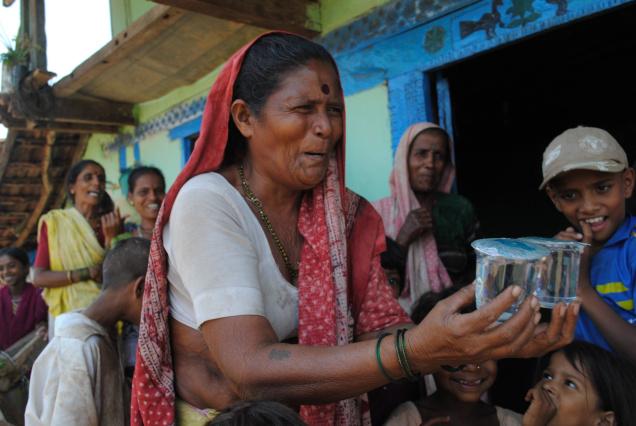
The men also fetch large blue drums of water by bullock cart from another well about five km away from the village. The women scoffed at the Maharashtra Navnirman Sena (MNS) which distributed sealed plastic glasses of water to the village after Parvati died. Crushed cups are strewn in the village but in Shakuntala's house, the children have kept them untouched. “Look at these cups of water. Of what use can they be. We refuse to drink this water,” laughs Yashoda. In the village, a large hexagonal water tank stands as a testimony to the futility of government schemes. It was built many years ago for storing water but it used to leak and there is no earthly use for it now, people say amid demands of tearing it down.
‘Unfortunate event'
Immediately after her death which Mr. Jadhav termed “an unfortunate event,” a bore well was dug in the village which yielded water. And in addition, a long-pending demand for a small dam on a nearby rivulet has been sanctioned with alacrity. “Work will begin in September and it will be completed next year and then Dolhara will be out of scarcity,” declares Mr. Jadhav.
The two wells in the village are dry and two tankers supply water once in a while. Now the government sends up to three tankers for a population of 1200-1500 in the village. The two hand-pumps don't work and a new one was installed now and one last year.
No post-mortem
Sanjay Dahale says his aunt was taken to Khodala for treatment but they couldn't do much and she was taken to a private hospital in Nashik. The police are investigating her death. The doctors charged Rs. 45,000 for a day's treatment. There was no post-mortem conducted after she died.
Mr. Jadhav clarified that Parvati's condition was critical and the doctors at the Nashik hospital said they would not be able to revive her and advised the relatives to take her home. She died on the way back. While going to fill water, she fell about 200 metres away from the well and did not sustain any injuries. There was no blood supply to her brain, he said, adding that she may have been unwell or not had anything for breakfast. He said women used the well all year round and there had been no such incidents so far.
Parvati's death is a warning to an apathetic administration. The question is will it wake up.


Comments
Add new comment