



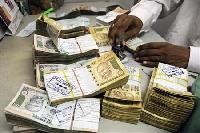
Mumbai, May 11: The Reserve Bank of India ordered exporters to convert half of their foreign exchange earnings kept in bank accounts into Indian rupee to prop up the worst-performing BRICS currency, a day after it closed at a record low, prompting fears of a further slide.
But the relief lasted only a few hours before the rupee resumed its decline since the order could bring in just about $3 billion, enough to cover five days of deficit.
The RBI also cut banks' intra-day positions in currency trade to five times of the net overnight open positions, which is set by the central bank as part of curbs announced on December 15. The overnight positions are not disclosed by the central bank.
More measures, including funding crude imports from foreign exchange reserves, a new US dollar mobilisation scheme, or even a sovereign dollar bond sale to boost the currency, could be on the cards, traders speculated.
The early rally faded soon with the rupee coming off highs of 52.95 to the US dollar to close at 53.44. Its all-time closing low was 53.83, on Wednesday.
Most currencies falling against dollar
Despite a series of measures from the central bank, many believe that weak macroeconomic variables such as fiscal and current account deficits, and worsening global liquidity due to deteriorating European sovereign credit crisis may diminish the effectiveness of its response.
"The RBI announced two measures that will ease, (and) slightly reverse near-term pressure on INR, but neither fixes the underlying problems that are causing INR to depreciate," said Rajiv Mallik, senior economist, CLSA Singapore. "Further, USD squeeze also has adverse implications for onshore INR liquidity."
Half the balances in the so-called Exchange Earners' Foreign Currency (EEFC) accounts should be converted into rupee balances within a fortnight and that holds true for future earnings as well, said the central bank in a notification. Exporters will be allowed to buy foreign exchange only after exhausting US dollar deposits in their accounts.
Most currencies are sliding against the greenback as global investors retreat to the safety of US dollar amid resurgence of doubts over the future of the Euro.
The rupee has been hurt more than others since India needs US dollars from outside to pay for imports as it does not export enough to pay for imports. Most big emerging countries have a surplus since they earn more US dollars from exports than needed to pay for imports.
"The facility of EEFC scheme is intended to enable exchange earners to save on conversion, transaction costs while undertaking forex transactions in future," said the central bank. "This facility is not intended to enable exchange earners to maintain assets in foreign currency, as India is still not fully convertible on capital account."
Some recent measures of the central bank are akin to its actions during the Asian crisis of 1997-98, when it ordered companies to bring in the proceeds of share sales in the form of Global Depository Receipts.
In December last year, the central bank brought in measures to curb speculation, which helped the rupee rally in the March quarter. It has reversed since due to the government's tax policies directed at overseas investors that have increased uncertainty and also because of lack of economic reforms.
With the current account deficit, the excess of imports over exports, at 4.3% of the gross domestic product and portfolio flows tapering off, the currency could be under renewed pressure if either exports do not rise sharply, or imports do not slow.
Both are unlikely now given the state of the economy. Subsidised petroleum products keep demand high, and import of gold continues due to high inflation expectation. Slowing European economies cap export growth.
Trade deficit for April stood at $13.4 billion in April, after hitting a record of $185 billion last fiscal. Exports rose 3.2% while imports grew 3.8% to $37.9 billion.
A breather could come in the form of unconventional measures, as in the past. "There could be some unconventional measures such as the IMD (India Millennium Deposits), or the RIB (Resurgent India Bonds)," said Rohit Bammi, partner at consultants KPMG. "There's a possibility of routing crude imports through foreign exchange reserves to take out the volatility."
At the turn of the century, India raised funds through the Resurgent India Bonds, and India Millennium Deposits to improve the reserves position. These involved paying high interest rates to lure overseas Indians.
Although neither the government nor the central bank has committed to such programmes, speculation is rife due to the sliding rupee. Indeed, some believe it may be the right time to float USD sovereign bonds that could bring in some fiscal discipline and also create a benchmark for Indian corporates keen to borrow overseas.

Comments
Add new comment