Overseas investors pull out Rs 1 trillion from India

June 11, 2012

overseas

New Delhi, June 11: Rich overseas entities, investing in Indian markets through 'participatory notes' (P-notes/PNs), are estimated to have pulled out over Rs 1 lakh crore (about USD 20 billion) in less than three months on fears of getting caught in the government's taxation net and its black money trail.

As a result, the quantum of money invested through these PNs has hit its rock-bottom levels of just about 10 per cent of total FII (foreign institutional investment) holdings -- which used to be more than 50 per cent a few years ago.

The participatory notes (PNs) allow foreign HNIs (high networth individuals) and other rich investors to invest in India through already-registered FIIs, while saving on time and costs associated with direct registrations.

The flight of PN investments began late in March after the government in its union budget proposed new taxation regime of General Anti-Avoidance Rule (GAAR) and certain retrospective amendments for taxing offshore transactions.

Sources said that PN investors have already pulled out close to Rs 1 lakh crore (about USD 20 billion) from Indian equity and debt markets, while they might have decided against putting in fresh investments worth at least Rs 50,000 crore ever since the new tax policy was proposed.

While GAAR has been deferred by a year, the tax proposals for offshore transactions could apply to FIIs as well.

It is feared that the new taxes could lead to heavy tax burden for the foreign investors investing through tax-friendly jurisdictions like Mauritius. Most of the overseas entities route their investments into India through such places to take benefit of their tax-friendly regimes.

There are apprehensions that FIIs could be forced to pass on their tax liabilities to their PN clients, thus adversely impacting their overall returns on investment.

Many hedge funds and ultra-rich investors from abroad prefer PNs, which are sold by India-registered FIIs, as it allows them maximise the returns through savings on costs and rigmarole of various regulatory processes.

As per the latest data available with market regulator Sebi, the total value of PNs in Indian markets stood at about Rs 1,30,012 crore (about USD 25 billion) at the end of April 2012, down from Rs 1,83,151 crore at the end of February and Rs 1,65,832 crore as on March 31, 2012.

This figure was on a sharp uptrend this year till middle of March, but started declining sharply after tax proposals came to be known. While the mid-month figures are not shared by Sebi, the industry sources said that the total value of PNs are estimated to have reached near Rs two trillion (about USD 40 billion), before it started sliding in late March.

Sources said that the total value of PNs is estimated to have fallen further to near Rs one lakh crore level (about USD 15 billion) currently, marking a fall of nearly same amount from its late-March peak.

The share of PNs in total FII holding stood at 16.4 per cent in February, but fell to 11.4 per cent by April. It has now further fallen to near 10 per cent level, sources said, while adding that most of the FII outflow currently taking place is in the PN accounts.

The PNs have been accounting for mostly 15-20 per cent of total FII holdings in India since 2009, while it used to much higher in the range of 25-40 per cent in 2008. However, it was as high as over 50 per cent at the peak of Indian stock market bull run during a few months in 2007.

In addition to the new taxation proposals, the government's recent white paper on Black Money has added to the flight of PN investments from India, sources said.

The white paper, tabled by the Parliament on May 21, said that PNs were being used by Indian citizens to re-invest the black money in the country.

"Investment in the Indian stock market through PNs is another way in which the black money generated by Indians is re-invested in India," it said.

Participatory note is a derivative instrument issued in foreign jurisdictions, by a foreign institutional investor (FII) or its sub-accounts against underlying Indian securities.

"... through the instrument of PNs, investment can be made in the Indian securities market by those investors who do not wish to be regulated by Indian regulators due to a variety of reasons," the white paper noted.

The reasons could include the desire of investors to keep their identity anonymous, which is possible also for the reason that PNs/ODIs can be freely traded and easily transferred without disclosing the identity of the actual beneficiaries, it added.

As per the white paper, since PNs are issued from offshore financial centres (OFCs) such as the Cayman Islands, British Virgin Islands, Switzerland, and Luxembourg, it is possible to hide the identity of the ultimate beneficiaries through multiple layers.

Amid rising concerns that some of the money coming through PNs could be unaccounted wealth under the of FII investment, market regulator Sebi has already taken various measures to ensure that these instruments are not used for black money laundering. It was due to the steps taken by Sebi that the PNs' share in total FII holding had previously fallen from over 50 per cent to 15-20 per cent.

Comments

Add new comment

  • Coastaldigest.com reserves the right to delete or block any comments.
  • Coastaldigset.com is not responsible for its readers’ comments.
  • Comments that are abusive, incendiary or irrelevant are strictly prohibited.
  • Please use a genuine email ID and provide your name to avoid reject.
News Network
December 4,2025

indigoflight.jpg

Domestic carrier IndiGo has cancelled over 180 flights from three major airports — Mumbai, Delhi and Bengaluru — on Thursday, December 4, as the airline struggles to secure the required crew to operate its flights in the wake of new flight-duty and rest-period norms for pilots.

While the number of cancellations at Mumbai airport stands at 86 (41 arrivals and 45 departures) for the day, at Bengaluru, 73 flights have been cancelled, including 41 arrivals, according to a PTI report that quoted sources.

"IndiGo cancelled over 180 flights on Thursday at three airports-Mumbai, Delhi and Bengaluru," the source told the news agency.

Besides, it had cancelled as many as 33 flights at Delhi airport for Thursday, the source said, adding, "The number of cancellations is expected to be higher by the end of the day."

The Gurugram-based airline's On-Time Performance (OTP) nosedived to 19.7 per cent at six key airports — Delhi, Mumbai, Chennai, Kolkata, Bengaluru and Hyderabad — on December 3, as it struggled to get the required crew to operate its services, down from almost half of December 2, when it was 35 per cent.

"IndiGo has been facing acute crew shortage since the implementation of the second phase of the FDTL (Flight Duty Time Limitations) norms, leading to cancellations and huge delays in its operations across the airports," a source had told PTI on Wednesday.

Chaos continued at several major airports for the third day on Thursday because of the cancellations.

A spokesperson for the Kempegowda International Airport (KIA) in Bengaluru said that 73 IndiGo flights had been cancelled on Thursday.

At least 150 flights were cancelled and dozens of others delayed on Wednesday, airport sources said, leaving thousands of travellers stranded, according to news agency Reuters.

The Directorate General of Civil Aviation (DGCA) has said it is investigating IndiGo flight disruptions and has asked the airline to submit the reasons for the current situation, as well as its plans to reduce flight cancellations and delays.

It may be mentioned here that the pilots' body, Federation of Indian Pilots (FIP), has alleged that IndiGo, despite getting a two-year preparatory window before the full implementation of new flight duty and rest period norms for cockpit crew, "inexplicably" adopted a "hiring freeze".

The FIP said it has urged the safety regulator, the DGCA, not to approve airlines' seasonal flight schedules unless they have adequate staff to operate their services "safely and reliably" in accordance with the New Flight Duty Time Limitations (FDTL) norms.

In a letter to the DGCA late on Wednesday, the FIP urged the DGCA to consider re-evaluating and reallocating slots to other airlines, which have the capacity to operate them without disruption during the peak holiday and fog season if IndiGo continues to "fail in delivering on its commitments to passengers due to its own avoidable staffing shortages."

Comments

Add new comment

  • Coastaldigest.com reserves the right to delete or block any comments.
  • Coastaldigset.com is not responsible for its readers’ comments.
  • Comments that are abusive, incendiary or irrelevant are strictly prohibited.
  • Please use a genuine email ID and provide your name to avoid reject.
News Network
December 3,2025

indigo.jpg

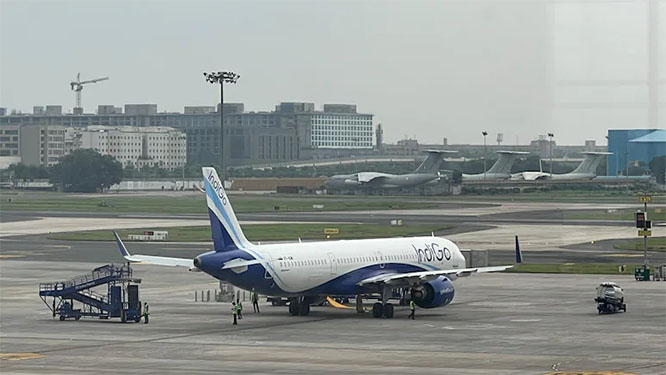
IndiGo, India’s largest airline, is battling one of its worst operational disruptions in recent years, with hundreds of delays and cancellations throwing domestic travel into chaos.

Government data on Tuesday showed its on-time performance plunging to 35%, an unusual dip for a carrier long associated with punctuality.

By Wednesday afternoon, airports in Delhi, Mumbai, Bengaluru and Hyderabad had collectively reported close to 200 cancellations, stranding travellers across the country.

Crew Shortage After New Duty Norms

A major trigger behind the meltdown is a severe crew shortage, especially among pilots, following the rollout of revised Flight Duty Time Limitation (FDTL) norms last month.

The rules mandate longer rest hours and more humane rosters — a shift IndiGo has struggled to incorporate across its vast network.

Sources said several flights were grounded due to lack of cabin crew, while some delays stretched upwards of eight hours.

With IndiGo controlling over 60% of India’s domestic aviation market, the ripple effect has impacted airports nationwide.

IndiGo Issues Apology, Lists “Compounding Factors”

In a statement, IndiGo acknowledged the large-scale disruption:

“We sincerely apologise to customers. A series of unforeseen operational challenges — technology glitches, winter schedule changes, adverse weather, system congestion and updated FDTL norms — created a compounding impact that could not have been anticipated.”

To stabilise operations, the airline has begun calibrated schedule adjustments for the next 48 hours, aiming to restore punctuality. Affected passengers are being offered refunds or alternate travel arrangements, IndiGo said.

What the FDTL Rules Require

The FDTL norms, designed to reduce pilot fatigue, cap duty and flying hours as follows:
•    Maximum 8 hours of flying per day
•    35 hours per week
•    125 hours per month
•    1,000 hours per year

Crew must also receive rest equalling twice the flight duration, with a minimum 10-hour rest period in any 24-hour window.

The DGCA introduced these limits to enhance flight safety.

Hyderabad: 33 Flights Cancelled, Long Queues Reported

Hyderabad’s Rajiv Gandhi International Airport saw heavy early-morning crowds as 33 IndiGo flights (arrivals and departures) were cancelled.

The airport clarified on X that operations were normal, advising passengers to contact IndiGo directly for latest flight status.

Cancellations included flights to and from Visakhapatnam, Goa, Ahmedabad, Delhi, Bengaluru, Chennai, Madurai, Hubli, Bhopal and Bhubaneswar.

Bengaluru: 42 Flights Disrupted

Bengaluru’s Kempegowda International Airport recorded 42 cancellations — 22 arrivals and 20 departures — affecting routes to Delhi, Mumbai, Chennai, Hyderabad, Goa, Kolkata and Lucknow.

Passengers Vent on Social Media

Irate travellers took to X to share their experiences. One passenger stranded in Hyderabad wrote: “I have been here since 3 a.m. and missed an important meeting.”

Another said: “My flight was pushed from 1:55 PM to 2:55 PM and now 4:35 PM. I was informed only three minutes before entering the airport.”

Delhi Airport Hit by Tech Glitch

At Delhi Airport, the disruption deepened due to a slowdown in the Amadeus system — used for reservations, check-ins and departure control.

The technical issue led to longer queues and sluggish processing, adding to delays already worsened by staff shortages.

Comments

Add new comment

  • Coastaldigest.com reserves the right to delete or block any comments.
  • Coastaldigset.com is not responsible for its readers’ comments.
  • Comments that are abusive, incendiary or irrelevant are strictly prohibited.
  • Please use a genuine email ID and provide your name to avoid reject.
News Network
December 2,2025

A major upgrade in safety and monitoring is planned for Haj 2026, with every Indian pilgrim set to receive a Haj Suvidha smart wristband linked to the official Haj Suvidha mobile app. The initiative aims to support pilgrims—especially senior citizens—who may struggle with smartphones during the 45-day journey.

What the Smart Wristband Will Do

Officials said the device will come with:
•    Location tracking
•    Pedometer
•    SOS emergency button
•    Qibla compass
•    Prayer timings
•    Basic health monitoring

SP Tiwari, secretary of the UP State Haj Committee, said the goal is to make the pilgrimage safer and more comfortable.

“Most Hajis are elderly and not comfortable with mobile apps,” he said. “The smartwatch will help locate pilgrims who forget their way or cannot communicate their location.”

The wristbands will be monitored by the Consulate General of India in Saudi Arabia, similar to mobile tracking via the Haj Suvidha App.

Free Distribution and Training

•    Smart wristbands will be given free of cost.
•    Training for pilgrims will be conducted between January and February 2026.
•    Sample units will reach state Haj committees soon.
•    Final devices will be distributed as pilgrims begin their journey.

New Rules for Accommodation

Two major decisions have also been finalised for Haj 2026:
1.    Separate rooms for men and women – including married couples. They may stay on the same floor but must occupy different rooms, following stricter Saudi guidelines.
2.    Cooking banned – gas cylinders will not be allowed; all meals will be provided through official catering services arranged by the Haj Committee of India.

These decisions were finalised during a meeting of the Haj Committee of India and state representatives in Mumbai.

Haj Suvidha App Launched Earlier

The government launched the Haj Suvidha App in 2024, offering:

•    Training modules
•    Accommodation and flight details
•    Baggage information
•    SOS and translation tools
•    Grievance redressal

Haj 2026 Quota and Key States

•    India’s total Haj quota for 2026: 1,75,025 pilgrims
•    70% (1,25,000) allotted to the Haj Committee of India
•    30% (around 50,000) reserved for Haj Group Organisers

Uttar Pradesh has the largest allocation (around 30,000 seats), though approximately 18,000 pilgrims are expected to go this year. States with high pilgrim numbers include Kerala, Maharashtra and Gujarat.

Dates of Haj 2026

The pilgrimage is scheduled to take place from 24 May to 29 May, 2026 (tentative).
Haj is one of the five pillars of Islam and is mandatory for Muslims who meet the required conditions.

Comments

Add new comment

  • Coastaldigest.com reserves the right to delete or block any comments.
  • Coastaldigset.com is not responsible for its readers’ comments.
  • Comments that are abusive, incendiary or irrelevant are strictly prohibited.
  • Please use a genuine email ID and provide your name to avoid reject.