Courage and risk needed to get higher growth: PM

September 15, 2012

Mohan_Singh

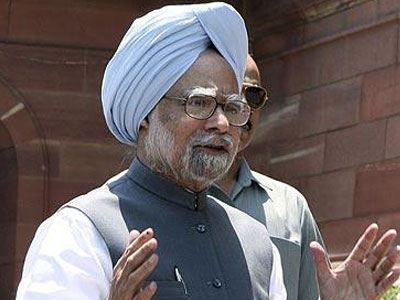
New Delhi, September 15: After unleashing big bang reforms measures in the last two days, Prime Minister Manmohan Singh today said it will take "courage and some risks" to break the policy logjam and strongly favoured higher FDI and FII flows.

Justifying the diesel price hike as an important step in the right direction, he said, rational energy pricing was critical and "our energy prices are out of line with world prices".

In his opening remarks at the full Planning Commission meeting for approving the 12th Plan document, the Prime Minister spoke of three economic scenarios of "strong inclusive growth", "insufficient action" and "policy logjam" and said the country needed close to one trillion dollar investment in infrastructure sector during the period.

"I believe that we can make Scenario I possible. It will take courage and some risks but it should be our endeavour to ensure that it materialises. The country deserves no less," he said.

In big ticket reforms, the Cabinet Committee on Political Affairs on Thursday decided to hike diesel prices and put a cap on supply of subsidised LPG cylinders while yesterday the Cabinet and CCEA cleared  FDI in multi-brand retailing and aviation and disinvestment in four PSUs.

Referring to high fiscal deficit and the need to bring it down, the Prime Minister said the 12th Plan projects a current account deficit of 2.9 per cent of GDP.

"This must be financed mainly through Foreign Direct Investment (FDI) and Foreign Institutional Investment (FII) flows so that reliance on  external debt is limited. I believe we can attract the financing we need provided out fiscal deficit is seen to be coming under control and the growth momentum is regained",he said.

Singh said, energy is a difficult area where policy needs a comprehensive review. "Rational energy pricing is therefore critical. Our energy prices are out of line with the world prices. The recent increase in diesel price is an important step in the right direction."

The Prime Minister said the central message of the Plan is that the objectives can be achieved provided policies that will take care of weaknesses put in place. For the first time the Plan introduces three alternative scenarios.

Under Scenario I called "strong inclusive growth" one can expect a number of virtuous cycles to start operating leading to positive results on both growth and inclusion. "This is the scenario we should aim for".

Scenario II, called "insufficient action", describes state of partial action with weak implementation. In this scenario, the virtuous cycles that reinforce growth in Scenario I, will not kick in, and growth can easily slow down to 6 to 6.5 per cent.

Singh said inclusiveness will also suffer. "This is where we will end up if we make only half-hearted efforts and slip in implementation. It is my sincere hope that we do not do so."

Calling Scenario III as "policy logjam", he said it reflects a situation where for one reason or another most of the policies needed to achieve Scenario I are not taken.

"If this continues for any length of time, vicious cycles begin to set in and growth could easily collapse to about 5 per cent per year, with very poor outcomes on inclusion.

"I urge everyone interested in the country's future to understand fully the implications of this scenario. They will quickly come to an agreement that the people of India deserve better than this," Singh said.

Referring to global economic issues, Prime Minister said, "these short term problems present a challenge, but they should not lead to undue pessimism about our medium term prospects.

"The economy has gained many strengths. Our immediate priority must be to orchestrate a rebound in the second half of the current year. We should then try to accelerate growth to reach around 9 percent by the end of the Plan period," he added.

The 12th Plan (2012-17) is proposing an annual average growth rate of 8.2 per cent, which is lower than the earlier estimate of 9 per cent. The economy recorded a growth rate of 7.9 per cent in the 11th Plan.

According to the Prime Minister, the 11th Plan growth rate was commendable, "for a period which saw two global crises – one in 2008 and another in 2011".

Singh further said that poverty declined twice as fast between financial years 2004-05 and 2009-10 than it did in the previous ten years, while agriculture grew at 3.3 percent per year in the 11th Plan, much faster than the 2.4 percent observed in the 10th Plan.

As regards the growth prospects in the 12th Plan, Singh said, "we must also recognise that the 12th Plan is starting in a year when the world economy is experiencing difficulties and our economy has also slowed down".

Referring to scaling down of the target in the 12th Plan from the original estimate of 9 per cent to 8.2 per cent, he said, "some downward revision is realistic given the state of the world".

Comments

Add new comment

  • Coastaldigest.com reserves the right to delete or block any comments.
  • Coastaldigset.com is not responsible for its readers’ comments.
  • Comments that are abusive, incendiary or irrelevant are strictly prohibited.
  • Please use a genuine email ID and provide your name to avoid reject.
News Network
December 5,2025

indigoCEO.jpg

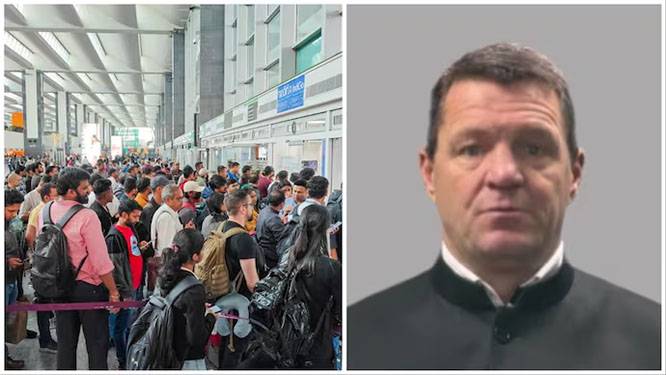
New Delhi, Dec 5: IndiGo CEO Pieter Elbers issued a public apology this evening after more than a thousand flights were cancelled today, making it the "most severely impacted day" in terms of cancellations. The biggest airline of the country cancelled "more than half" of its daily number of flights on Friday, said Elbers. He also said that even though the crisis will persist on Saturday, the airline anticipates fewer than 1,000 flight cancellations.

"Full normalisation is expected between December 10 and 15, though IndiGo cautions that recovery will take time due to the scale of operations," the IndiGo CEO said. 

IndiGo operates around 2,300 domestic and international flights daily.

Pieter Elbers, while apologising for the major inconvenience due to delays and cancellations, said the situation is a result of various causes.

The crisis at IndiGo stems from new regulations that boost pilots' weekly rest requirements by 12 hours to 48 and allow only two night-time landings per week, down from six. IndiGo has attributed the mass cancellations to "misjudgment and planning gaps".

Elbers also listed three lines of action that the airline will adopt to address the issue.

"Firstly, customer communication and addressing your needs, for this, messages have been sent on social media. And just now, a more detailed communication with information, refunds, cancellations and other customer support measures was sent," he said.

The airline has also stepped up its call centre capacity.

"Secondly, due to yesterday's situation, we had customers stranded mostly at the nation's largest airports. Our focus was for all of them to be able to travel today itself, which will be achieved. For this, we also ask customers whose flights are cancelled not to come to the airports as notifications are sent," the CEO said.

"Thirdly, cancellations were made for today to align our crew and planes to be where they need to start tomorrow morning afresh. Earlier measures of the last few days, regrettable, have proven not to be enough, but we have decided today to reboot all our systems and schedules, resulting in the highest numbers of cancellations so far, but imperative for progressive improvements starting from tomorrow," he added.

As airports witnessed chaotic scenes, the Directorate General of Civil Aviation (DGCA) stepped in to grant IndiGo a temporary exemption from stricter night duty rules for pilots. It also allowed substitution of leaves with a weekly rest period. 

Civil Aviation Minister Ram Mohan Naidu has said a high-level inquiry will be ordered and accountability will be fixed.

Comments

Add new comment

  • Coastaldigest.com reserves the right to delete or block any comments.
  • Coastaldigset.com is not responsible for its readers’ comments.
  • Comments that are abusive, incendiary or irrelevant are strictly prohibited.
  • Please use a genuine email ID and provide your name to avoid reject.
News Network
December 4,2025

indigoflight.jpg

Domestic carrier IndiGo has cancelled over 180 flights from three major airports — Mumbai, Delhi and Bengaluru — on Thursday, December 4, as the airline struggles to secure the required crew to operate its flights in the wake of new flight-duty and rest-period norms for pilots.

While the number of cancellations at Mumbai airport stands at 86 (41 arrivals and 45 departures) for the day, at Bengaluru, 73 flights have been cancelled, including 41 arrivals, according to a PTI report that quoted sources.

"IndiGo cancelled over 180 flights on Thursday at three airports-Mumbai, Delhi and Bengaluru," the source told the news agency.

Besides, it had cancelled as many as 33 flights at Delhi airport for Thursday, the source said, adding, "The number of cancellations is expected to be higher by the end of the day."

The Gurugram-based airline's On-Time Performance (OTP) nosedived to 19.7 per cent at six key airports — Delhi, Mumbai, Chennai, Kolkata, Bengaluru and Hyderabad — on December 3, as it struggled to get the required crew to operate its services, down from almost half of December 2, when it was 35 per cent.

"IndiGo has been facing acute crew shortage since the implementation of the second phase of the FDTL (Flight Duty Time Limitations) norms, leading to cancellations and huge delays in its operations across the airports," a source had told PTI on Wednesday.

Chaos continued at several major airports for the third day on Thursday because of the cancellations.

A spokesperson for the Kempegowda International Airport (KIA) in Bengaluru said that 73 IndiGo flights had been cancelled on Thursday.

At least 150 flights were cancelled and dozens of others delayed on Wednesday, airport sources said, leaving thousands of travellers stranded, according to news agency Reuters.

The Directorate General of Civil Aviation (DGCA) has said it is investigating IndiGo flight disruptions and has asked the airline to submit the reasons for the current situation, as well as its plans to reduce flight cancellations and delays.

It may be mentioned here that the pilots' body, Federation of Indian Pilots (FIP), has alleged that IndiGo, despite getting a two-year preparatory window before the full implementation of new flight duty and rest period norms for cockpit crew, "inexplicably" adopted a "hiring freeze".

The FIP said it has urged the safety regulator, the DGCA, not to approve airlines' seasonal flight schedules unless they have adequate staff to operate their services "safely and reliably" in accordance with the New Flight Duty Time Limitations (FDTL) norms.

In a letter to the DGCA late on Wednesday, the FIP urged the DGCA to consider re-evaluating and reallocating slots to other airlines, which have the capacity to operate them without disruption during the peak holiday and fog season if IndiGo continues to "fail in delivering on its commitments to passengers due to its own avoidable staffing shortages."

Comments

Add new comment

  • Coastaldigest.com reserves the right to delete or block any comments.
  • Coastaldigset.com is not responsible for its readers’ comments.
  • Comments that are abusive, incendiary or irrelevant are strictly prohibited.
  • Please use a genuine email ID and provide your name to avoid reject.
News Network
December 3,2025

indigo.jpg

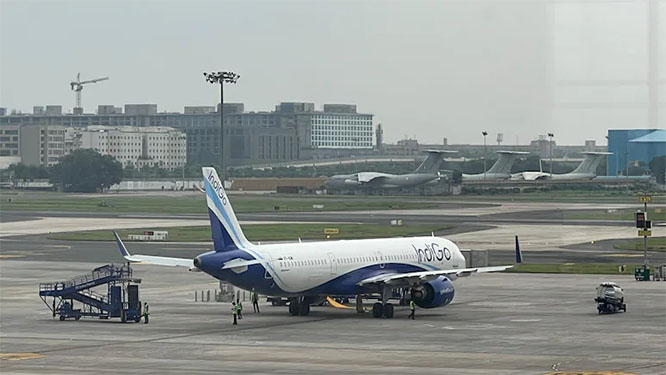
IndiGo, India’s largest airline, is battling one of its worst operational disruptions in recent years, with hundreds of delays and cancellations throwing domestic travel into chaos.

Government data on Tuesday showed its on-time performance plunging to 35%, an unusual dip for a carrier long associated with punctuality.

By Wednesday afternoon, airports in Delhi, Mumbai, Bengaluru and Hyderabad had collectively reported close to 200 cancellations, stranding travellers across the country.

Crew Shortage After New Duty Norms

A major trigger behind the meltdown is a severe crew shortage, especially among pilots, following the rollout of revised Flight Duty Time Limitation (FDTL) norms last month.

The rules mandate longer rest hours and more humane rosters — a shift IndiGo has struggled to incorporate across its vast network.

Sources said several flights were grounded due to lack of cabin crew, while some delays stretched upwards of eight hours.

With IndiGo controlling over 60% of India’s domestic aviation market, the ripple effect has impacted airports nationwide.

IndiGo Issues Apology, Lists “Compounding Factors”

In a statement, IndiGo acknowledged the large-scale disruption:

“We sincerely apologise to customers. A series of unforeseen operational challenges — technology glitches, winter schedule changes, adverse weather, system congestion and updated FDTL norms — created a compounding impact that could not have been anticipated.”

To stabilise operations, the airline has begun calibrated schedule adjustments for the next 48 hours, aiming to restore punctuality. Affected passengers are being offered refunds or alternate travel arrangements, IndiGo said.

What the FDTL Rules Require

The FDTL norms, designed to reduce pilot fatigue, cap duty and flying hours as follows:
•    Maximum 8 hours of flying per day
•    35 hours per week
•    125 hours per month
•    1,000 hours per year

Crew must also receive rest equalling twice the flight duration, with a minimum 10-hour rest period in any 24-hour window.

The DGCA introduced these limits to enhance flight safety.

Hyderabad: 33 Flights Cancelled, Long Queues Reported

Hyderabad’s Rajiv Gandhi International Airport saw heavy early-morning crowds as 33 IndiGo flights (arrivals and departures) were cancelled.

The airport clarified on X that operations were normal, advising passengers to contact IndiGo directly for latest flight status.

Cancellations included flights to and from Visakhapatnam, Goa, Ahmedabad, Delhi, Bengaluru, Chennai, Madurai, Hubli, Bhopal and Bhubaneswar.

Bengaluru: 42 Flights Disrupted

Bengaluru’s Kempegowda International Airport recorded 42 cancellations — 22 arrivals and 20 departures — affecting routes to Delhi, Mumbai, Chennai, Hyderabad, Goa, Kolkata and Lucknow.

Passengers Vent on Social Media

Irate travellers took to X to share their experiences. One passenger stranded in Hyderabad wrote: “I have been here since 3 a.m. and missed an important meeting.”

Another said: “My flight was pushed from 1:55 PM to 2:55 PM and now 4:35 PM. I was informed only three minutes before entering the airport.”

Delhi Airport Hit by Tech Glitch

At Delhi Airport, the disruption deepened due to a slowdown in the Amadeus system — used for reservations, check-ins and departure control.

The technical issue led to longer queues and sluggish processing, adding to delays already worsened by staff shortages.

Comments

Add new comment

  • Coastaldigest.com reserves the right to delete or block any comments.
  • Coastaldigset.com is not responsible for its readers’ comments.
  • Comments that are abusive, incendiary or irrelevant are strictly prohibited.
  • Please use a genuine email ID and provide your name to avoid reject.