



'Kargil was a poor test of India's air warfare capability'

September 21, 2012

Kargil

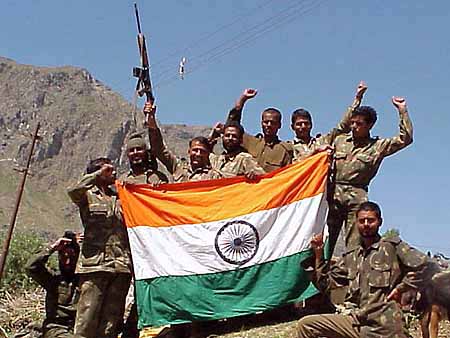
Washington, September 21: Kargil conflict was a "poor test" of India's air warfare capability, a prominent US think-tank has said, warning that with threats of future wars with Pakistan and China persisting, Indian defence establishment has to prepare accordingly.

"Despite the happy ending of the Kargil experience for India, the IAF’s fighter pilots were restricted in their operations due to myriad challenges specific to this campaign.

They were thus consigned to do what they could rather than what they might have done if they had more room for maneuver," said the think-tank in a report released yesterday.

The Kargil war, in which India emerged victorious over Pakistan, the 70-page report titles "Airpower At 18,000': the Indian Air Force in the Kargil War' further brought to light the initial near-total lack of transparency and open communication between Indian Army's top leaders and the IAF.

The report by the Carnegie Endowment for International Peace said the covert Pakistani intrusion into Jammu and Kashmir had exposed a gaping hole in India's nationwide real-time intelligence.

"On a strategic level, the Kargil War vividly demonstrated that a stable bilateral nuclear deterrence relationship can markedly inhibit such regional conflicts in intensity and scale—if not preclude them altogether," it said.

"In the absence of the nuclear stabilizing factor, those flash points could erupt into open-ended conventional showdowns for the highest stakes. But the Kargil War also demonstrated that nuclear deterrence is not a panacea," the report said.

It said the possibility of future conventional wars of major consequence along India's borders with Pakistan and China persists, and the Indian defence establishment must plan and prepare accordingly.

According to the report, Pakistan's military leaders miscalculated badly in their apparent belief that the international community would press immediately for a cease-fire in Kashmir out of concern over a possible escalation of the fighting to the nuclear level, with the net result that Pakistan would be left with an easily acquired new slice of the terrain on the Indian side of the LoC.

Carnegie said the nuclear balance between the two countries did not deter a determined Indian conventional response, and the successful reaction that India ultimately mounted on the Kargil heights fell well short of being all out in scale.

"Furthermore, since the Vajpayee government scrupulously kept its combat operations confined to Indian-controlled Kashmir, the international community had no compelling reason to intervene," it said.

As a result, a remote but high-intensity and high-stakes showdown was allowed to run on for more than two months, something the Pakistan Army’s leaders all but certainly did not anticipate when they first conjured up their incursion plan.

The Kargil experience also suggested that if China and Pakistan came to appreciate that India possessed overwhelming conventional force preponderance in the region, that presence could act as a deterrent against such provocations in the future, it said.

According to the report, prudent Indian defence planners will likely find themselves shortchanged in their preparations for the full spectrum of possible challenges to their country’s security in years to come if they draw undue comfort from the happy ending of the Kargil experience and accept that conflict as their only planning baseline for hedging against future contingencies along the Line of Control.

Comments

Add new comment

  • Coastaldigest.com reserves the right to delete or block any comments.
  • Coastaldigset.com is not responsible for its readers’ comments.
  • Comments that are abusive, incendiary or irrelevant are strictly prohibited.
  • Please use a genuine email ID and provide your name to avoid reject.
News Network
December 5,2025

indigoCEO.jpg

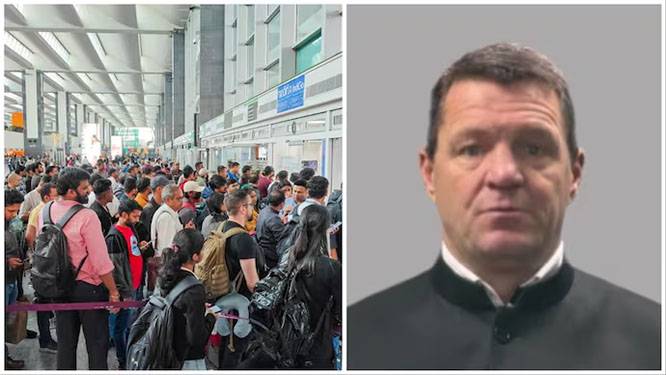
New Delhi, Dec 5: IndiGo CEO Pieter Elbers issued a public apology this evening after more than a thousand flights were cancelled today, making it the "most severely impacted day" in terms of cancellations. The biggest airline of the country cancelled "more than half" of its daily number of flights on Friday, said Elbers. He also said that even though the crisis will persist on Saturday, the airline anticipates fewer than 1,000 flight cancellations.

"Full normalisation is expected between December 10 and 15, though IndiGo cautions that recovery will take time due to the scale of operations," the IndiGo CEO said. 

IndiGo operates around 2,300 domestic and international flights daily.

Pieter Elbers, while apologising for the major inconvenience due to delays and cancellations, said the situation is a result of various causes.

The crisis at IndiGo stems from new regulations that boost pilots' weekly rest requirements by 12 hours to 48 and allow only two night-time landings per week, down from six. IndiGo has attributed the mass cancellations to "misjudgment and planning gaps".

Elbers also listed three lines of action that the airline will adopt to address the issue.

"Firstly, customer communication and addressing your needs, for this, messages have been sent on social media. And just now, a more detailed communication with information, refunds, cancellations and other customer support measures was sent," he said.

The airline has also stepped up its call centre capacity.

"Secondly, due to yesterday's situation, we had customers stranded mostly at the nation's largest airports. Our focus was for all of them to be able to travel today itself, which will be achieved. For this, we also ask customers whose flights are cancelled not to come to the airports as notifications are sent," the CEO said.

"Thirdly, cancellations were made for today to align our crew and planes to be where they need to start tomorrow morning afresh. Earlier measures of the last few days, regrettable, have proven not to be enough, but we have decided today to reboot all our systems and schedules, resulting in the highest numbers of cancellations so far, but imperative for progressive improvements starting from tomorrow," he added.

As airports witnessed chaotic scenes, the Directorate General of Civil Aviation (DGCA) stepped in to grant IndiGo a temporary exemption from stricter night duty rules for pilots. It also allowed substitution of leaves with a weekly rest period. 

Civil Aviation Minister Ram Mohan Naidu has said a high-level inquiry will be ordered and accountability will be fixed.

Comments

Add new comment

  • Coastaldigest.com reserves the right to delete or block any comments.
  • Coastaldigset.com is not responsible for its readers’ comments.
  • Comments that are abusive, incendiary or irrelevant are strictly prohibited.
  • Please use a genuine email ID and provide your name to avoid reject.
News Network
December 4,2025

indigoflight.jpg

Domestic carrier IndiGo has cancelled over 180 flights from three major airports — Mumbai, Delhi and Bengaluru — on Thursday, December 4, as the airline struggles to secure the required crew to operate its flights in the wake of new flight-duty and rest-period norms for pilots.

While the number of cancellations at Mumbai airport stands at 86 (41 arrivals and 45 departures) for the day, at Bengaluru, 73 flights have been cancelled, including 41 arrivals, according to a PTI report that quoted sources.

"IndiGo cancelled over 180 flights on Thursday at three airports-Mumbai, Delhi and Bengaluru," the source told the news agency.

Besides, it had cancelled as many as 33 flights at Delhi airport for Thursday, the source said, adding, "The number of cancellations is expected to be higher by the end of the day."

The Gurugram-based airline's On-Time Performance (OTP) nosedived to 19.7 per cent at six key airports — Delhi, Mumbai, Chennai, Kolkata, Bengaluru and Hyderabad — on December 3, as it struggled to get the required crew to operate its services, down from almost half of December 2, when it was 35 per cent.

"IndiGo has been facing acute crew shortage since the implementation of the second phase of the FDTL (Flight Duty Time Limitations) norms, leading to cancellations and huge delays in its operations across the airports," a source had told PTI on Wednesday.

Chaos continued at several major airports for the third day on Thursday because of the cancellations.

A spokesperson for the Kempegowda International Airport (KIA) in Bengaluru said that 73 IndiGo flights had been cancelled on Thursday.

At least 150 flights were cancelled and dozens of others delayed on Wednesday, airport sources said, leaving thousands of travellers stranded, according to news agency Reuters.

The Directorate General of Civil Aviation (DGCA) has said it is investigating IndiGo flight disruptions and has asked the airline to submit the reasons for the current situation, as well as its plans to reduce flight cancellations and delays.

It may be mentioned here that the pilots' body, Federation of Indian Pilots (FIP), has alleged that IndiGo, despite getting a two-year preparatory window before the full implementation of new flight duty and rest period norms for cockpit crew, "inexplicably" adopted a "hiring freeze".

The FIP said it has urged the safety regulator, the DGCA, not to approve airlines' seasonal flight schedules unless they have adequate staff to operate their services "safely and reliably" in accordance with the New Flight Duty Time Limitations (FDTL) norms.

In a letter to the DGCA late on Wednesday, the FIP urged the DGCA to consider re-evaluating and reallocating slots to other airlines, which have the capacity to operate them without disruption during the peak holiday and fog season if IndiGo continues to "fail in delivering on its commitments to passengers due to its own avoidable staffing shortages."

Comments

Add new comment

  • Coastaldigest.com reserves the right to delete or block any comments.
  • Coastaldigset.com is not responsible for its readers’ comments.
  • Comments that are abusive, incendiary or irrelevant are strictly prohibited.
  • Please use a genuine email ID and provide your name to avoid reject.