



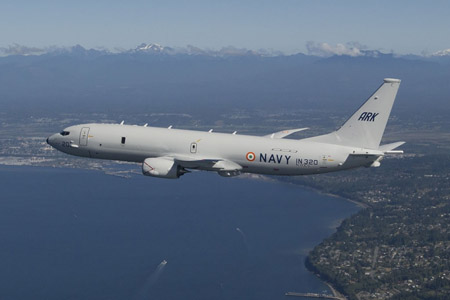
P8-Is: Indian Navy's eye in the sky

January 17, 2013

indiannavy
New Delhi, Jan 17: The Boeing P8-I long-range maritime reconnaissance aircraft (LRMRA) which the Indian Navy got lat month is the most sophisticated weapon system in its inventory yet.

The aircraft, which is now being used for training by Indian naval personnel in coordination with the US Navy in the US, has the latest radars, electronic warfare systems, and weapons to kill hostile submarines, several of which lurk underwater in the Arabian Sea and Bay of Bengal around the Indian coast.

Built on the body of a civilian Boeing 737-800 jetliner with the wings of a 737-900, the P8-I is actually an attack aircraft, capable of discriminating between friendly and hostile vessels far away and then hit them with desired priority and lethality.

Its key capability though is to detect and delete hostile submarines, as also small boats in shallow waters which pose the most serious threat to Indian naval assets.

India has purchased eight P8-Is from the US Navy under the US government’s Foreign Military Sales (FMS) programme and the government has cleared four more for which there was an option. Another 12 P8-Is, or similar aircraft, should be acquired later.

The $2.1 billion-plus deal for aircraft covers onboard offensive and defensive systems and training. Weapons like the Boeing Harpoon Block II missiles, sonobuoys, Raytheon’s Mk 54 torpedoes, some freefall weapons cost additional.

The P8-I is a derivative of the US Navy’s P8-A multi-mission maritime aircraft (MMA) developed at the cost of billions of dollars. The first P8-A was delivered to it in March 2012, and so far, it has received five of the 117 ordered aircraft.

The Indian Navy is the first foreign customer and not much apart in time.

Understandably though, the P8-Is would not have the same range and features as the P8-As, but then the Indian requirements are met appropriately. In any case, there cannot be 100 per cent commonality as neither would the US share its latest technologies nor is India looking for interoperability with US assets.

Mission computers form the heart of the P8-I, integrating various sensors, radars and weapons on board, directing their power, reach and the required urgency in neutralizing hostile targets.

There are five to seven consoles for the operators, who can command the system to initiate and execute real-time action and attack.

Although the P8-I is not an AWACS (airborne warning and control systems) aircraft, it can operate as one in a limited way, and coordinate with the Indian Navy or Indian Air Force (IAF) combat jets to shower hell on an enemy.

The Indian P8-Is will be integrated with the Indian Navy and IAF assets, including fighters, AWACS and ground stations, thanks to net-centricity. Both the Navy and IAF fly Mig 29s for instance, and in the recent years, all the three services are approaching war-fighting with an emphasis on jointness.

The three services periodically hold joint exercises, and one such is due between the Indian Navy and IAF around March. Once the P8-I start arriving from mid-2013 onwards, there would be more exercises.

Meanwhile, the infrastructure to operate the P8-Is is being built at INS Rajali at Arakkonam Naval Air Station in Tamil Nadu, from where the aircraft can easily fly towards the Bay of Bengal or the Arabian Sea. All the 12 aircraft will be based there.

Notably, unlike the earlier aircraft used for maritime reconnaissance and attack role, the four-engined Il-38 and Tu 142 which the Indian Navy has, or the Orion P3C which the US Navy has been flying so far, the P8-I is a jet with jet speed. Its two CFM 56 engines have, however, been tweaked to allow it to fly slow, and low above water.

The acquisition of the P8-I has brought to the Indian Navy some of the most sophisticated radar and other systems, particularly Raytheon’s AN/APY-10 multi-mission surface search radar with a range of 200-400 km. This forward-looking Synthetic Aperture Radar (SAR) with 240 degree coverage is built on the technology of the famed AESA (Active Electronically Scanned Array) radar that the (IAF) wants on all its combat aircraft, beginning with the Multi Role Combat Aircraft (MRCA) being negotiated now.

To ensure 360 degree scanning however, the Indian Navy has got an aft radar from US Telephonics for rear coverage.

The US Navy aircraft do not need aft radars as there are several US surveillance assets, including aircraft and satellites, in the sky at any time. The P-8A however is primarily meant to function in alignment with the unmanned Broad Area Maritime Surveillance (BAMS) aircraft (designated MQ-4C Triton), which is still under development by Northrop Grumman.

The P8-I has some systems supplied by Indian companies to make its communications secure and compatible with Indian naval and air assets.

They include Data Link II (communication system) from Bharat Electronics, IFF (Identify Friend or Foe system) transponder from HAL (Hindustan Aeronautics Ltd), speech secrecy system from ECIL (Electronics Corporation of India Ltd) and mobile SATCOM (satellite communication system) from Avantel. All the P8-Is, as well as other navy aircraft now have net-centric capabilities and interoperability with IAF aircraft and ground stations.

India received the first P8-I when Cmde Alok Bhatnagar, naval attache at the Indian embassy in Washington and other Indian Navy officers received it on-site in Seattle in accordance with the contract awarded in 2009.

Indian naval pilots, systems operators and technicians, some of whom have been stationed there to monitor the progress of the project and some others, will now conduct test and training flights with US Navy assistance before this aircraft is brought home.

India will receive two more fully-equipped P-8Is within 2013, and all the eight by 2015.

A Boeing statement said that the manufacturing programme is progressing on schedule, and that Boeing is already assembling the fourth and fifth P-8Is.

Comments

Add new comment

  • Coastaldigest.com reserves the right to delete or block any comments.
  • Coastaldigset.com is not responsible for its readers’ comments.
  • Comments that are abusive, incendiary or irrelevant are strictly prohibited.
  • Please use a genuine email ID and provide your name to avoid reject.
News Network
December 6,2025

indigoticket.jpg

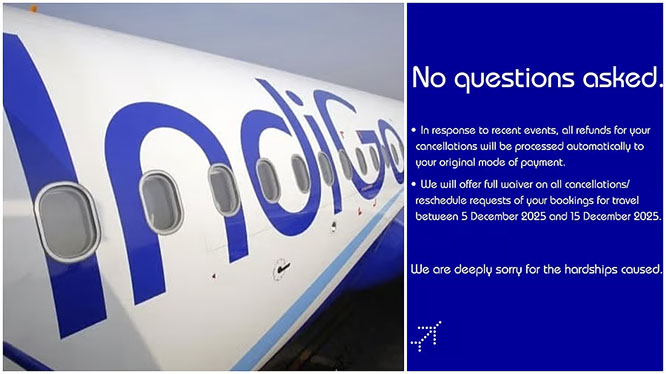
With IndiGo flight disruptions impacting thousands of passengers, the airline on Saturday said that it will offer full waiver on all cancellations/reschedule requests for travel bookings between December 5, 2025 and December 15, 2025.

Earlier in the day, the civil aviation ministry had directed the airline to complete the ticket refund process for the cancelled flights by Sunday evening, as well as ensure baggage separated from the travellers are delivered in the next two days.

In a post on X, titled 'No questions asked', IndiGo wrote, "In response to recent events, all refunds for your cancellations will be processed automatically to your original mode of payment."

"We are deeply sorry for the hardships caused," it further added.

Several passengers, however, complained of not getting full refund as promised by the airline.

Netizens have shared screenchots of getting charged for airline cancellation fee and convenience fee.

"Please tell me why u have did this airline cancellation charges when u say full amount will be refunded (sic)," a user wrote sharing a screenshot of the refund page.

"Well, but you have still debited the convenience charges," wrote another.

Passengers have also raised concerns about the "cancel" option being disabled on the IndiGo app. "First enable the 'Cancel' button on your App & offer full refund on tickets cancelled by customers between the said dates," wrote a user.

A day after the country's largest airline, IndiGo, cancelled more than 1,000 flights and caused disruptions for the fifth day on Saturday, the ministry said that any delay or non-compliance in refund processing will invite immediate regulatory action.

The refund process for all cancelled or disrupted flights must be completed by 8 pm on Sunday, the ministry said in a statement.

"Airlines have also been instructed not to levy any rescheduling charges for passengers whose travel plans were affected by cancellations," it said.

On Saturday, more than 400 flights were cancelled at various airports.

IndiGo has also been instructed to set up dedicated passenger support and refund facilitation cells.

Comments

Add new comment

  • Coastaldigest.com reserves the right to delete or block any comments.
  • Coastaldigset.com is not responsible for its readers’ comments.
  • Comments that are abusive, incendiary or irrelevant are strictly prohibited.
  • Please use a genuine email ID and provide your name to avoid reject.
News Network
December 4,2025

indigocrisis.jpg

Angry outbursts, long queues, and desperate appeals filled airports across India today as IndiGo grappled with a severe operational breakdown. Hundreds of flights have been cancelled or delayed, leaving thousands of passengers stranded through the night and forcing many to spend long hours at helpdesks.

Social media was flooded with videos of fliers pleading for assistance, accusing the airline of misleading updates, and demanding accommodation after being stuck for 10 to 12 hours at airports such as Hyderabad and Bengaluru.

What Triggered the Meltdown?

IndiGo has attributed the widespread disruption to “a multitude of unforeseen operational challenges.” These include:

•    Minor technology glitches
•    Winter-season schedule adjustments
•    Bad weather
•    Congestion in the aviation network
•    New crew rostering rules (Flight Duty Time Limitations or FDTL)

Among these, the most disruptive has been the implementation of the updated FDTL norms introduced by the Directorate General of Civil Aviation (DGCA) in January 2024.

These rules were designed to reduce pilot fatigue and improve passenger safety. Key changes include:

•    Longer weekly rest periods for flight crew
•    A revised definition of “night,” extending it by an extra hour
•    Tighter caps on flight duty timing and night landings
•    Cutting night shifts for pilots and crew from six per roster cycle to just two

Once these norms became fully enforceable, airlines were required to overhaul rosters well in advance. For IndiGo, this triggered a sudden shortage of crew available for duty, leading to cascading delays and cancellations.

Why IndiGo Was Hit the Hardest

IndiGo is India’s largest airline by a wide margin, operating over 2,200 flights daily. That’s roughly double the number operated by Air India.

When an airline of this size experiences even a 10–20% disruption, it translates to 200–400 flights being delayed or grounded — producing massive spillover effects across the country.

IndiGo also relies heavily on high-frequency overnight operations, a model typical of low-cost carriers that aim to maximise aircraft utilisation and reduce downtime. The stricter FDTL norms clash with these overnight-heavy schedules, forcing the airline to pull back services.

Aviation bodies have also criticised IndiGo’s preparedness. The Airline Pilots' Association of India (ALPA) said airlines were given a two-year window to plan for the new rules but “started preparing rather late.” IndiGo, it said, failed to rebuild crew rosters 15 days in advance as required.

The Federation of Indian Pilots (FIP) went further, calling the crisis the result of IndiGo’s “prolonged and unorthodox lean manpower strategy,” and alleging that the airline adopted a hiring freeze even as it knew the new rules would require more careful staffing.

How Many Flights Are Affected?

In the past 48 hours, over 300 flights have been cancelled. At least 100 more are expected to be cancelled today.

City-wise impact:

•    Hyderabad: 33 expected cancellations; several fliers stranded overnight
•    Bengaluru: over 70 expected cancellations
•    Delhi, Mumbai, Chennai, Kolkata: widespread delays and missed connections

Passengers shared distressing accounts online.

One customer at Hyderabad airport said they waited from 6 PM to 9 AM with “no action taken” regarding their delayed Pune flight. Another said IndiGo repeatedly told them the crew was “arriving soon,” only for the delay to stretch over 12 hours.

IndiGo has apologised for the disruption and promised that operations will stabilise within 48 hours, adding that “calibrated adjustments” are being made to contain the chaos.

What Should Passengers Do Now?

For those flying in the next few days, especially with IndiGo, here are key precautions:

1. Keep Checking Flight Status
Monitor your flight closely before leaving for the airport, as delays may be announced last-minute.

2. Arrive Early
Expect long queues at counters and security due to crowding and rescheduling.

3. Carry Essentials
Pack snacks, water, basic medicines, chargers, and items for children or senior citizens. Extended waiting times should be anticipated.

4. Use Flexible Booking Options
If you booked tickets with a free-date-change or cancellation option, consider using them.
If you haven’t booked yet, prefer refundable or flexible fares, or even consider alternate airlines.

5. Follow IndiGo’s Updates
Keep an eye on IndiGo’s official social media channels and contact customer support for rebooking and refund queries.

What Needs to Change?

Pilot groups have raised concerns not just about staffing but also the planning practices behind it.
The Federation of Indian Pilots accused IndiGo of:

•    Imposing an unexplained hiring freeze despite knowing the FDTL changes were coming
•    Entering non-poaching agreements that limited talent movement
•    Keeping pilot pay frozen
•    Underestimating the need to restructure operations in advance

They have urged DGCA to approve seasonal schedules only after airlines prove they have adequate pilot strength under the new norms.

ALPA also warned that some airlines might be using the delays as an “immature pressure tactic” to push DGCA for relaxations in the new rules — which, if granted, could compromise the very safety standards the norms were meant to protect.

Both pilot bodies stressed that no exemption should dilute safety, and any deviations should be based solely on scientific risk assessment.

Is a Solution in Sight?

While IndiGo says normalcy will return within two days, aviation experts believe that fully stabilising operations could take longer, depending on how quickly the airline can:
•    Re-align rosters
•    Mobilise rested crew
•    Boost staffing
•    Adjust its winter schedule to match regulatory requirements
Passengers are advised to remain prepared for continued delays over the next few days as the airline works through its backlog. 

Comments

Add new comment

  • Coastaldigest.com reserves the right to delete or block any comments.
  • Coastaldigset.com is not responsible for its readers’ comments.
  • Comments that are abusive, incendiary or irrelevant are strictly prohibited.
  • Please use a genuine email ID and provide your name to avoid reject.
News Network
December 4,2025

indigoflight.jpg

Domestic carrier IndiGo has cancelled over 180 flights from three major airports — Mumbai, Delhi and Bengaluru — on Thursday, December 4, as the airline struggles to secure the required crew to operate its flights in the wake of new flight-duty and rest-period norms for pilots.

While the number of cancellations at Mumbai airport stands at 86 (41 arrivals and 45 departures) for the day, at Bengaluru, 73 flights have been cancelled, including 41 arrivals, according to a PTI report that quoted sources.

"IndiGo cancelled over 180 flights on Thursday at three airports-Mumbai, Delhi and Bengaluru," the source told the news agency.

Besides, it had cancelled as many as 33 flights at Delhi airport for Thursday, the source said, adding, "The number of cancellations is expected to be higher by the end of the day."

The Gurugram-based airline's On-Time Performance (OTP) nosedived to 19.7 per cent at six key airports — Delhi, Mumbai, Chennai, Kolkata, Bengaluru and Hyderabad — on December 3, as it struggled to get the required crew to operate its services, down from almost half of December 2, when it was 35 per cent.

"IndiGo has been facing acute crew shortage since the implementation of the second phase of the FDTL (Flight Duty Time Limitations) norms, leading to cancellations and huge delays in its operations across the airports," a source had told PTI on Wednesday.

Chaos continued at several major airports for the third day on Thursday because of the cancellations.

A spokesperson for the Kempegowda International Airport (KIA) in Bengaluru said that 73 IndiGo flights had been cancelled on Thursday.

At least 150 flights were cancelled and dozens of others delayed on Wednesday, airport sources said, leaving thousands of travellers stranded, according to news agency Reuters.

The Directorate General of Civil Aviation (DGCA) has said it is investigating IndiGo flight disruptions and has asked the airline to submit the reasons for the current situation, as well as its plans to reduce flight cancellations and delays.

It may be mentioned here that the pilots' body, Federation of Indian Pilots (FIP), has alleged that IndiGo, despite getting a two-year preparatory window before the full implementation of new flight duty and rest period norms for cockpit crew, "inexplicably" adopted a "hiring freeze".

The FIP said it has urged the safety regulator, the DGCA, not to approve airlines' seasonal flight schedules unless they have adequate staff to operate their services "safely and reliably" in accordance with the New Flight Duty Time Limitations (FDTL) norms.

In a letter to the DGCA late on Wednesday, the FIP urged the DGCA to consider re-evaluating and reallocating slots to other airlines, which have the capacity to operate them without disruption during the peak holiday and fog season if IndiGo continues to "fail in delivering on its commitments to passengers due to its own avoidable staffing shortages."

Comments

Add new comment

  • Coastaldigest.com reserves the right to delete or block any comments.
  • Coastaldigset.com is not responsible for its readers’ comments.
  • Comments that are abusive, incendiary or irrelevant are strictly prohibited.
  • Please use a genuine email ID and provide your name to avoid reject.
