



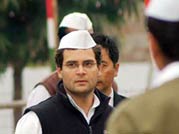
Rahul is Congress VP, get set for 2014 showdown with Modi

January 20, 2013

rahul_against_modi
Jaipur, Jan 20: Rahul Gandhi has finally taken the big leap. On Saturday, amid high anticipation, the Congress formally anointed him as the party's vice-president - in other words, the No. 2, which in light of Sonia Gandhi's indifferent health, means his imminent elevation as No. 1. It also means that Rahul Gandhi has agreed to be the party's candidate for PM in 2014 elections, thus setting the stage - if BJP settles for Narendra Modi as its best bet for the election - for a showdown with the Gujarat strongman.

The decision ends the tense uncertainty in Congress over whether Rahul was agreeable to assume a larger responsibility. The young leader, often viewed as a reluctant inheritor, has taken a long time to step up to the plate which will now relieve Sonia Gandhi of some burden and end Congress's anxiety. Rahul's elevation might also act as an impetus to the saffron legions clamouring for the projection of Narendra Modi as their candidate for the PM's job.

In his acceptance remark, Rahul told members of CWC, some of whom were colleagues of his father Rajiv and grandmother Indira: "I have travelled the country widely in last eight years and I believe we can transform the country." The proposal to make Rahul the party vice president was moved by Defence minister A K Antony on the second day of the party's Chintan Shivir (brainstorming session) here. Antony said this was the wish of Congress workers. Sonia and Rahul indicated their agreement.

The leg-up for the Gandhi scion, as indicated by TOI on January 18, marks another generational change in Congress—the fifth from Nehru-Gandhi family after Jawaharlal, Indira, Rajiv and Sonia. Congress general secretary Janardan Dwivedi said no decision has been taken on giving Rahul the command of the coming Lok Sabha polls. But, for all practical purposes, the baton has changed hands and is likely to hasten the induction of a new AICC team. That Sonia Gandhi has decided to keep herself aloof, at least formally so, may only accelerate the transition.

Rahul had so far resisted the formal No 2 tag to the point of virtually exasperating party leaders and triggering all sorts of speculation. His elevation looked imminent when he was asked, along with three other senior leaders, to look after Congress affairs when Sonia had to go abroad for medical treatment. But the expectations proved wrong, and after the party's debacle in UP last year - an election in which Rahul led the charge - contributed to the uncertainty about Rahul's elevation.

The clamour for drafting in Rahul as the de-jure leader of the Congress reached a crescendo on January 19, eclipsing every discussion on social-economic, political and organisational challenges for which the Chintan Shivir was ostensibly called. The atmospherics of the build-up marked the takeover of the Grand Old Party by its youth brigade.

Sonia Gandhi on Friday had made it clear that youth and urban middle class were party's priorities for 2014: a reflection of the worry that the urban constituencies and the middle classes who were crucial to Congress's back-to- back Lok Sabha wins, particularly the 2009 one, had drifted away. Rahul's remark , expressing his confidence in the country's transformation, appeared to be aimed at the same constituency - aspirational India, currently disillusioned by the non-fulfilment of the promise held out by the UPA.

The new role for Rahul is also likely to be the spur for the BJP to end its ambivalence over what to do with Narendra Modi. Although the BJP leadership has come around to give a second term to Nitin Gadkari, there is recognition in the party that it cannot allow a perception of a Rahul-Gadkari match-up to grow as that is viewed to be to the BJP's disadvantage.

Rahul is only the third vice-president in Congress history after Arjun singh occupied the post under Rajiv Gandhi in 1986, and Jitendra Prasada under Sitaram Kesari in 1997.

Comments

Add new comment

  • Coastaldigest.com reserves the right to delete or block any comments.
  • Coastaldigset.com is not responsible for its readers’ comments.
  • Comments that are abusive, incendiary or irrelevant are strictly prohibited.
  • Please use a genuine email ID and provide your name to avoid reject.
News Network
December 4,2025

indigoflight.jpg

Domestic carrier IndiGo has cancelled over 180 flights from three major airports — Mumbai, Delhi and Bengaluru — on Thursday, December 4, as the airline struggles to secure the required crew to operate its flights in the wake of new flight-duty and rest-period norms for pilots.

While the number of cancellations at Mumbai airport stands at 86 (41 arrivals and 45 departures) for the day, at Bengaluru, 73 flights have been cancelled, including 41 arrivals, according to a PTI report that quoted sources.

"IndiGo cancelled over 180 flights on Thursday at three airports-Mumbai, Delhi and Bengaluru," the source told the news agency.

Besides, it had cancelled as many as 33 flights at Delhi airport for Thursday, the source said, adding, "The number of cancellations is expected to be higher by the end of the day."

The Gurugram-based airline's On-Time Performance (OTP) nosedived to 19.7 per cent at six key airports — Delhi, Mumbai, Chennai, Kolkata, Bengaluru and Hyderabad — on December 3, as it struggled to get the required crew to operate its services, down from almost half of December 2, when it was 35 per cent.

"IndiGo has been facing acute crew shortage since the implementation of the second phase of the FDTL (Flight Duty Time Limitations) norms, leading to cancellations and huge delays in its operations across the airports," a source had told PTI on Wednesday.

Chaos continued at several major airports for the third day on Thursday because of the cancellations.

A spokesperson for the Kempegowda International Airport (KIA) in Bengaluru said that 73 IndiGo flights had been cancelled on Thursday.

At least 150 flights were cancelled and dozens of others delayed on Wednesday, airport sources said, leaving thousands of travellers stranded, according to news agency Reuters.

The Directorate General of Civil Aviation (DGCA) has said it is investigating IndiGo flight disruptions and has asked the airline to submit the reasons for the current situation, as well as its plans to reduce flight cancellations and delays.

It may be mentioned here that the pilots' body, Federation of Indian Pilots (FIP), has alleged that IndiGo, despite getting a two-year preparatory window before the full implementation of new flight duty and rest period norms for cockpit crew, "inexplicably" adopted a "hiring freeze".

The FIP said it has urged the safety regulator, the DGCA, not to approve airlines' seasonal flight schedules unless they have adequate staff to operate their services "safely and reliably" in accordance with the New Flight Duty Time Limitations (FDTL) norms.

In a letter to the DGCA late on Wednesday, the FIP urged the DGCA to consider re-evaluating and reallocating slots to other airlines, which have the capacity to operate them without disruption during the peak holiday and fog season if IndiGo continues to "fail in delivering on its commitments to passengers due to its own avoidable staffing shortages."

Comments

Add new comment

  • Coastaldigest.com reserves the right to delete or block any comments.
  • Coastaldigset.com is not responsible for its readers’ comments.
  • Comments that are abusive, incendiary or irrelevant are strictly prohibited.
  • Please use a genuine email ID and provide your name to avoid reject.
News Network
December 6,2025

pilot.jpg

New Delhi: IndiGo, India’s largest airline, faced major operational turbulence this week after failing to prepare for new pilot-fatigue regulations issued by the Directorate General of Civil Aviation (DGCA). The stricter rules—designed to improve flight safety—took effect in phases through 2024, with the latest implementation on November 1. IndiGo has acknowledged that inadequate roster planning led to widespread cancellations and delays.

Below are the key DGCA rules that affected IndiGo’s operations:

1. Longer Mandatory Weekly Rest

Weekly rest for pilots has been increased from 36 hours to 48 hours.

The government says the extended break is essential to curb cumulative fatigue. This rule remains in force despite the current crisis.

2. Cap on Night Landings

Pilots can now perform only two night landings per week—a steep reduction from the earlier limit of six.

Night hours, defined as midnight to early morning, are considered the least alert period for pilots.

Given the disruptions, this rule has been temporarily relaxed for IndiGo until February 10.

3. Reduced Maximum Night Flight Duty

Flight duty that stretches into the night is now capped at 10 hours.

This measure has also been kept on hold for IndiGo until February 10 to stabilize operations.

4. Weekly Rest Cannot Be Replaced With Personal Leave

Airlines can no longer count a pilot’s personal leave as part of the mandatory 48-hour rest.

Pilots say this closes a loophole that previously reduced actual rest time.

Currently, all airlines are exempt from this rule to normalise travel.

5. Mandatory Fatigue Monitoring

Airlines must submit quarterly fatigue reports along with corrective actions to DGCA.

This system aims to create a transparent fatigue-tracking framework across the industry.

The DGCA has stressed that these rules were crafted to strengthen flight safety and align India with global fatigue-management standards. The temporary relaxations are expected to remain until February 2025, giving IndiGo time to stabilise its schedules and restore normal air travel.

Comments

Add new comment

  • Coastaldigest.com reserves the right to delete or block any comments.
  • Coastaldigset.com is not responsible for its readers’ comments.
  • Comments that are abusive, incendiary or irrelevant are strictly prohibited.
  • Please use a genuine email ID and provide your name to avoid reject.
News Network
December 2,2025

A major upgrade in safety and monitoring is planned for Haj 2026, with every Indian pilgrim set to receive a Haj Suvidha smart wristband linked to the official Haj Suvidha mobile app. The initiative aims to support pilgrims—especially senior citizens—who may struggle with smartphones during the 45-day journey.

What the Smart Wristband Will Do

Officials said the device will come with:
•    Location tracking
•    Pedometer
•    SOS emergency button
•    Qibla compass
•    Prayer timings
•    Basic health monitoring

SP Tiwari, secretary of the UP State Haj Committee, said the goal is to make the pilgrimage safer and more comfortable.

“Most Hajis are elderly and not comfortable with mobile apps,” he said. “The smartwatch will help locate pilgrims who forget their way or cannot communicate their location.”

The wristbands will be monitored by the Consulate General of India in Saudi Arabia, similar to mobile tracking via the Haj Suvidha App.

Free Distribution and Training

•    Smart wristbands will be given free of cost.
•    Training for pilgrims will be conducted between January and February 2026.
•    Sample units will reach state Haj committees soon.
•    Final devices will be distributed as pilgrims begin their journey.

New Rules for Accommodation

Two major decisions have also been finalised for Haj 2026:
1.    Separate rooms for men and women – including married couples. They may stay on the same floor but must occupy different rooms, following stricter Saudi guidelines.
2.    Cooking banned – gas cylinders will not be allowed; all meals will be provided through official catering services arranged by the Haj Committee of India.

These decisions were finalised during a meeting of the Haj Committee of India and state representatives in Mumbai.

Haj Suvidha App Launched Earlier

The government launched the Haj Suvidha App in 2024, offering:

•    Training modules
•    Accommodation and flight details
•    Baggage information
•    SOS and translation tools
•    Grievance redressal

Haj 2026 Quota and Key States

•    India’s total Haj quota for 2026: 1,75,025 pilgrims
•    70% (1,25,000) allotted to the Haj Committee of India
•    30% (around 50,000) reserved for Haj Group Organisers

Uttar Pradesh has the largest allocation (around 30,000 seats), though approximately 18,000 pilgrims are expected to go this year. States with high pilgrim numbers include Kerala, Maharashtra and Gujarat.

Dates of Haj 2026

The pilgrimage is scheduled to take place from 24 May to 29 May, 2026 (tentative).
Haj is one of the five pillars of Islam and is mandatory for Muslims who meet the required conditions.

Comments

Add new comment

  • Coastaldigest.com reserves the right to delete or block any comments.
  • Coastaldigset.com is not responsible for its readers’ comments.
  • Comments that are abusive, incendiary or irrelevant are strictly prohibited.
  • Please use a genuine email ID and provide your name to avoid reject.
