Car sales drop for 9th month, temporary workers face the heat

August 12, 2013

Car_sales_drop

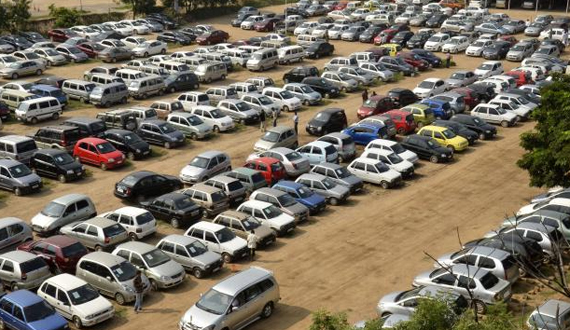
New Delhi, Aug 12: With car sales in India falling for a record ninth month in a row in July posting 7.4 per cent decline and that of heavy and medium commercial vehicles dipping for 17th month in succession, industry body SIAM today said auto sector has started retrenching temporary workers.

According to the latest data released by the Society of Indian Automobile Manufacturers (SIAM), domestic passenger car sales declined to 1,31,163 units in July this year from 1,41,646 units in the same month of 2012.

While total sales of commercial vehicles dropped by 14.93 per cent to 55,301 units from 65,008 units in the year-ago period, heavy and medium commercial vehicles (M&HCV) sales were down 19.88 per cent at 18,611 units.

"It is a very serious situation for the industry. The original equipment manufacturers (OEMs) have started adjusting temporary and casual workforce," SIAM Director General Vishnu Mathur told reporters here.

While he did not share the exact number of temporary workers affected by the downsizing, Mathur said: "In the manufacturing sector, not restricted to auto sector alone, companies by and large tend to keep more temporary and casual workers."

According to SIAM estimates, the OEMs employ a total of about two lakh workers, another five lakh by component makers while four lakh are employed at dealer and service centres.

While Maruti Suzuki India (MSI) has already asked some of its temporary workers at the diesel engine plant at Manesar to go on indefinite leave, Toyota Kirloskar Motor also confirmed that it is "currently not renewing contracts of the temporary employees", without specifying details.

Mathur further said the demand slump has affected across the segments. "For the total passenger vehicles, including cars, July was the 8th straight month of decline. Similarly, for motorcycles and grand total of all categories, it was the 6th straight month of decline."

Total sales of vehicles across categories registered a decline of 2.08 per cent to 14,15,102 units in July 2013 as against 14,45,112 units in the same month of 2012.

He said in the wake of the continuous decline in automobile sales, SIAM has approached the government seeking stimulus package, including reduction in excise duty, fleet modernisation and put an end to ban on new government vehicle purchase that has been on since May last year.

The overall economic factors, high interest rates, fuel prices and low sentiments continue to hurt demand, although new model launches such as Honda Amaze, Ford EcoSport have been able to bring "some excitement in the market", he added.

In July, market leader MSI posted 10.88 per cent increase in its domestic car sales at 63,040 units, while that of rival Hyundai Motor India were down by 5.67 per cent at 25,939 units. Tata Motors' car sales were down by 59.59 per cent at 8,546 units during the month.

Mahindra & Mahindra's utility vehicle (UV) sales were down 30.10 per cent in the month at 14,503 units.

SIAM said the UV segment, which was doing well in earlier months, has been hurt by the hike in excise duty to 30 per cent. In July, the segment saw a decline of 17.53 per cent at 37,010 units.

"There is a correlation in the drop of UV sales and excise hike. It was growing at high double digits till March, when it grew by 34 per cent, but then in April it came down to a growth of just 3.99 per cent. Since then the segment has been struggling to grow," Mathur said.

According to the SIAM data, domestic motorcycle sales declined by 1.52 per cent to 8,09,312 units in the last month, from 8,21,821 units in the same month previous year.

Market leader Hero MotoCorp (HMC) posted a decline of 3.79 per cent at 4,20,397 units.

Bajaj Auto also saw a decline of 23.61 per cent at 1,53,173 units, while Honda Motorcycle and Scooter India (HMSI) saw its bike sales grow by 38.27 per cent to 1,40,611 units in July this year.

The scooters segment saw a growth of 9.80 per cent to 2,71,438 units during the month, SIAM said.

HMSI's scooter sales grew by 7.69 per cent at 1,35,584 units, while that of HMC jumped by 57.6 per cent at 56,798 units. TVS Motor Co saw its scooter sales decline by 13.94 per cent at 35,010 units.

Total two-wheeler sales in July 2013 declined by 0.06 per cent to 11,31,992 units from 11,32,696 units in the same period of previous year, SIAM said.

According to SIAM, three-wheeler sales in the country declined by 6.14 per cent at 41,570 units.

When asked if automobile sales could pick up in the festive season, Mathur said: "There is hope. We have had a good monsoon this year as we have said earlier. Companies are preparing for the festive season with new launches. We hope that there will be someting positive in the festive season."

Comments

Add new comment

  • Coastaldigest.com reserves the right to delete or block any comments.
  • Coastaldigset.com is not responsible for its readers’ comments.
  • Comments that are abusive, incendiary or irrelevant are strictly prohibited.
  • Please use a genuine email ID and provide your name to avoid reject.
News Network
December 4,2025

indigoflight.jpg

Domestic carrier IndiGo has cancelled over 180 flights from three major airports — Mumbai, Delhi and Bengaluru — on Thursday, December 4, as the airline struggles to secure the required crew to operate its flights in the wake of new flight-duty and rest-period norms for pilots.

While the number of cancellations at Mumbai airport stands at 86 (41 arrivals and 45 departures) for the day, at Bengaluru, 73 flights have been cancelled, including 41 arrivals, according to a PTI report that quoted sources.

"IndiGo cancelled over 180 flights on Thursday at three airports-Mumbai, Delhi and Bengaluru," the source told the news agency.

Besides, it had cancelled as many as 33 flights at Delhi airport for Thursday, the source said, adding, "The number of cancellations is expected to be higher by the end of the day."

The Gurugram-based airline's On-Time Performance (OTP) nosedived to 19.7 per cent at six key airports — Delhi, Mumbai, Chennai, Kolkata, Bengaluru and Hyderabad — on December 3, as it struggled to get the required crew to operate its services, down from almost half of December 2, when it was 35 per cent.

"IndiGo has been facing acute crew shortage since the implementation of the second phase of the FDTL (Flight Duty Time Limitations) norms, leading to cancellations and huge delays in its operations across the airports," a source had told PTI on Wednesday.

Chaos continued at several major airports for the third day on Thursday because of the cancellations.

A spokesperson for the Kempegowda International Airport (KIA) in Bengaluru said that 73 IndiGo flights had been cancelled on Thursday.

At least 150 flights were cancelled and dozens of others delayed on Wednesday, airport sources said, leaving thousands of travellers stranded, according to news agency Reuters.

The Directorate General of Civil Aviation (DGCA) has said it is investigating IndiGo flight disruptions and has asked the airline to submit the reasons for the current situation, as well as its plans to reduce flight cancellations and delays.

It may be mentioned here that the pilots' body, Federation of Indian Pilots (FIP), has alleged that IndiGo, despite getting a two-year preparatory window before the full implementation of new flight duty and rest period norms for cockpit crew, "inexplicably" adopted a "hiring freeze".

The FIP said it has urged the safety regulator, the DGCA, not to approve airlines' seasonal flight schedules unless they have adequate staff to operate their services "safely and reliably" in accordance with the New Flight Duty Time Limitations (FDTL) norms.

In a letter to the DGCA late on Wednesday, the FIP urged the DGCA to consider re-evaluating and reallocating slots to other airlines, which have the capacity to operate them without disruption during the peak holiday and fog season if IndiGo continues to "fail in delivering on its commitments to passengers due to its own avoidable staffing shortages."

Comments

Add new comment

  • Coastaldigest.com reserves the right to delete or block any comments.
  • Coastaldigset.com is not responsible for its readers’ comments.
  • Comments that are abusive, incendiary or irrelevant are strictly prohibited.
  • Please use a genuine email ID and provide your name to avoid reject.
News Network
December 6,2025

indigoticket.jpg

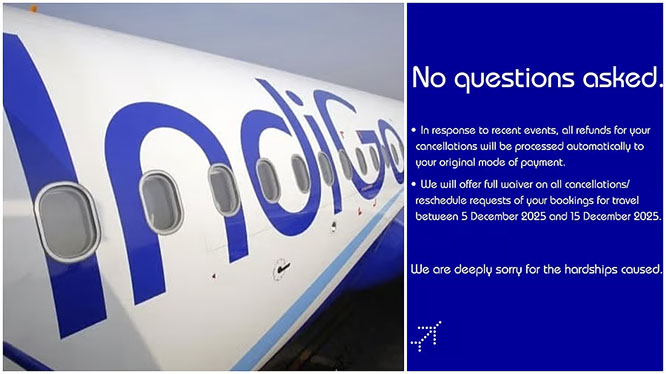
With IndiGo flight disruptions impacting thousands of passengers, the airline on Saturday said that it will offer full waiver on all cancellations/reschedule requests for travel bookings between December 5, 2025 and December 15, 2025.

Earlier in the day, the civil aviation ministry had directed the airline to complete the ticket refund process for the cancelled flights by Sunday evening, as well as ensure baggage separated from the travellers are delivered in the next two days.

In a post on X, titled 'No questions asked', IndiGo wrote, "In response to recent events, all refunds for your cancellations will be processed automatically to your original mode of payment."

"We are deeply sorry for the hardships caused," it further added.

Several passengers, however, complained of not getting full refund as promised by the airline.

Netizens have shared screenchots of getting charged for airline cancellation fee and convenience fee.

"Please tell me why u have did this airline cancellation charges when u say full amount will be refunded (sic)," a user wrote sharing a screenshot of the refund page.

"Well, but you have still debited the convenience charges," wrote another.

Passengers have also raised concerns about the "cancel" option being disabled on the IndiGo app. "First enable the 'Cancel' button on your App & offer full refund on tickets cancelled by customers between the said dates," wrote a user.

A day after the country's largest airline, IndiGo, cancelled more than 1,000 flights and caused disruptions for the fifth day on Saturday, the ministry said that any delay or non-compliance in refund processing will invite immediate regulatory action.

The refund process for all cancelled or disrupted flights must be completed by 8 pm on Sunday, the ministry said in a statement.

"Airlines have also been instructed not to levy any rescheduling charges for passengers whose travel plans were affected by cancellations," it said.

On Saturday, more than 400 flights were cancelled at various airports.

IndiGo has also been instructed to set up dedicated passenger support and refund facilitation cells.

Comments

Add new comment

  • Coastaldigest.com reserves the right to delete or block any comments.
  • Coastaldigset.com is not responsible for its readers’ comments.
  • Comments that are abusive, incendiary or irrelevant are strictly prohibited.
  • Please use a genuine email ID and provide your name to avoid reject.
News Network
December 6,2025

pilot.jpg

New Delhi: IndiGo, India’s largest airline, faced major operational turbulence this week after failing to prepare for new pilot-fatigue regulations issued by the Directorate General of Civil Aviation (DGCA). The stricter rules—designed to improve flight safety—took effect in phases through 2024, with the latest implementation on November 1. IndiGo has acknowledged that inadequate roster planning led to widespread cancellations and delays.

Below are the key DGCA rules that affected IndiGo’s operations:

1. Longer Mandatory Weekly Rest

Weekly rest for pilots has been increased from 36 hours to 48 hours.

The government says the extended break is essential to curb cumulative fatigue. This rule remains in force despite the current crisis.

2. Cap on Night Landings

Pilots can now perform only two night landings per week—a steep reduction from the earlier limit of six.

Night hours, defined as midnight to early morning, are considered the least alert period for pilots.

Given the disruptions, this rule has been temporarily relaxed for IndiGo until February 10.

3. Reduced Maximum Night Flight Duty

Flight duty that stretches into the night is now capped at 10 hours.

This measure has also been kept on hold for IndiGo until February 10 to stabilize operations.

4. Weekly Rest Cannot Be Replaced With Personal Leave

Airlines can no longer count a pilot’s personal leave as part of the mandatory 48-hour rest.

Pilots say this closes a loophole that previously reduced actual rest time.

Currently, all airlines are exempt from this rule to normalise travel.

5. Mandatory Fatigue Monitoring

Airlines must submit quarterly fatigue reports along with corrective actions to DGCA.

This system aims to create a transparent fatigue-tracking framework across the industry.

The DGCA has stressed that these rules were crafted to strengthen flight safety and align India with global fatigue-management standards. The temporary relaxations are expected to remain until February 2025, giving IndiGo time to stabilise its schedules and restore normal air travel.

Comments

Add new comment

  • Coastaldigest.com reserves the right to delete or block any comments.
  • Coastaldigset.com is not responsible for its readers’ comments.
  • Comments that are abusive, incendiary or irrelevant are strictly prohibited.
  • Please use a genuine email ID and provide your name to avoid reject.