



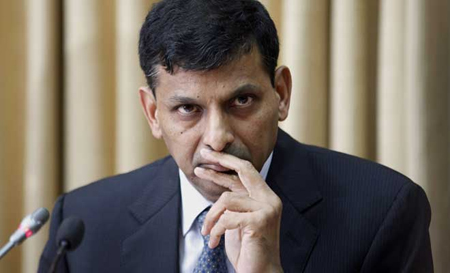
Raghuram Rajan's first monetary policy today: Can he please all?

September 20, 2013

Raghuram_Rajan

New Delhi, Sep 20: Reserve Bank governor Raghuram Rajan faces his first big test today as he delivers his maiden monetary policy. Having won universal applause for his "rupee speech", which resulted in a dramatic change in Street sentiments, there's hope that Dr Rajan will roll back some of the emergency measures, announced in July, that have been hurting Indian Inc.

Ben Bernanke's surprise decision on Wednesday not to wind down its massive monetary stimulus has come as a shot in arm for Dr Rajan as the pressure on rupee has eased considerably. However, the Fed's decision also means that expectations have risen manifold.

The biggest challenge for Dr Rajan will be to spell out a policy that is consistent with his hardline views on inflation, and also takes into consideration India' stuttering growth, which hit a decade low in the last fiscal.

With retail inflation around the double-digit mark and headline inflation at a 6-month high, Dr Rajan is unlikely to lower the benchmark repo rate, which currently stands at 7.25 per cent. He is also unlikely to tinker with the cash reserve ratio, or the portion of deposits banks have to maintain with the central bank, unchanged at 4 per cent.

"There is a change of guard, so we don't know what the flavour will be, but Rajan is likely to be hawkish and reiterate the importance of low and stable inflation for sustained economic recovery," said Rajeev Malik, senior economist at CLSA in Singapore.

A status quo would disappoint the banking industry and millions of consumers who are struggling under the burden of high Equated Monthly Installments (EMIs). With peak festival season around the corner, demand for loans is expected to go up.

"We have made our recommendations for releasing the liquidity, making it more accessible, making it less expensive," State Bank of India (SBI) Chairman Pratip Chaudhuri said.

But, economists say holding rates will be the best step for India under current circumstance.

"We expect the RBI to keep all policy rates (repo, CRR) unchanged, in line with consensus; sound hawkish on near-term inflation risks due to supply shocks emanating from food and rupee," Nomura analyst Sonal Varma said.

What Dr Rajan is expected to do is to scale back the tight liquidity measures that have helped the rupee bounce from a record low. Dr Rajan is widely expected to leave the marginal standing facility (MSF) unchanged, a Reuters poll showed. The overnight rate is generally viewed as the central bank's effective policy rate now, since it is the major interest rate tool being used to support the rupee.

The central bank jacked it up by 200 basis points in July to 10.25 per cent so that it stood 300 basis points above the official policy repo rate, aiming to tighten market liquidity and make it more expensive to speculate against the rupee.

Still, A. Prasanna, economist at ICICI Securities Primary Dealership Ltd in Mumbai, said it was a 50/50 call as to whether Rajan cuts the MSF to 9.25 per cent.

Several economists expect Dr Rajan to reverse some of the other rupee-supporting steps. He might relax a requirement that banks meet 99 per cent of their cash reserve ratio on a daily basis. The minimum was increased from 70 per cent previously, which drained liquidity from money markets but also choked off credit.

"Out-of-the-box solutions"

India Inc. is looking forward to some unconventional measures from Dr Rajan.

"We expect the new RBI governor to initiate measures that would enthuse the market participants, boost investor sentiment and bring confidence back in the economy," said Sidharth Birla, senior vice president of industry body Ficci.

Better communications:

In his first-day press conference, Dr Rajan spoke of the need for communication and a "clear framework" as to where the central bank is headed.

"We need a more comprehensive policy statement from the RBI underlining the outlook on inflation and guidance around the future of monetary policy framework, especially with regards to inflation targeting," said Gaurav Kapur, senior economist at Royal Bank of Scotland.


Normal 0 false false false EN-US X-NONE X-NONE MicrosoftInternetExplorer4

Raghuram Rajan's first monetary policy today: Can he please all?

New Delhi, Sep 20: Reserve Bank governor Raghuram Rajan faces his first big test today as he delivers his maiden monetary policy. Having won universal applause for his "rupee speech", which resulted in a dramatic change in Street sentiments, there's hope that Dr Rajan will roll back some of the emergency measures, announced in July, that have been hurting Indian Inc.

Ben Bernanke's surprise decision on Wednesday not to wind down its massive monetary stimulus has come as a shot in arm for Dr Rajan as the pressure on rupee has eased considerably. However, the Fed's decision also means that expectations have risen manifold.

The biggest challenge for Dr Rajan will be to spell out a policy that is consistent with his hardline views on inflation, and also takes into consideration India' stuttering growth, which hit a decade low in the last fiscal.

With retail inflation around the double-digit mark and headline inflation at a 6-month high, Dr Rajan is unlikely to lower the benchmark repo rate, which currently stands at 7.25 per cent. He is also unlikely to tinker with the cash reserve ratio, or the portion of deposits banks have to maintain with the central bank, unchanged at 4 per cent.

"There is a change of guard, so we don't know what the flavour will be, but Rajan is likely to be hawkish and reiterate the importance of low and stable inflation for sustained economic recovery," said Rajeev Malik, senior economist at CLSA in Singapore.

A status quo would disappoint the banking industry and millions of consumers who are struggling under the burden of high Equated Monthly Installments (EMIs). With peak festival season around the corner, demand for loans is expected to go up.

"We have made our recommendations for releasing the liquidity, making it more accessible, making it less expensive," State Bank of India (SBI) Chairman Pratip Chaudhuri said.

But, economists say holding rates will be the best step for India under current circumstance.

"We expect the RBI to keep all policy rates (repo, CRR) unchanged, in line with consensus; sound hawkish on near-term inflation risks due to supply shocks emanating from food and rupee," Nomura analyst Sonal Varma said.

What Dr Rajan is expected to do is to scale back the tight liquidity measures that have helped the rupee bounce from a record low. Dr Rajan is widely expected to leave the marginal standing facility (MSF) unchanged, a Reuters poll showed. The overnight rate is generally viewed as the central bank's effective policy rate now, since it is the major interest rate tool being used to support the rupee.

The central bank jacked it up by 200 basis points in July to 10.25 per cent so that it stood 300 basis points above the official policy repo rate, aiming to tighten market liquidity and make it more expensive to speculate against the rupee.

Still, A. Prasanna, economist at ICICI Securities Primary Dealership Ltd in Mumbai, said it was a 50/50 call as to whether Rajan cuts the MSF to 9.25 per cent.

Several economists expect Dr Rajan to reverse some of the other rupee-supporting steps. He might relax a requirement that banks meet 99 per cent of their cash reserve ratio on a daily basis. The minimum was increased from 70 per cent previously, which drained liquidity from money markets but also choked off credit.

"Out-of-the-box solutions"

India Inc. is looking forward to some unconventional measures from Dr Rajan.

"We expect the new RBI governor to initiate measures that would enthuse the market participants, boost investor sentiment and bring confidence back in the economy," said Sidharth Birla, senior vice president of industry body Ficci.

Better communications:

In his first-day press conference, Dr Rajan spoke of the need for communication and a "clear framework" as to where the central bank is headed.

"We need a more comprehensive policy statement from the RBI underlining the outlook on inflation and guidance around the future of monetary policy framework, especially with regards to inflation targeting," said Gaurav Kapur, senior economist at Royal Bank of Scotland.

Comments

Add new comment

  • Coastaldigest.com reserves the right to delete or block any comments.
  • Coastaldigset.com is not responsible for its readers’ comments.
  • Comments that are abusive, incendiary or irrelevant are strictly prohibited.
  • Please use a genuine email ID and provide your name to avoid reject.
News Network
December 3,2025

indigo.jpg

IndiGo, India’s largest airline, is battling one of its worst operational disruptions in recent years, with hundreds of delays and cancellations throwing domestic travel into chaos.

Government data on Tuesday showed its on-time performance plunging to 35%, an unusual dip for a carrier long associated with punctuality.

By Wednesday afternoon, airports in Delhi, Mumbai, Bengaluru and Hyderabad had collectively reported close to 200 cancellations, stranding travellers across the country.

Crew Shortage After New Duty Norms

A major trigger behind the meltdown is a severe crew shortage, especially among pilots, following the rollout of revised Flight Duty Time Limitation (FDTL) norms last month.

The rules mandate longer rest hours and more humane rosters — a shift IndiGo has struggled to incorporate across its vast network.

Sources said several flights were grounded due to lack of cabin crew, while some delays stretched upwards of eight hours.

With IndiGo controlling over 60% of India’s domestic aviation market, the ripple effect has impacted airports nationwide.

IndiGo Issues Apology, Lists “Compounding Factors”

In a statement, IndiGo acknowledged the large-scale disruption:

“We sincerely apologise to customers. A series of unforeseen operational challenges — technology glitches, winter schedule changes, adverse weather, system congestion and updated FDTL norms — created a compounding impact that could not have been anticipated.”

To stabilise operations, the airline has begun calibrated schedule adjustments for the next 48 hours, aiming to restore punctuality. Affected passengers are being offered refunds or alternate travel arrangements, IndiGo said.

What the FDTL Rules Require

The FDTL norms, designed to reduce pilot fatigue, cap duty and flying hours as follows:
•    Maximum 8 hours of flying per day
•    35 hours per week
•    125 hours per month
•    1,000 hours per year

Crew must also receive rest equalling twice the flight duration, with a minimum 10-hour rest period in any 24-hour window.

The DGCA introduced these limits to enhance flight safety.

Hyderabad: 33 Flights Cancelled, Long Queues Reported

Hyderabad’s Rajiv Gandhi International Airport saw heavy early-morning crowds as 33 IndiGo flights (arrivals and departures) were cancelled.

The airport clarified on X that operations were normal, advising passengers to contact IndiGo directly for latest flight status.

Cancellations included flights to and from Visakhapatnam, Goa, Ahmedabad, Delhi, Bengaluru, Chennai, Madurai, Hubli, Bhopal and Bhubaneswar.

Bengaluru: 42 Flights Disrupted

Bengaluru’s Kempegowda International Airport recorded 42 cancellations — 22 arrivals and 20 departures — affecting routes to Delhi, Mumbai, Chennai, Hyderabad, Goa, Kolkata and Lucknow.

Passengers Vent on Social Media

Irate travellers took to X to share their experiences. One passenger stranded in Hyderabad wrote: “I have been here since 3 a.m. and missed an important meeting.”

Another said: “My flight was pushed from 1:55 PM to 2:55 PM and now 4:35 PM. I was informed only three minutes before entering the airport.”

Delhi Airport Hit by Tech Glitch

At Delhi Airport, the disruption deepened due to a slowdown in the Amadeus system — used for reservations, check-ins and departure control.

The technical issue led to longer queues and sluggish processing, adding to delays already worsened by staff shortages.

Comments

Add new comment

  • Coastaldigest.com reserves the right to delete or block any comments.
  • Coastaldigset.com is not responsible for its readers’ comments.
  • Comments that are abusive, incendiary or irrelevant are strictly prohibited.
  • Please use a genuine email ID and provide your name to avoid reject.
News Network
December 2,2025

A major upgrade in safety and monitoring is planned for Haj 2026, with every Indian pilgrim set to receive a Haj Suvidha smart wristband linked to the official Haj Suvidha mobile app. The initiative aims to support pilgrims—especially senior citizens—who may struggle with smartphones during the 45-day journey.

What the Smart Wristband Will Do

Officials said the device will come with:
•    Location tracking
•    Pedometer
•    SOS emergency button
•    Qibla compass
•    Prayer timings
•    Basic health monitoring

SP Tiwari, secretary of the UP State Haj Committee, said the goal is to make the pilgrimage safer and more comfortable.

“Most Hajis are elderly and not comfortable with mobile apps,” he said. “The smartwatch will help locate pilgrims who forget their way or cannot communicate their location.”

The wristbands will be monitored by the Consulate General of India in Saudi Arabia, similar to mobile tracking via the Haj Suvidha App.

Free Distribution and Training

•    Smart wristbands will be given free of cost.
•    Training for pilgrims will be conducted between January and February 2026.
•    Sample units will reach state Haj committees soon.
•    Final devices will be distributed as pilgrims begin their journey.

New Rules for Accommodation

Two major decisions have also been finalised for Haj 2026:
1.    Separate rooms for men and women – including married couples. They may stay on the same floor but must occupy different rooms, following stricter Saudi guidelines.
2.    Cooking banned – gas cylinders will not be allowed; all meals will be provided through official catering services arranged by the Haj Committee of India.

These decisions were finalised during a meeting of the Haj Committee of India and state representatives in Mumbai.

Haj Suvidha App Launched Earlier

The government launched the Haj Suvidha App in 2024, offering:

•    Training modules
•    Accommodation and flight details
•    Baggage information
•    SOS and translation tools
•    Grievance redressal

Haj 2026 Quota and Key States

•    India’s total Haj quota for 2026: 1,75,025 pilgrims
•    70% (1,25,000) allotted to the Haj Committee of India
•    30% (around 50,000) reserved for Haj Group Organisers

Uttar Pradesh has the largest allocation (around 30,000 seats), though approximately 18,000 pilgrims are expected to go this year. States with high pilgrim numbers include Kerala, Maharashtra and Gujarat.

Dates of Haj 2026

The pilgrimage is scheduled to take place from 24 May to 29 May, 2026 (tentative).
Haj is one of the five pillars of Islam and is mandatory for Muslims who meet the required conditions.

Comments

Add new comment

  • Coastaldigest.com reserves the right to delete or block any comments.
  • Coastaldigset.com is not responsible for its readers’ comments.
  • Comments that are abusive, incendiary or irrelevant are strictly prohibited.
  • Please use a genuine email ID and provide your name to avoid reject.
News Network
December 6,2025

pilot.jpg

New Delhi: IndiGo, India’s largest airline, faced major operational turbulence this week after failing to prepare for new pilot-fatigue regulations issued by the Directorate General of Civil Aviation (DGCA). The stricter rules—designed to improve flight safety—took effect in phases through 2024, with the latest implementation on November 1. IndiGo has acknowledged that inadequate roster planning led to widespread cancellations and delays.

Below are the key DGCA rules that affected IndiGo’s operations:

1. Longer Mandatory Weekly Rest

Weekly rest for pilots has been increased from 36 hours to 48 hours.

The government says the extended break is essential to curb cumulative fatigue. This rule remains in force despite the current crisis.

2. Cap on Night Landings

Pilots can now perform only two night landings per week—a steep reduction from the earlier limit of six.

Night hours, defined as midnight to early morning, are considered the least alert period for pilots.

Given the disruptions, this rule has been temporarily relaxed for IndiGo until February 10.

3. Reduced Maximum Night Flight Duty

Flight duty that stretches into the night is now capped at 10 hours.

This measure has also been kept on hold for IndiGo until February 10 to stabilize operations.

4. Weekly Rest Cannot Be Replaced With Personal Leave

Airlines can no longer count a pilot’s personal leave as part of the mandatory 48-hour rest.

Pilots say this closes a loophole that previously reduced actual rest time.

Currently, all airlines are exempt from this rule to normalise travel.

5. Mandatory Fatigue Monitoring

Airlines must submit quarterly fatigue reports along with corrective actions to DGCA.

This system aims to create a transparent fatigue-tracking framework across the industry.

The DGCA has stressed that these rules were crafted to strengthen flight safety and align India with global fatigue-management standards. The temporary relaxations are expected to remain until February 2025, giving IndiGo time to stabilise its schedules and restore normal air travel.

Comments

Add new comment

  • Coastaldigest.com reserves the right to delete or block any comments.
  • Coastaldigset.com is not responsible for its readers’ comments.
  • Comments that are abusive, incendiary or irrelevant are strictly prohibited.
  • Please use a genuine email ID and provide your name to avoid reject.