



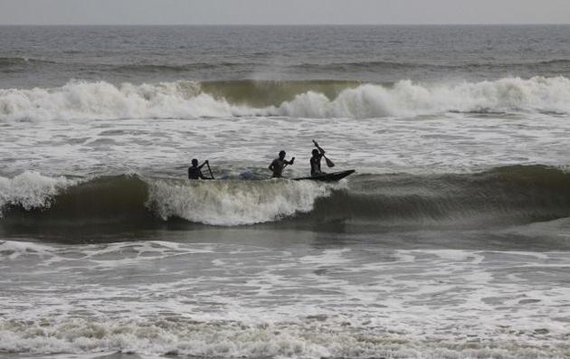
Bhubaneswar, Oct 11: Odisha and Andhra Pradesh on braced for the “very severe” cyclone that is expected to hit the east coast with winds gusting up to 220 kmph tomorrow evening, as lakhs of people were being evacuated to safer places and the military kept on standby.
Cyclone Phailin — the biggest cyclone in years to hit Odisha — is expected to make landfall near Gopalpur in Ganjam district in the eastern State after crossing an area between Paradip in Odisha and Kalingapatnam in Andhra Pradesh.
Five districts were in the eye of the storm with IMD chief Dr. L.S. Rathore identifying Ganjam, Khurda, Puri and Jagatsinghpur districts in Odisha and Srikakalum in Andhra Pradesh as those that is likely to be worst hit.
Mr. Rathore said the cyclone storm over east central Bay of Bengal currently lay 450 km southeast of Gopalpur and warned that it will be accompanied by a storm surge of up to three metres in the districts that will bear the brunt.
“Cyclone Phailin is a very severe cyclone,” Mr. Rathore said in Delhi. Mr. Rathore said the storm, which will hit the coast at 6 p.m., is unlikely to develop into a super cyclone. Phailin was named by Thailand and it means sapphire in Thai.
“The U.S. Navy has also forecast that the wind speed will be above 240 kmph. Therefore, the cyclone is not less than any super cyclone for us,” Special Relief Commissioner P.K. Mohapatra told reporters in Bhubaneshwar.
Mr. Mohapatra said the IMD had declared the 1,999 calamity as a super cyclone as the wind speed had crossed 220 kmph. An estimated 9,885 persons were killed in the super cyclone that pummelled Odisha.
“This time around, the wind speed is not much different than the previous super cyclone,” he said.
Squalls with a wind speed of 45-55 kmph to 65 kmph have already started along Odisha coast since morning under the impact of Phailin. About 25 cm of rain has been predicted in the 24 hours starting October 11 night in the affected districts due to the cyclone.
The Odisha health department cancelled holidays and leaves of all doctors in view of the impending situation even as the State government set a target of “zero casualty” and ordered speedy evacuation of people in seven coastal districts.
The East Coast Railway planned to regulate and cancel about 24 passenger trains between Visakhapatnam and Bhadrak on the Howrah-Chennai Main Line route on Saturday.
64,000 evacuated in A.P.
Authorities began evacuating 64,000 people from the low-lying areas of three vulnerable districts in Andhra Pradesh, State Revenue Minister N. Raghuveera Reddy said.
Emergency food supplies and shelters for people expected to flee the heavy winds and rains were also being readied in the vulnerable districts. Disaster management teams were also kept in readiness.
Odisha government set a target of “zero casualty” and ordered speedy evacuation of people in low-lying areas in seven coastal districts which is home to lakhs of people.
Defence Minister A.K. Antony ordered the Armed Forces to be ready to move in to Odisha and Andhra Pradesh.
Two IAF IL-76 aircraft have already airlifted NDRF teams and equipment to Bhubaneshwar.
Odisha sets zero casualty target
“The Collectors of all seven districts like Ganjam, Gajapati, Puri, Jagatsingpur, Kendrapara, Nayagarh and Khurda have been directed to start evacuation and ensure 100 per cent evacuation of people to cyclone and flood shelters and other safe places by today evening,” said Revenue and Disaster Management Minister S.N. Patro.
The Collectors of Bhadrak and Balasore districts have also been alerted, the Minister said.
As at least 9,885 persons were killed in the super cyclone of 1999, the State government was concerned about the safety of the people. “Our first priority is zero casualty,” Mr. Patro said.
Mr. Patro directed the district authorities said relief teams to be ready with relief material and necessary means of transportation. “Fuel like diesel, kerosene, LPG should be kept reserved in the district and block locations,” he said.
Odisha govt. to open free kitchens
Chief Secretary J.K. Mohapatra said the government has also directed opening of free kitchens from this evening for the people who would be evacuated to safe shelters. “Dry food should be kept reserved for the next day,” he said adding that the teams for clearing of roads must be kept ready with all required equipment.
“They (road clearing team) must be visible on roads just after the cyclone passes away and they should clear the roads within 12 hours of cyclone,” Mr. J.K. Mohapatra said in his directive.
NHAI authorities have also been mobilized for clearing of National Highways, officials said adding that police have been asked to strengthen patrolling on NH for smooth passage of vehicles carrying relief materials.
“We are making necessary arrangements for air dropping of food packets. Specific teams have been constituted for the purpose who are busy making food packets for 1 lakh people,” a senior officer at the Special Relief Commission’s office said.
“Apart from road cleaning, power and water supply should also be restored within 24 to 48 hours,” Mr. J.K. Mohapatra said adding that the Food Supply department has been instructed to place enforcement squads in each district to ensure that essential commodities were not hoarded or over priced by unscrupulous business men, retailers and wholesellers.
Energy Secretary Pradeep Kumar Jena informed that all executive engineers have been kept in readiness and all section offices of distribution companies have been kept ready with teams consisting of 15 to 20 members and necessary material for restoration of power supply.
Mr. Patro has also directed that the services of any government officer who remains absent and does not perform the assigned duties, will be terminated with immediate effect.
Meanwhile, the state government held a meeting with NGOs and gave specific responsibilities. “The NGOs are told to to mobilise people for evacuation and to assist in the process of providing them necessary services at safe shelters,” Mr. Patro said.
The minister suggested to the Special Relief Commissioner to spell out the material to be accepted as relief from donor agencies, NGOs and individuals.
Kalinga stadium here is being used as state relief distribution centre.
Meanwhile, the health department cancelled holidays and leaves of all doctors in view of the impending situation.
“The doctors who are on leave are asked to join immediately,” Health Minister Damodar Rout said.
'Not less than a super cyclone'
Cyclone Phailin with a windspeed of 220 kmph is turning into a super cyclone before making landfall on Saturday evening near Gopalpur in Odisha where the government has galvanised its machinery to deal with its impact and is evacuating people from low-lying areas.
“The U.S. Navy has also forecast that the wind speed will be above 240 kmph. Therefore, the cyclone is not less than any super cyclone for us,” Special Relief Commissioner P.K. Mohapatra said.
He said that though the IMD on Thursday indicated that the wind speed would be limited to 185 kmph, it was now forecasting it at 220 kmph.
Mr. P.K. Mohapatra said the IMD had declared the 1999 calamity as a super cyclone as the wind speed had crossed 220 kmph.
“This time around, the wind speed is not much different than the previous super cyclone,” he said.
Squalls with a wind speed of 45-55 kmph to 65 kmph have already started along Odisha coast since morning.
“It would increase in intensity with gale wind speeds reaching 210-220 kmph along and off south Odisha at the time of landfall,” the IMD said in a bulletin categorised as an Orange Message.
It would make landfall near Gopalpur in Ganjam district on Saturday evening after crossing an area between Paradip in Odisha and Kalingapatnam in Andhra Pradesh.
The IMD said the cyclone over east central Bay of Bengal remained stationary and lay 520 km south-southeast of Paradip and 530 km southeast of Gopalpur.
The IMD forecast a storm surge of 2.5 meter to 3.0 meter in Ganjam, Khurda, Puri and Jagatsinghpur districts.
A storm surge is a rise of the sea as a result of atmospheric pressure changes and winds associated with a storm.
Local Cautionary (LC-III) has been hoisted in all the ports in the State.The Navy, the Air Force, the National Disaster Response Force and the Odisha Disaster Rapid Action Force were ready for relief and rescue operations as soon as the cyclone hits the coast, Mr. P.K. Mohapatra said.
A worried State government held meetings and evaluated the changed circumstances.
“At least 28 teams of the National Disaster Response Forces are at the disposal of the Odisha government for evacuation and relief operations,” a senior official said after one such meeting.
So far eight teams of NDRF, reaching having 20 personnel, have been deployed in Puri district, the official said.
Revenue and Disaster Management Minister S.N. Patro said district collectors have been told to complete evacuation of people by Friday evening.
“We do not want to take any chance,” Mr. Patro said, adding that shelters were ready.
Appealing to the people not to panic, Chief Minister Naveen Patnaik asked them to cooperate with the government in relief and rescue operations.
Odisha on high alert as Phailin gains strength
Massive evacuation was undertaken by district administrations of Ganjam, Gajapati, Puri and Jagatsinghpur of Odisha, which are likely to be hit by severe cyclonic storm Phailin – whose wind speed was upgraded 205-215 kmph on Friday morning.
“The very severe cyclonic storm, Phailin over east central Bay of Bengal moved west-northwestwards with a speed of 15 kmph and lay centred about 520km south-southeast of Paradip and 530km southeast of Gopalpur,” said S. C. Sahu, director, Bhubaneswar Metrological Centre.
The met office said it would move north-westwards and cross north Andhra Pradesh and Odisha coast between Kalingapatnam and Paradip, close to Gopalpur (Odisha) on Saturday evening. “The wind speed would touch 205-215 kmph.”
Mr. Sahu said the severe cyclonic would intensify further as sea surface temperature was favourable for intensification of the system. Heavy rain would start lashing southern Odisha from Friday afternoon.
State branch secretary of Indian Red Cross Society Mangala Prasad Mohanty said, “We have already evacuated people from low lying areas to our 65 cyclone shelters. Our special emphasis is on destitute women and people with disability.”
“From our experience of 1999 Super Cyclone, it suggests the Phailin would have similar devastating impact on coastal Odisha. We are working in close coordination with the state government officials,” Mr. Mohanty said.
According to government estimates, Super Cyclone killed about 8000 people in the State.




Comments
Add new comment