



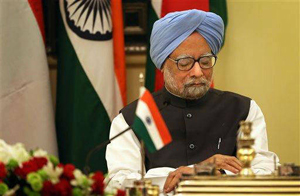
PM admits he cleared coal block allocation to Hindalco

October 20, 2013

PM_Hindalco
New Delhi, Oct 20: The Prime Minister's Office on Saturday ended its silence on the latest and possibly most explosive development in Coalgate by acknowledging that Manmohan Singh put his stamp of approval (on October 1, 2005) on the allocation of a coal block to top industrialist Kumar Birla's Hindalco. At the same time, it vigorously rebutted the Central Bureau of Investigation's claim of illegality, saying the PM stood by the decision as no wrong had been committed.

Taking what is being seen in political and bureaucratic circles as an uncharacteristically strong stand, the PMO said, "The PM is satisfied that the final decision in this regard was entirely appropriate and based on merits of the case placed before him."

The PMO statement comes after retired coal secretary P C Parakh — booked along with Birla for alleged criminal conspiracy and misconduct, and corruption - said that if CBI thought there were irregularities, then the PM ought to be "accused No 1" for giving his approval.

With the opposition baying for his resignation, Singh's move to forthrightly own up to having sought a reassessment of Hindalco's case after a representation by Odisha chief minister Naveen Patnaik appears intended to cap a politically debilitating controversy.

But by doing so, Singh, who at the time held charge of the coal ministry, accepted he was the "competent authority" who signed off on the coal allocations in the 2006-09 period - under CBI's lens — when he held charge of the portfolio. On whether the PM would be ready to be questioned in any Coalgate case, as suggested by senior minister Kamal Nath, a PMO spokesperson declined comment, saying CBI was yet to make such a request.

The PMO said it didn't wish to impede the CBI's investigation, but justified altering the screening committee's earlier decision to award the coal block in question to public sector companies Neyveli Lignite Corp (NLC) and Mahanadi Coalfields Ltd (MCL) by relying heavily on Patnaik's backing to Hindalco.

In accommodating Hindalco as the third partner in a joint venture, PM also waived a violation in guidelines to enhance the firm's share by arguing that NLC and Mahanadi were "sister PSUs" and Neyveli's share could be made good from Mahanadi's 70% allocation.

It invoked the "federal framework" to say Patnaik's views had to be accommodated, and claimed that public sector claimants had not been disadvantaged.

Countering criticism that private sector Hindalco had been favoured, PMO said the coal requirements of the two PSUs, who also sought the blocks, were protected in a separate arrangement.

Neyveli Lignite was originally allotted Talabira II coal blocks in Sambhalpur by the screening committee headed by then coal secretary P C Parakh as the panel held that Hindalco had failed to utilize a previously allocated block. The committee also said Hindalco had been provided adequate coal linkages from MLC, which it had failed to utilize. It was felt NLC and Mahanadi could together develop Talabira II and III to extract an additional 30 million tonnes of coal.

The coal ministry altered the screening committee's decision and gave Hindalco a 15% stake in a joint venture with NLC and Mahanadi, said the PMO, after considering representations from Birla and Patnaik, which were referred to it by the PM.

PMO said while the original recommendation was being processed by it, the PM received a letter dated 17.8.2005 from the Odisha CM saying that the state government assigned "topmost priority" to allocating Talabira II to Hindalco. Singh noted "please get a report from the coal ministry" on the letter.

Birla in his letter also sought the linkage and officials said he explained that Hindalco had not been able to use its previous allocation as a bauxite lease for its aluminium plant had not materialized.

Coal ministry resubmitted the file on 16.9.2005 proposing that Talabira II and III be mined as a single entity by the JV. Mahanadi's holdings would be proportionate to the extractable reserves in Talabira III or 70% of annual production.

The coal ministry told the PM that the total requirement of coal from the blocks by the main contenders was 503 million tons. The ministry said the claim of Orissa Sponge Iron Ltd would be accommodated elsewhere and Mahanadi was made a partner along with Hindalco and NLC.

Neyveli could not be dropped as it was a central PSU backed by the screening committee. In its account, PMO has leaned on the Odisha CM's "clear preference" for Hindalco in the "interest of creating more employment and growth of the state's manufacturing sector."


Comments

Add new comment

  • Coastaldigest.com reserves the right to delete or block any comments.
  • Coastaldigset.com is not responsible for its readers’ comments.
  • Comments that are abusive, incendiary or irrelevant are strictly prohibited.
  • Please use a genuine email ID and provide your name to avoid reject.
News Network
December 6,2025

pilot.jpg

New Delhi: IndiGo, India’s largest airline, faced major operational turbulence this week after failing to prepare for new pilot-fatigue regulations issued by the Directorate General of Civil Aviation (DGCA). The stricter rules—designed to improve flight safety—took effect in phases through 2024, with the latest implementation on November 1. IndiGo has acknowledged that inadequate roster planning led to widespread cancellations and delays.

Below are the key DGCA rules that affected IndiGo’s operations:

1. Longer Mandatory Weekly Rest

Weekly rest for pilots has been increased from 36 hours to 48 hours.

The government says the extended break is essential to curb cumulative fatigue. This rule remains in force despite the current crisis.

2. Cap on Night Landings

Pilots can now perform only two night landings per week—a steep reduction from the earlier limit of six.

Night hours, defined as midnight to early morning, are considered the least alert period for pilots.

Given the disruptions, this rule has been temporarily relaxed for IndiGo until February 10.

3. Reduced Maximum Night Flight Duty

Flight duty that stretches into the night is now capped at 10 hours.

This measure has also been kept on hold for IndiGo until February 10 to stabilize operations.

4. Weekly Rest Cannot Be Replaced With Personal Leave

Airlines can no longer count a pilot’s personal leave as part of the mandatory 48-hour rest.

Pilots say this closes a loophole that previously reduced actual rest time.

Currently, all airlines are exempt from this rule to normalise travel.

5. Mandatory Fatigue Monitoring

Airlines must submit quarterly fatigue reports along with corrective actions to DGCA.

This system aims to create a transparent fatigue-tracking framework across the industry.

The DGCA has stressed that these rules were crafted to strengthen flight safety and align India with global fatigue-management standards. The temporary relaxations are expected to remain until February 2025, giving IndiGo time to stabilise its schedules and restore normal air travel.

Comments

Add new comment

  • Coastaldigest.com reserves the right to delete or block any comments.
  • Coastaldigset.com is not responsible for its readers’ comments.
  • Comments that are abusive, incendiary or irrelevant are strictly prohibited.
  • Please use a genuine email ID and provide your name to avoid reject.
News Network
December 4,2025

indigoflight.jpg

Domestic carrier IndiGo has cancelled over 180 flights from three major airports — Mumbai, Delhi and Bengaluru — on Thursday, December 4, as the airline struggles to secure the required crew to operate its flights in the wake of new flight-duty and rest-period norms for pilots.

While the number of cancellations at Mumbai airport stands at 86 (41 arrivals and 45 departures) for the day, at Bengaluru, 73 flights have been cancelled, including 41 arrivals, according to a PTI report that quoted sources.

"IndiGo cancelled over 180 flights on Thursday at three airports-Mumbai, Delhi and Bengaluru," the source told the news agency.

Besides, it had cancelled as many as 33 flights at Delhi airport for Thursday, the source said, adding, "The number of cancellations is expected to be higher by the end of the day."

The Gurugram-based airline's On-Time Performance (OTP) nosedived to 19.7 per cent at six key airports — Delhi, Mumbai, Chennai, Kolkata, Bengaluru and Hyderabad — on December 3, as it struggled to get the required crew to operate its services, down from almost half of December 2, when it was 35 per cent.

"IndiGo has been facing acute crew shortage since the implementation of the second phase of the FDTL (Flight Duty Time Limitations) norms, leading to cancellations and huge delays in its operations across the airports," a source had told PTI on Wednesday.

Chaos continued at several major airports for the third day on Thursday because of the cancellations.

A spokesperson for the Kempegowda International Airport (KIA) in Bengaluru said that 73 IndiGo flights had been cancelled on Thursday.

At least 150 flights were cancelled and dozens of others delayed on Wednesday, airport sources said, leaving thousands of travellers stranded, according to news agency Reuters.

The Directorate General of Civil Aviation (DGCA) has said it is investigating IndiGo flight disruptions and has asked the airline to submit the reasons for the current situation, as well as its plans to reduce flight cancellations and delays.

It may be mentioned here that the pilots' body, Federation of Indian Pilots (FIP), has alleged that IndiGo, despite getting a two-year preparatory window before the full implementation of new flight duty and rest period norms for cockpit crew, "inexplicably" adopted a "hiring freeze".

The FIP said it has urged the safety regulator, the DGCA, not to approve airlines' seasonal flight schedules unless they have adequate staff to operate their services "safely and reliably" in accordance with the New Flight Duty Time Limitations (FDTL) norms.

In a letter to the DGCA late on Wednesday, the FIP urged the DGCA to consider re-evaluating and reallocating slots to other airlines, which have the capacity to operate them without disruption during the peak holiday and fog season if IndiGo continues to "fail in delivering on its commitments to passengers due to its own avoidable staffing shortages."

Comments

Add new comment

  • Coastaldigest.com reserves the right to delete or block any comments.
  • Coastaldigset.com is not responsible for its readers’ comments.
  • Comments that are abusive, incendiary or irrelevant are strictly prohibited.
  • Please use a genuine email ID and provide your name to avoid reject.
News Network
December 2,2025

A major upgrade in safety and monitoring is planned for Haj 2026, with every Indian pilgrim set to receive a Haj Suvidha smart wristband linked to the official Haj Suvidha mobile app. The initiative aims to support pilgrims—especially senior citizens—who may struggle with smartphones during the 45-day journey.

What the Smart Wristband Will Do

Officials said the device will come with:
•    Location tracking
•    Pedometer
•    SOS emergency button
•    Qibla compass
•    Prayer timings
•    Basic health monitoring

SP Tiwari, secretary of the UP State Haj Committee, said the goal is to make the pilgrimage safer and more comfortable.

“Most Hajis are elderly and not comfortable with mobile apps,” he said. “The smartwatch will help locate pilgrims who forget their way or cannot communicate their location.”

The wristbands will be monitored by the Consulate General of India in Saudi Arabia, similar to mobile tracking via the Haj Suvidha App.

Free Distribution and Training

•    Smart wristbands will be given free of cost.
•    Training for pilgrims will be conducted between January and February 2026.
•    Sample units will reach state Haj committees soon.
•    Final devices will be distributed as pilgrims begin their journey.

New Rules for Accommodation

Two major decisions have also been finalised for Haj 2026:
1.    Separate rooms for men and women – including married couples. They may stay on the same floor but must occupy different rooms, following stricter Saudi guidelines.
2.    Cooking banned – gas cylinders will not be allowed; all meals will be provided through official catering services arranged by the Haj Committee of India.

These decisions were finalised during a meeting of the Haj Committee of India and state representatives in Mumbai.

Haj Suvidha App Launched Earlier

The government launched the Haj Suvidha App in 2024, offering:

•    Training modules
•    Accommodation and flight details
•    Baggage information
•    SOS and translation tools
•    Grievance redressal

Haj 2026 Quota and Key States

•    India’s total Haj quota for 2026: 1,75,025 pilgrims
•    70% (1,25,000) allotted to the Haj Committee of India
•    30% (around 50,000) reserved for Haj Group Organisers

Uttar Pradesh has the largest allocation (around 30,000 seats), though approximately 18,000 pilgrims are expected to go this year. States with high pilgrim numbers include Kerala, Maharashtra and Gujarat.

Dates of Haj 2026

The pilgrimage is scheduled to take place from 24 May to 29 May, 2026 (tentative).
Haj is one of the five pillars of Islam and is mandatory for Muslims who meet the required conditions.

Comments

Add new comment

  • Coastaldigest.com reserves the right to delete or block any comments.
  • Coastaldigset.com is not responsible for its readers’ comments.
  • Comments that are abusive, incendiary or irrelevant are strictly prohibited.
  • Please use a genuine email ID and provide your name to avoid reject.