



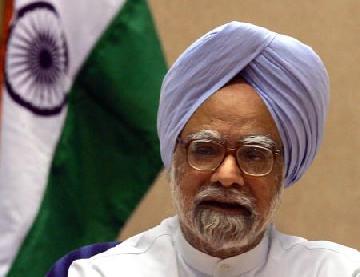
Border issue to top agenda during PM's China visit

October 20, 2013

Manmohan-Singh
New Delhi, Oct 20: Indicating that the proposed border cooperation agreement with China will top the agenda during his visit, Prime Minister Manmohan Singh today said he will discuss the issue with Premier Li Keqiang with a forward- looking and problem-solving approach.

In a statement before leaving on a five-day visit to Russia and China, he, however, made no reference to negotiations on a deal for setting up of two new nuclear reactors in the Russian-aided Kudankulam power project.

"India and China have historical issues and there are areas of concern. The two governments are addressing them with sincerity and maturity, without letting them affect the overall atmosphere of friendship and cooperation," Singh said.

"I will be discussing some of these issues as part of strategic communication between leaders with a forward-looking and problem-solving approach," he said in the departure statement.

Singh noted that together India and China have reached important consensus on maintaining peace and tranquillity on the border and made preliminary progress towards settlement of the India-China boundary question.

Officials on both sides are working on a Border Defence Cooperation Agreement (BDCA) to avoid face-off between their armies against the backdrop of a prolonged intrusion by People's Liberation Army (PLA) troops in the Depsang Valley in Ladakh during this summer.

There are indications that the agreement may be signed during the visit.

On Wednesday, after discussion and lunch with the Chinese Premier, Prime Minister Singh will be hosted a dinner by President Xi Jinping, a rare honour for an Indian leader.

As the world's two most populous nations and largest emerging economies, India and China today have a growing congruence of regional, global and economic interests, driven by respective developmental aspirations and shaped by the evolving strategic environment, Singh said.

Peaceful, friendly and cooperative relations between India and China have provided conditions for both the countries and the wider region to grow with stability, he said.


Comments

Add new comment

  • Coastaldigest.com reserves the right to delete or block any comments.
  • Coastaldigset.com is not responsible for its readers’ comments.
  • Comments that are abusive, incendiary or irrelevant are strictly prohibited.
  • Please use a genuine email ID and provide your name to avoid reject.
News Network
December 6,2025

pilot.jpg

New Delhi: IndiGo, India’s largest airline, faced major operational turbulence this week after failing to prepare for new pilot-fatigue regulations issued by the Directorate General of Civil Aviation (DGCA). The stricter rules—designed to improve flight safety—took effect in phases through 2024, with the latest implementation on November 1. IndiGo has acknowledged that inadequate roster planning led to widespread cancellations and delays.

Below are the key DGCA rules that affected IndiGo’s operations:

1. Longer Mandatory Weekly Rest

Weekly rest for pilots has been increased from 36 hours to 48 hours.

The government says the extended break is essential to curb cumulative fatigue. This rule remains in force despite the current crisis.

2. Cap on Night Landings

Pilots can now perform only two night landings per week—a steep reduction from the earlier limit of six.

Night hours, defined as midnight to early morning, are considered the least alert period for pilots.

Given the disruptions, this rule has been temporarily relaxed for IndiGo until February 10.

3. Reduced Maximum Night Flight Duty

Flight duty that stretches into the night is now capped at 10 hours.

This measure has also been kept on hold for IndiGo until February 10 to stabilize operations.

4. Weekly Rest Cannot Be Replaced With Personal Leave

Airlines can no longer count a pilot’s personal leave as part of the mandatory 48-hour rest.

Pilots say this closes a loophole that previously reduced actual rest time.

Currently, all airlines are exempt from this rule to normalise travel.

5. Mandatory Fatigue Monitoring

Airlines must submit quarterly fatigue reports along with corrective actions to DGCA.

This system aims to create a transparent fatigue-tracking framework across the industry.

The DGCA has stressed that these rules were crafted to strengthen flight safety and align India with global fatigue-management standards. The temporary relaxations are expected to remain until February 2025, giving IndiGo time to stabilise its schedules and restore normal air travel.

Comments

Add new comment

  • Coastaldigest.com reserves the right to delete or block any comments.
  • Coastaldigset.com is not responsible for its readers’ comments.
  • Comments that are abusive, incendiary or irrelevant are strictly prohibited.
  • Please use a genuine email ID and provide your name to avoid reject.