



The situation is somewhat better in Odisha. But though flood waters are receding, seven more persons died on Saturday, taking the toll to 17. The fifth India-Australia one-dayer in Cuttack was washed out.
And in neighbouring West Bengal, torrential rains flooded streets, uprooted trees and sent houses crashing that took two lives.
For now, the Andhra Pradesh government appears ill prepared to handle the rain fury, which has been continuing for the last five days. Though the National Disaster Response Force (NDRF) has been pressed into service and chief minister Kiran Kumar Reddy has asked officials to take up rescue and relief measures on a war footing, the going is slow at best.
Of the 16 affected districts, the NDRF has been active in the worst-hit Srikakulam, West Godavari, Prakasam, Guntur, Nalgonda and Mahabubnagar districts. In the rest, the state machinery is at work.
Besides the river Vamsadhara, which was in spate by Friday,the river Krishna is about to overflow as well. To control the situation, 315,000 cusecs of water has already been discharged into the Bay of Bengal from Vijayawada’s Prakasam Barrage.
But that has not helped much. Road and rail routes have been badly hit – huge stretches of train tracks are under water, so are parts of the Vijayawada-Hyderabad highway. Overall, 935 km of roads have been damaged.
The government’s other headache is the damage to irrigation tanks. The state has the largest number of minor irrigation tanks, which cater to 1.8 million hectors of drought-prone and dry areas which have no other methods of irrigation.
“Altogether, 405 minor irrigation tanks have been damaged and breaches have occurred to canals in different districts,” said disaster management commissioner T Radha. The chief minister has already asked officials to accord top priority to repair and restoration of these tanks.
Jharkhand feels the heat
Floods in Odisha threatened to inundate the low-lying areas of Jamshedpur in Jharkhand, while floodwater rushed into a dozen villages in Ichagarh block of Seraikela-Kharsawan district, after all 13 gates of Chadil Dam were opened with the water level at 181.70 metres, crossing the previous highest level of 181.60 metres.
Water levels in Kharkai and Subarnarekha rivers are also rising due to the incessant rain in Odisha, resulting in the opening of one gate of Byanbil Dam in Mayurbhanj district.
/* Style Definitions */ table.MsoNormalTable {mso-style-name:"Table Normal"; mso-tstyle-rowband-size:0; mso-tstyle-colband-size:0; mso-style-noshow:yes; mso-style-priority:99; mso-style-qformat:yes; mso-style-parent:""; mso-padding-alt:0in 5.4pt 0in 5.4pt; mso-para-margin-top:0in; mso-para-margin-right:0in; mso-para-margin-bottom:10.0pt; mso-para-margin-left:0in; line-height:115%; mso-pagination:widow-orphan; font-size:11.0pt; font-family:"Calibri","sans-serif"; mso-ascii-font-family:Calibri; mso-ascii-theme-font:minor-latin; mso-fareast-font-family:"Times New Roman"; mso-fareast-theme-font:minor-fareast; mso-hansi-font-family:Calibri; mso-hansi-theme-font:minor-latin; mso-bidi-font-family:"Times New Roman"; mso-bidi-theme-font:minor-bidi;}
Floods may worsen in AP, eases in Odisha; 49 dead
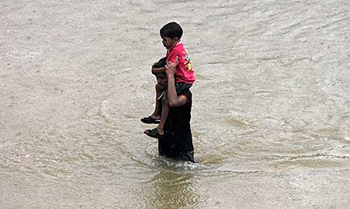
Hyderabad/Bhubaneswar, Oct 27: Thirty-two people dead, 15,000 houses collapsed across 4,000 villages, 72,000 people evacuated and crops over 564,000 hectares destroyed – the floods in Andhra Pradesh are getting worse by the hour. And the deluge can only get worse, with more rains expected in the next 48 hours.
The situation is somewhat better in Odisha. But though flood waters are receding, seven more persons died on Saturday, taking the toll to 17. The fifth India-Australia one-dayer in Cuttack was washed out.
And in neighbouring West Bengal, torrential rains flooded streets, uprooted trees and sent houses crashing that took two lives.
For now, the Andhra Pradesh government appears ill prepared to handle the rain fury, which has been continuing for the last five days. Though the National Disaster Response Force (NDRF) has been pressed into service and chief minister Kiran Kumar Reddy has asked officials to take up rescue and relief measures on a war footing, the going is slow at best.
Of the 16 affected districts, the NDRF has been active in the worst-hit Srikakulam, West Godavari, Prakasam, Guntur, Nalgonda and Mahabubnagar districts. In the rest, the state machinery is at work.
Besides the river Vamsadhara, which was in spate by Friday,the river Krishna is about to overflow as well. To control the situation, 315,000 cusecs of water has already been discharged into the Bay of Bengal from Vijayawada’s Prakasam Barrage.
But that has not helped much. Road and rail routes have been badly hit – huge stretches of train tracks are under water, so are parts of the Vijayawada-Hyderabad highway. Overall, 935 km of roads have been damaged.
The government’s other headache is the damage to irrigation tanks. The state has the largest number of minor irrigation tanks, which cater to 1.8 million hectors of drought-prone and dry areas which have no other methods of irrigation.
“Altogether, 405 minor irrigation tanks have been damaged and breaches have occurred to canals in different districts,” said disaster management commissioner T Radha. The chief minister has already asked officials to accord top priority to repair and restoration of these tanks.
Jharkhand feels the heat
Floods in Odisha threatened to inundate the low-lying areas of Jamshedpur in Jharkhand, while floodwater rushed into a dozen villages in Ichagarh block of Seraikela-Kharsawan district, after all 13 gates of Chadil Dam were opened with the water level at 181.70 metres, crossing the previous highest level of 181.60 metres.
Water levels in Kharkai and Subarnarekha rivers are also rising due to the incessant rain in Odisha, resulting in the opening of one gate of Byanbil Dam in Mayurbhanj district.


Comments
Add new comment